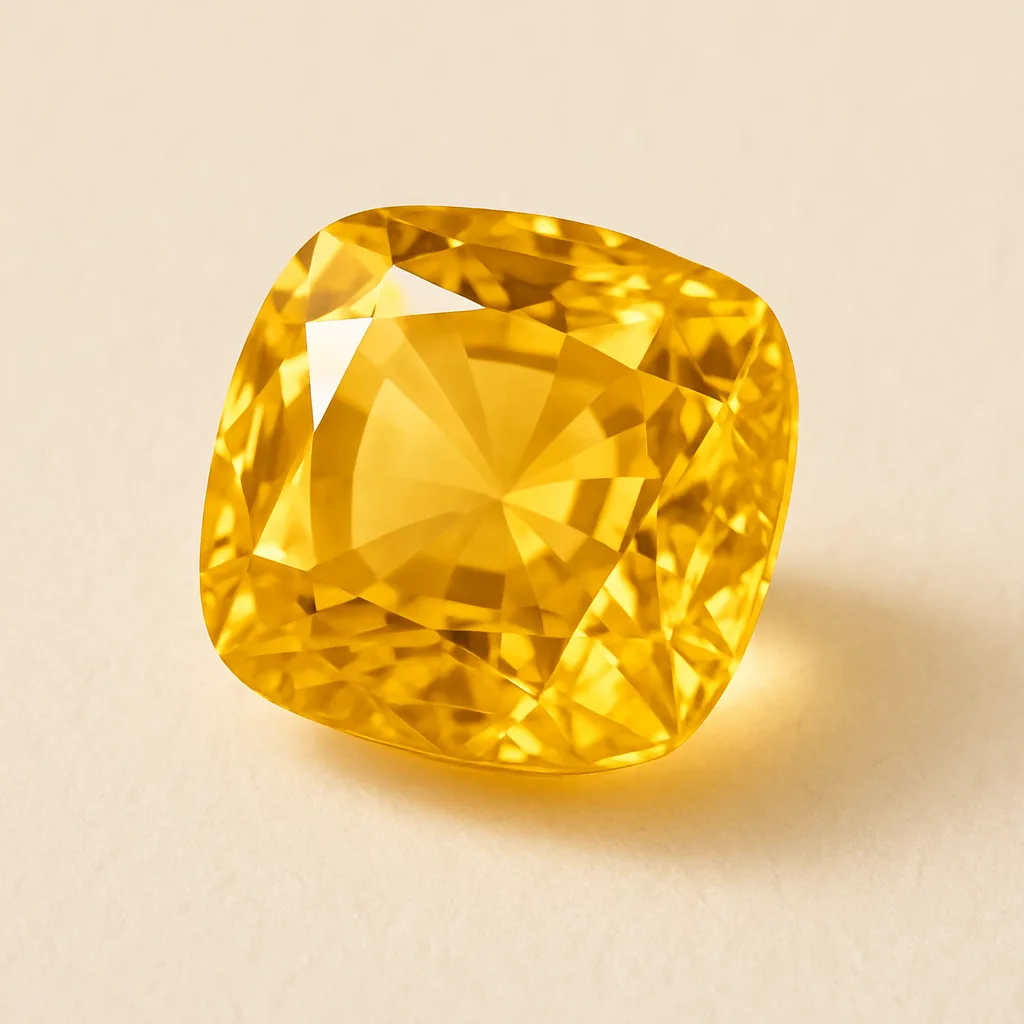
identified this stone yet
Synthetic Yellow Sapphire
| Hardness | 9 |
| Specific gravity | 4.00 |
| Refractive index | 1.762-1.770 |
| Crystal system | 六方晶系(三方晶系) |
Pale yellow ('champagne') through medium yellow ('Ceylon yellow') to deep golden ('Imperial yellow') and slightly orange-yellow. The flame-fusion process produces consistently saturated, even color — typically more uniform than natural Sri Lankan or Madagascan material.
- Curved growth striae (Verneuil) — diagnostic at 10× immersion
- Round gas bubbles, often in trails or clusters
- Swirl flow patterns
- Otherwise typically very clean
- Doubly refractive (uniaxial negative) — identical to natural corundum
- RI 1.762–1.770, 0.008
- Weak (yellow, golden yellow)
- Vitreous to sub-adamantine luster
- 01 and gas bubbles diagnostic of Verneuil at 10× immersion
- 02RI 1.762–1.770 and Mohs 9 separate from citrine (RI 1.54, Mohs 7) and yellow glass (RI ~1.50, no )
- 03Iron-driven yellow under long-wave UV is suggestive of synthetic but is not species-exclusive
- 04Color zoning markedly more uniform than natural Sri Lankan yellow sapphire
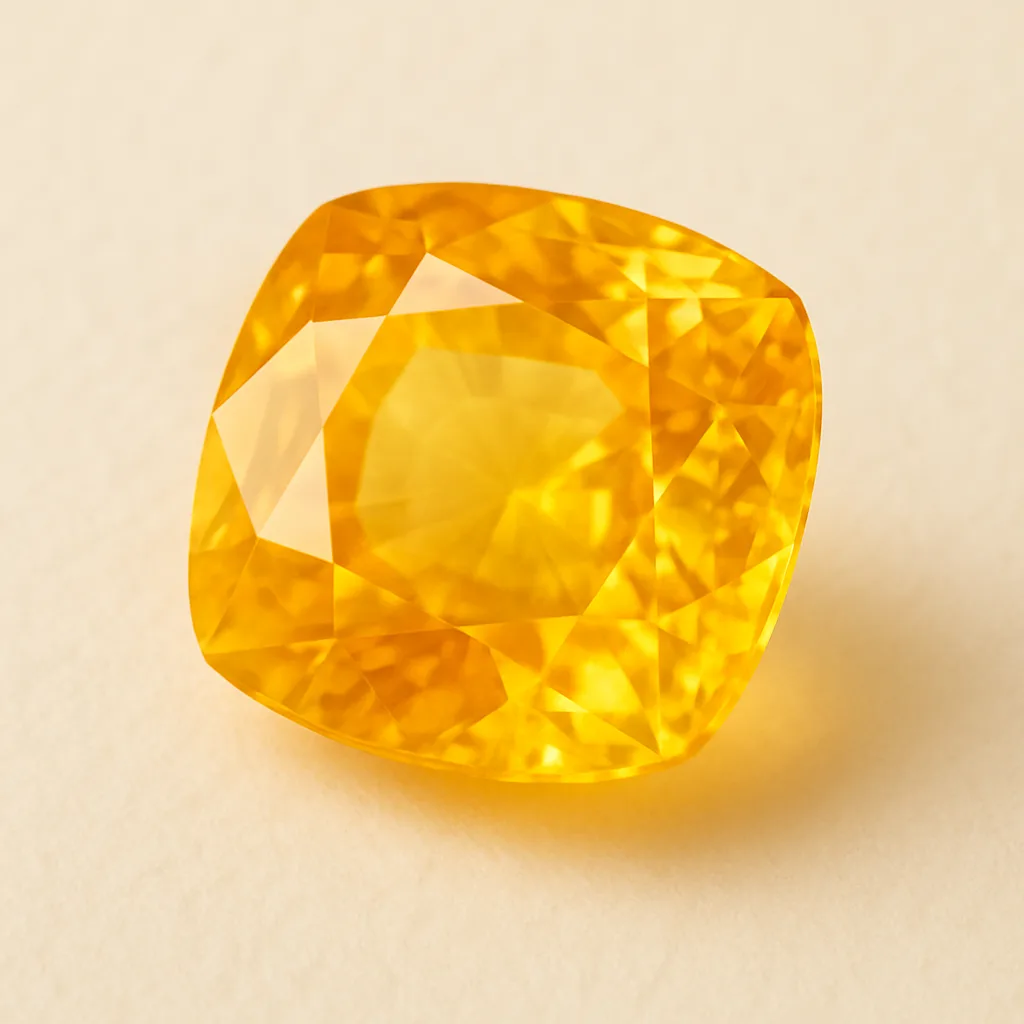
- Mohs 9 — extremely durable
- Ultrasonic and steam safe
- Stable to light and standard cleaning chemicals
$5–$30/ct for commercial flame-fusion synthetic yellow sapphire in standard sizes; $30–$100/ct for premium Djeva-grade or Indian-trade Pukhraj-grade synthetic material with selected color. Natural untreated Sri Lankan yellow sapphire in fine color and clarity above 3 ct trades at $500–$3,000/ct.
Note: Synthetic yellow sapphire competes against natural yellow sapphire (Sri Lankan, Madagascan, Tanzanian, Australian Anakie), against citrine (Mohs 7 vs. Mohs 9), against synthetic citrine, and against yellow glass (Mohs ~5–6, no birefringence). The Vedic jyotish Pukhraj substitute market is the principal modern commercial driver beyond costume jewelry. Disclosure as 'synthetic,' 'lab-grown,' or 'created' is required under FTC, CIBJO, JIS, and Indian Bureau of Standards rules.
Synthetic yellow sapphire is Al₂O₃ (trigonal) doped with iron (Fe³⁺) in trace amounts, producing iron d-d transitions for the yellow coloration. Mohs 9, SG 3.99–4.01, RI 1.762–1.770, 0.008. Curved growth striae and round gas bubbles, the diagnostic markers of Verneuil flame-fusion, are visible at 10× immersion. The is weaker and the color zoning markedly more uniform than natural Ceylon (Sri Lankan), Madagascan Ilakaka, or Australian Anakie yellow sapphire.
Origins
Switzerland (Djeva, founded 1914 in Monthey), Germany, France, Thailand (significant capacity since the 1970s), Russia, India, and China. Thai and Indian producers dominate the modern commercial market, with significant volumes destined for the Indian astrological (jyotish) trade as Pukhraj substitutes.
History
Verneuil flame-fusion yellow corundum became a standard commercial product by the late 1940s, with iron-doped chemistry providing reliable yellow saturation. The post-war American costume jewelry industry consumed synthetic yellow sapphire as a citrine substitute in mid-range lines. The single largest modern market driver is the Indian Vedic jyotish trade — yellow sapphire ('Pukhraj') is the planetary stone for Jupiter (Guru / Brihaspati), worn by individuals seeking enhancement of Jupiter's influence on wealth, wisdom, and family life. Natural yellow sapphire suitable for traditional Vedic astrological prescription (unheated, with specific weight and color requirements per the Garuda Purana and Brihat Samhita) is expensive; disclosed synthetic material at 1–2 ct sizes serves a substantial under-budget astrological market through Indian temple and astrologer-mediated retail channels. The 1996 FTC Jewelry Guides and corresponding Indian Bureau of Standards (IS) regulations require explicit disclosure of synthetic origin at the retail level. Karl Schmetzer's 1980s–1990s studies in Gems & Gemology established the modern Western gemological literature on synthetic yellow corundum.
Lore & symbolism
September's birthstone (synthetic versions accepted as substitutes in modern lay practice). The 5th and 45th wedding anniversary sapphire associations apply to all colors. The Vedic jyotish prescription of yellow sapphire (Pukhraj) for Jupiter (Guru / Brihaspati) is the most active modern folkloric and ritual use; some traditional schools insist on natural material only, while modern Indian retail practice increasingly accepts disclosed synthetic Pukhraj for under-budget applications. The Sanskrit Ratnapariksha and the Garuda Purana name Pukhraj among the navaratna (nine sacred stones), with prescriptions tied to natal-chart Jupiter placements.
Tools to confirm this stone
Tools that help confirm Synthetic Yellow Sapphire. Tap any item to jump to the matching section on the gem tools page.
- 10× loupeDETAILS →
Essential 10× tool to read inclusions, polish marks, and color zoning
- UV lamp (short-wave 254 nm)DETAILS →
Short-wave UV reveals yellow fluorescence (moderate) — a decisive synthetic-vs-natural cue
- RefractometerDETAILS →
Precise refractive-index reading pins down natural vs synthetic species
- Last reviewed
- April 28, 2026
- Bibliography
- Gem Encyclopedia / GIA (Gemological Institute of America)
- Gem Identification Standards / Central Gem Laboratory (CGL), Tokyo
- Mineral & Gem Database / Mindat.org / Gemdat.org
- Introduction to Gemology / Gemmological Association of All Japan (GAAJ)
The gemological data on this page (refractive index, specific gravity, hardness, crystal system, etc.) is cross-checked against the authoritative primary sources listed above. Values may be revised as gemological research advances.