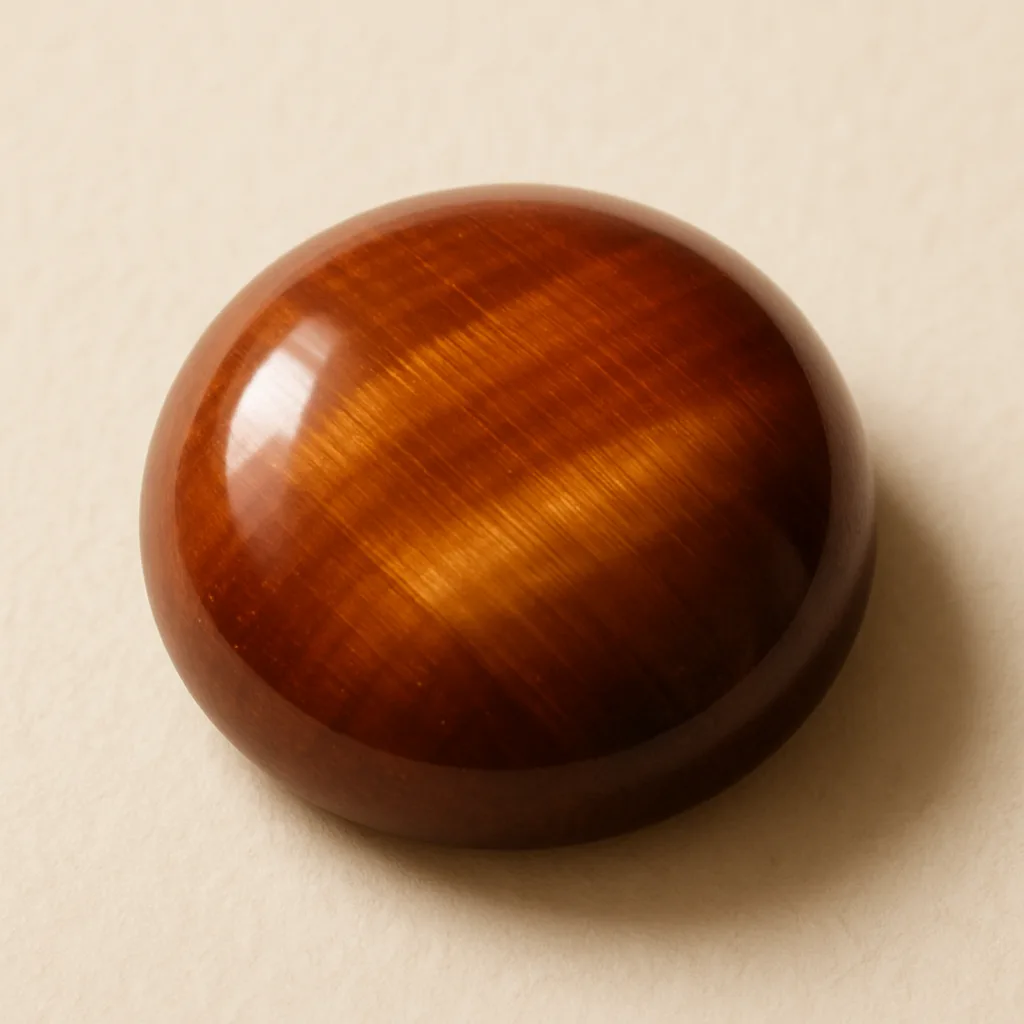
identified this stone yet
Tiger's Eye
| Hardness | 7 |
| Specific gravity | 2.64-2.71 |
| Refractive index | 1.544-1.553 |
| Crystal system | 六方晶系(クロシドライト仮晶) |
Golden brown through honey, mahogany, and red-brown. Blue-gray 'hawk's eye' is the unoxidized parent material; red 'red tiger eye' is heat-treated.
- Parallel pseudomorphic crocidolite fibers — the defining texture
- Limonite staining producing the characteristic brown coloration
- Iron-oxide veining between fiber bundles
- Strong chatoyancy — a single bright band moves with the light
- Silky to satin luster on surface
- Refractive index 1.544–1.553 (quartz-aggregate value)
- Specific gravity 2.64–2.71
- 01Silky chatoyant band — the brightest in the gem world along with chrysoberyl cat's-eye
- 02aceted tiger's eye is uncommon
- 03Mohs 7 — distinctly harder than dyed or imitation 'fiber stones'
- 04Hawk's-eye blue-gray indicates unoxidized parent material; red indicates
- Mohs 7 with no — safe for everyday wear
- Sensitive to acid; remove before swimming in chlorinated pools
- Avoid prolonged immersion in ultrasonic cleaners — fibrous structure can trap residue
From a few hundred yen for small commercial cabochons up to several tens of thousands of yen for large, sharply chatoyant pieces.
Note: South African and Australian material dominates the global market. Heat-treated 'red tiger eye' is widespread and accepted but should be disclosed. Dyed or assembled imitations exist for the metaphysical market and are typically obvious at 10× by their too-uniform or unnaturally bright color.
Tiger's eye is a pseudomorph: quartz has slowly replaced the original blue asbestiform amphibole crocidolite (a riebeckite variety), retaining the parallel fibrous texture and producing chatoyancy. Iron oxidation during the replacement turns the fibers golden brown to red-brown. Where the crocidolite has not yet fully oxidized, the stone retains its original blue-gray color and is called 'hawk's eye.' Heat-treated material with intensified red tones is marketed as 'red tiger eye.' Almost all commercial tiger's eye comes from Griqualand West in South Africa's Northern Cape.
Origins
Griqualand West, in the Northern Cape Province of South Africa — particularly around Prieska, Hotazel, and Niekerkshoop — has been the world's dominant source since commercial mining began in 1873. The Mount Brockman Banded Iron Formation in Western Australia's Pilbara region supplies most of the rest. Smaller deposits occur in Namibia, India, California, Brazil, Myanmar, and Henan Province in China. The South African material formed within a banded iron formation roughly 2.2 billion years old, making tiger's eye one of the geologically oldest gem materials in regular use.
History
abochons. The stone returned to fashion through the late-twentieth-century power-crystal movement, where it is marketed as a 'stone of prosperity' and intuition.
Lore & symbolism
Sometimes listed as a secondary August birthstone alongside peridot and sardonyx. Long associated with vigilance, courage, and prosperity — the 'all-seeing eye' that detects falsehood. In Chinese tradition it is regarded as a tiger-spirit talisman for protecting wealth and warding off the evil eye.
Tools to confirm this stone
Tools that help confirm Tiger's Eye. Tap any item to jump to the matching section on the gem tools page.
- Last reviewed
- April 28, 2026
- Bibliography
- Gem Encyclopedia / GIA (Gemological Institute of America)
- Gem Identification Standards / Central Gem Laboratory (CGL), Tokyo
- Mineral & Gem Database / Mindat.org / Gemdat.org
- Introduction to Gemology / Gemmological Association of All Japan (GAAJ)
The gemological data on this page (refractive index, specific gravity, hardness, crystal system, etc.) is cross-checked against the authoritative primary sources listed above. Values may be revised as gemological research advances.