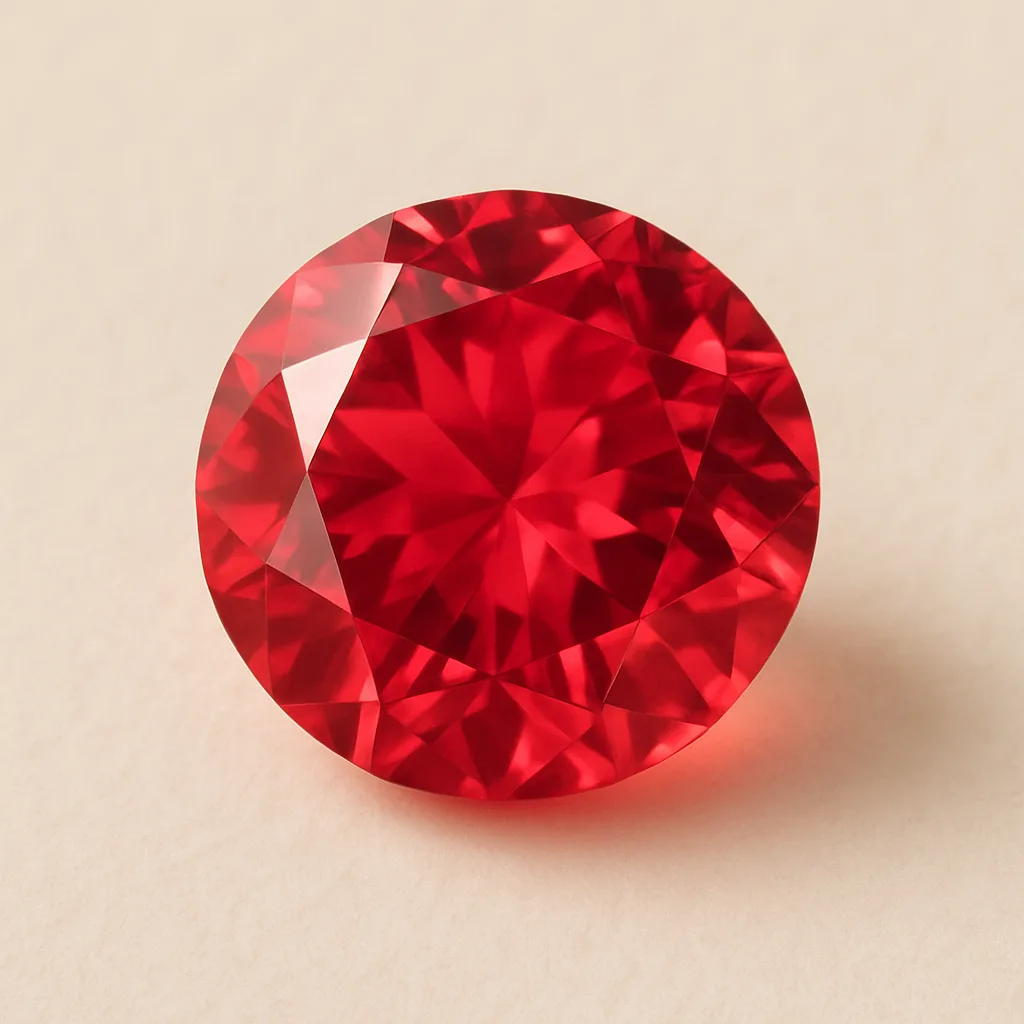
identified this stone yet
Synthetic Red Spinel
| Hardness | 8 |
| Specific gravity | 3.60-3.64 |
| Refractive index | 1.725-1.740 |
| Crystal system | 等軸晶系(立方晶系) |
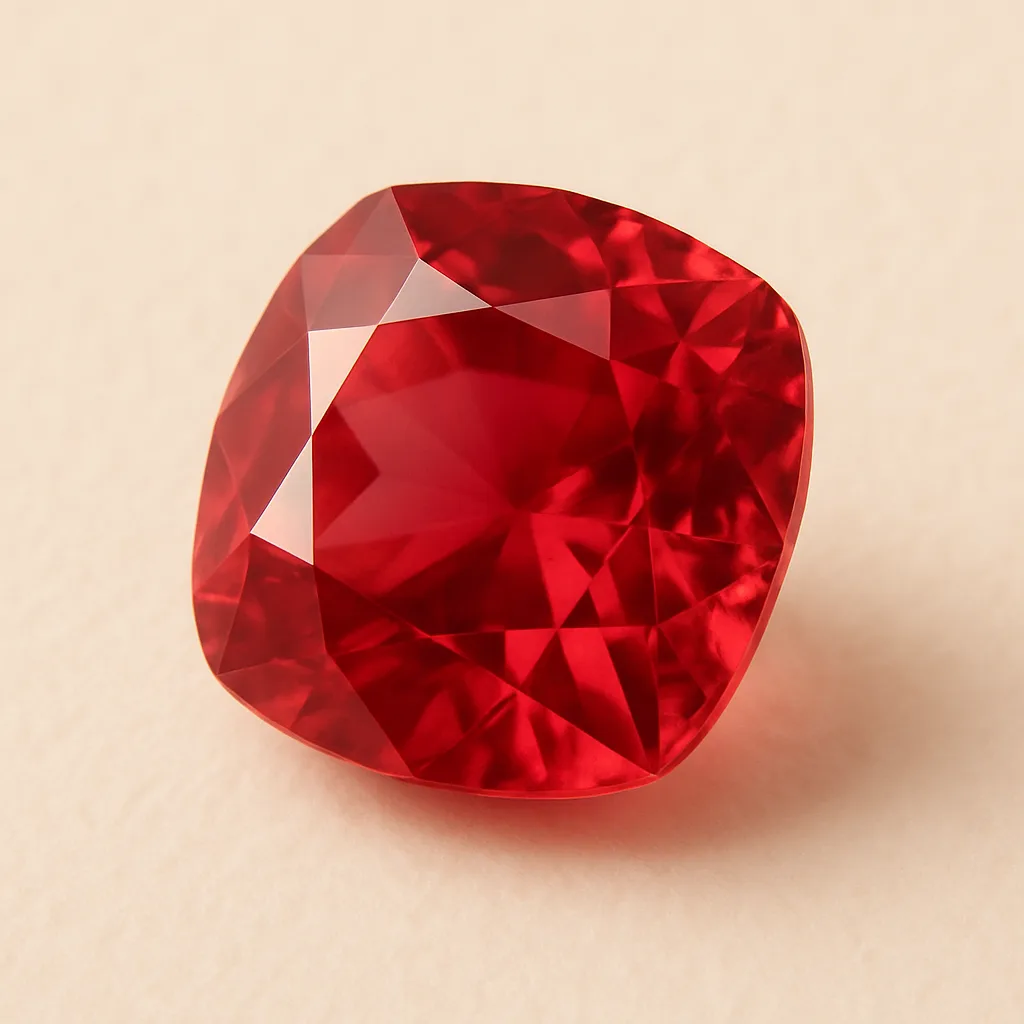
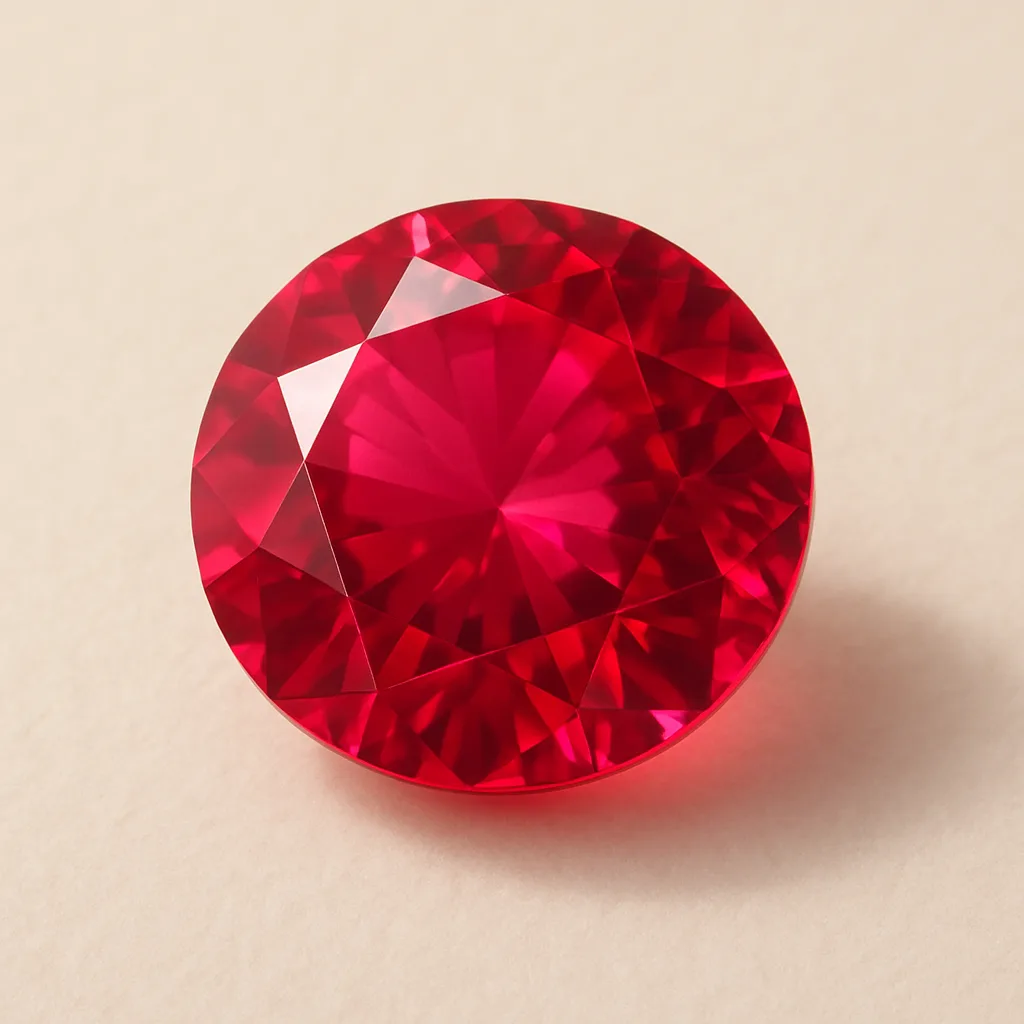
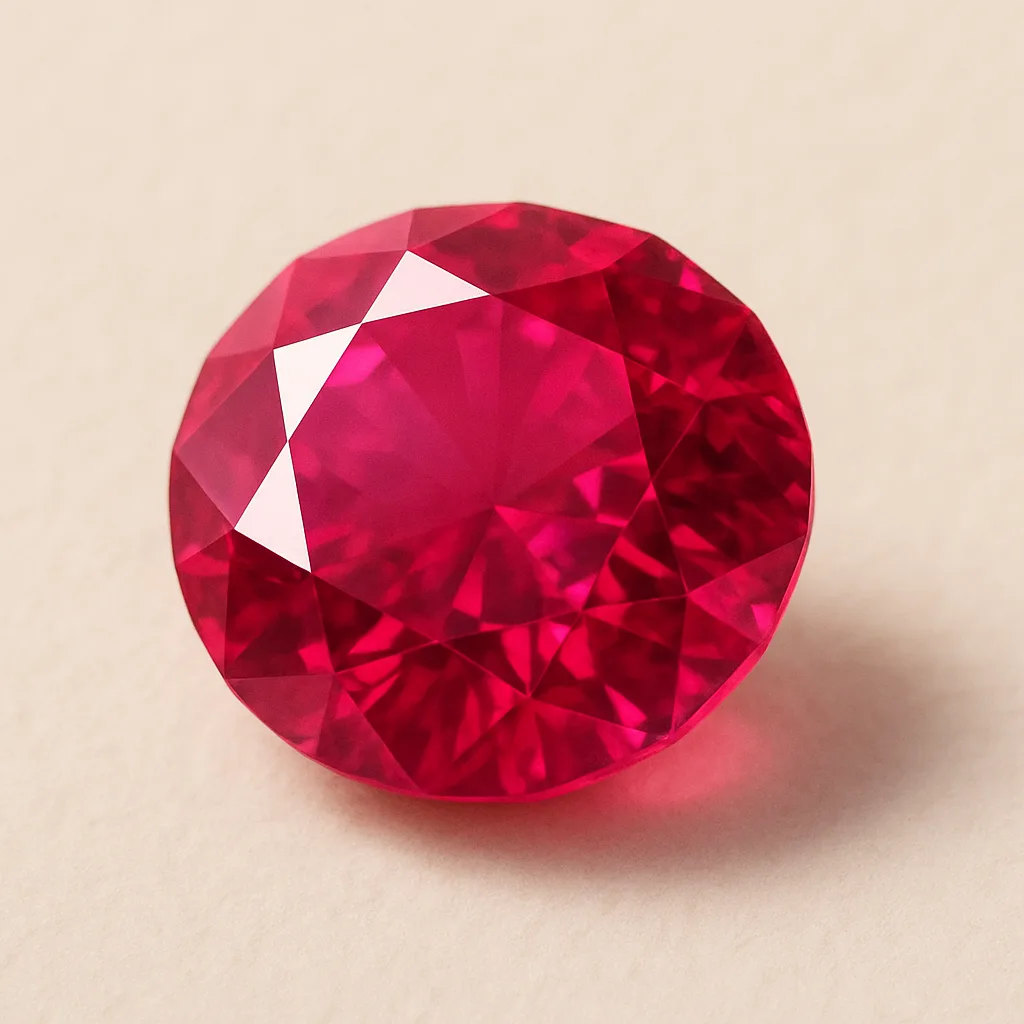
Saturated medium-light to medium-dark red, ranging from pinkish red through pure red to slightly orange-red ('ruby red'). The flame-fusion process produces consistently saturated, even color — typically more uniform than natural Mogok or Mahenge spinel of equivalent grade. Some chromium-rich material approaches the saturation of fine natural Mogok material.
- Curved growth striae (Verneuil) — diagnostic at 10× immersion
- Round gas bubbles, often in trails or clusters
- Swirl flow patterns
- Otherwise typically very clean
- Singly refractive (isotropic cubic) — no , no
- Refractive index 1.725–1.740
- Vitreous luster
- 01 and gas bubbles diagnostic of Verneuil at 10× immersion
- 02Single refraction (no ) at the refractometer — immediately separates from synthetic ruby (corundum, weakly doubly refractive)
- 03Absence of — natural ruby and synthetic ruby show distinct dichroism (purplish red and yellowish red)
- 04Strong red UV is suggestive of chromium-bearing material (spinel, ruby, or alexandrite) but not species-specific
- 05RI 1.725–1.740 and SG 3.60–3.64 immediately separate from synthetic ruby (RI 1.762–1.770, SG ~4.00)
- Mohs 8 — durable for everyday wear
- Ultrasonic and steam safe
- Stable to light and standard cleaning chemicals
- No — robust against impact at edges
$5–$30/ct for commercial flame-fusion synthetic red spinel in standard sizes. Premium Djeva-grade material with selected color and clean stones above 3 ct can reach $50–$150/ct. Genuine Mogok red spinel above 3 ct in fine color trades at $2,000–$10,000+/ct, and the very best Mahenge or 'Jedi' Mogok material can exceed $20,000/ct.
Note: Synthetic red spinel competes against natural red spinel (Mogok, Mahenge, Vietnamese Luc Yen), against synthetic ruby (which is the genuine corundum species at slightly higher cost), against ruby-color glass (Mohs ~5–6, no birefringence), and against red garnet (almandine and pyrope-almandine). The Mohs-8 durability is excellent; the single refraction and absence of pleochroism are the principal markers separating it from synthetic ruby. Strong red UV fluorescence is also characteristic, though not exclusive.
Synthetic red spinel is MgAl₂O₄ (cubic, isotropic) doped with chromium (Cr³⁺) in tetrahedral or octahedral sites to produce a strong saturated red. Mohs 8, SG 3.60–3.64, RI 1.725–1.740, isotropic (no , no ). Curved growth striae and round gas bubbles, the diagnostic markers of Verneuil flame-fusion, are visible at 10× immersion. The strong under long-wave UV (often stronger than natural red spinel of comparable color) is a useful but not exclusive discriminator — natural Mogok red spinel can fluoresce moderately red, so UV alone is not decisive.
Origins
Switzerland (Djeva, founded 1914 by Hrand Djevahirdjian in Monthey and still operating), Germany, France (the original Verneuil and L. Paris workshops), Thailand (significant capacity since the 1970s), Russia, India, and China. Djeva remains the historic premium producer for Verneuil red spinel; Thai and Chinese producers dominate modern commercial supply.
History
Auguste Verneuil announced his flame-fusion ruby process in 1902 and his colleague L. Paris extended the process to spinel in 1908 — using magnesium oxide and aluminum oxide feedstock in stoichiometric ratio. Chromium-doped red production was commercial by the 1910s, marketed initially as a 'ruby substitute' or even as 'synthetic ruby' in the European jewelry trade — a misnomer since ruby is corundum, not spinel. The mid-20th-century American costume jewelry industry — Coro, Trifari, Eisenberg, Boucher, Schreiner — absorbed enormous volumes of synthetic red spinel as a low-cost ruby substitute, often set in vermeil and sterling mountings without explicit synthetic disclosure. The 1957 FTC Jewelry Guides and 1996 revision tightened disclosure requirements at the retail level. The historic confusion between red spinel and ruby — culminating famously in the Black Prince's Ruby (a 170-ct red spinel in the British Imperial State Crown, identified as spinel by gemologist Edward William Streeter in 1879) and the Timur Ruby (a 352.5-ct red spinel acquired by the East India Company in 1849) — has parallels in the synthetic-ruby and synthetic-red-spinel marketing histories.
Lore & symbolism
August's birthstone in some traditions where spinel-substitute associations are accepted (synthetic versions accepted in modern lay practice). The 22nd wedding anniversary in some lists. Modern crystal writing positions synthetic red spinel with the same passion- and vitality-enhancing associations as natural red spinel.
Tools to confirm this stone
Tools that help confirm Synthetic Red Spinel. Tap any item to jump to the matching section on the gem tools page.
- 10× loupeDETAILS →
Essential 10× tool to read inclusions, polish marks, and color zoning
- Chelsea filterDETAILS →
Quick chrome-content screen — chromium-bearing stones glow red through the filter
- UV lamp (long-wave 365 nm)DETAILS →
Long-wave UV reveals red fluorescence (strong)
- UV lamp (short-wave 254 nm)DETAILS →
Short-wave UV reveals red fluorescence (moderate) — a decisive synthetic-vs-natural cue
- Handheld spectroscopeDETAILS →
Absorption-line pattern identifies the chromophore (Cr, Fe, or Co)
- Last reviewed
- April 28, 2026
- Bibliography
- Gem Encyclopedia / GIA (Gemological Institute of America)
- Gem Identification Standards / Central Gem Laboratory (CGL), Tokyo
- Mineral & Gem Database / Mindat.org / Gemdat.org
- Introduction to Gemology / Gemmological Association of All Japan (GAAJ)
The gemological data on this page (refractive index, specific gravity, hardness, crystal system, etc.) is cross-checked against the authoritative primary sources listed above. Values may be revised as gemological research advances.