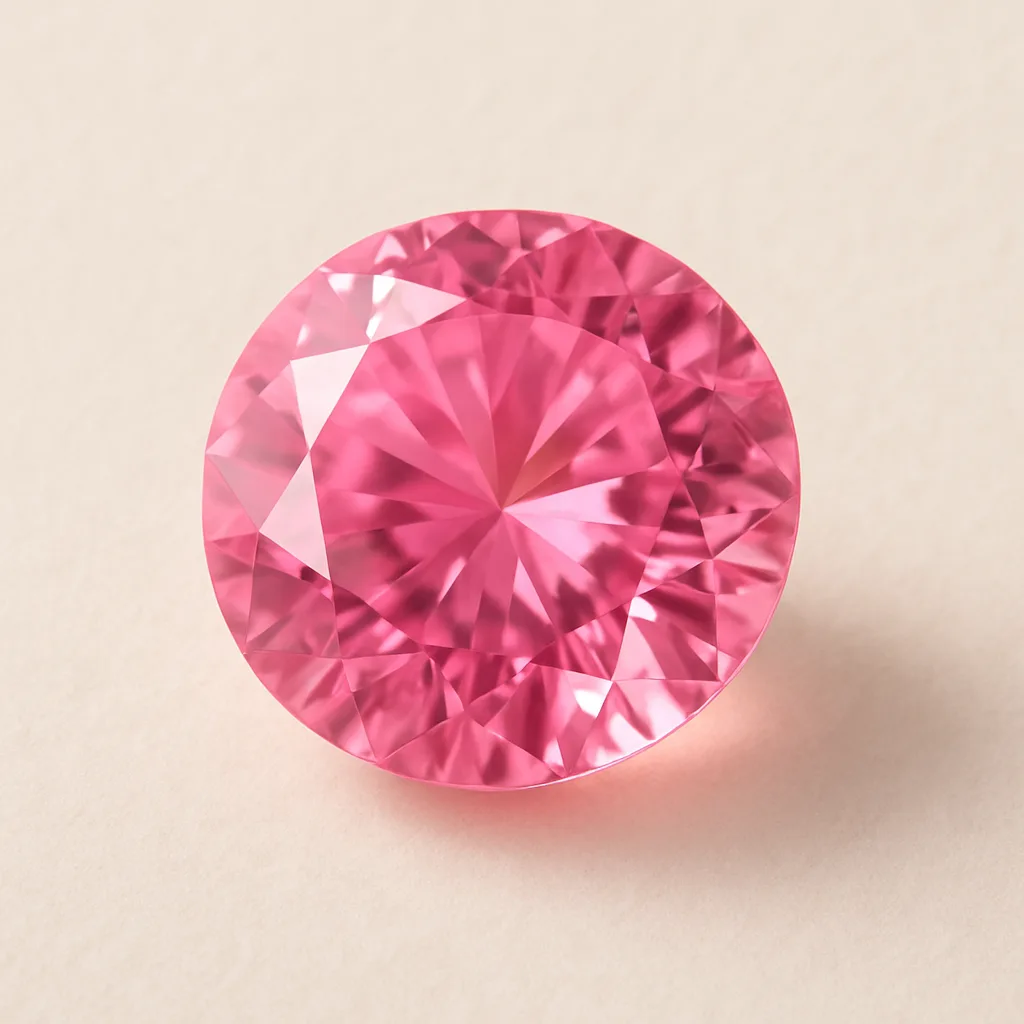
identified this stone yet
Synthetic Pink Sapphire
| Hardness | 9 |
| Specific gravity | 4.00 |
| Refractive index | 1.762-1.770 |
| Crystal system | 六方晶系(三方晶系) |
Pale baby pink, vivid hot pink, and saturated raspberry pink. Modern synthetic pink sapphire is typically produced in pre-selected color saturations matching commercial demand — clean, even saturation with no color zoning, often more uniform than natural material from any single origin.
- Verneuil flame-fusion: visible at 10× under immersion
- Verneuil: round gas bubbles, often in trails or clusters
- Flux-grown: wispy 'breadcrumb' flux residue and platinum crucible flakes
- Hydrothermal: chevron (V-shaped) growth patterns, seed-crystal slabs
- nclusions
- Doubly refractive (uniaxial negative) — identical to natural pink sapphire
- Weak to moderate dichroism — pink and pale yellowish-pink along different optical directions
- 0.008–0.009
- Vitreous to sub-adamantine luster
- 01 visible under 10× immersion are the diagnostic feature of Verneuil flame-fusion
- 02Round gas bubbles indicate synthetic (flame-fusion) or glass
- 03Wispy flux residue or platinum flakes indicate flux-grown synthetic
- 04nclusions is a synthetic warning sign
- 05Lab reports from GIA, AGL, or GRS are definitive for any stone trading above commercial prices
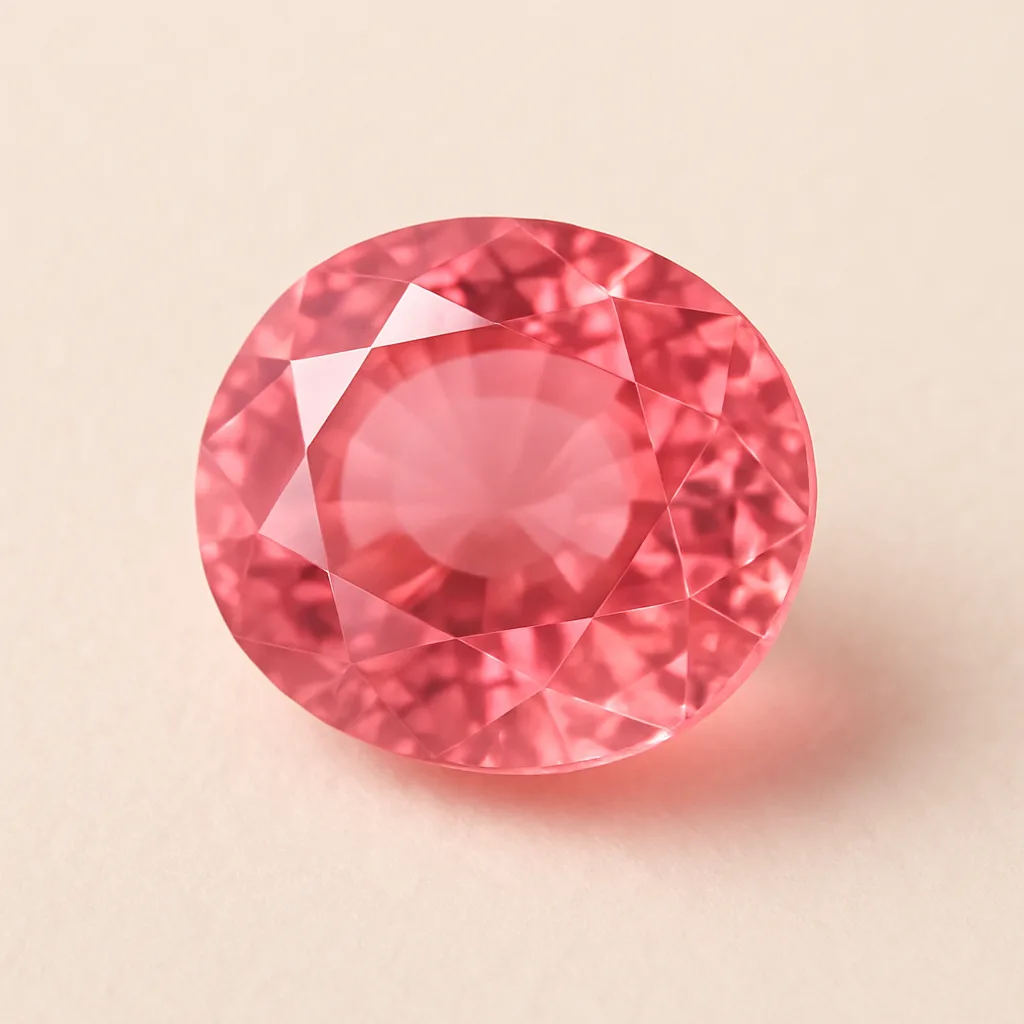
- Mohs 9 with no — extremely durable for everyday wear
- Ultrasonic and steam cleaning are safe
- Stable to light and normal cleaning chemicals
Roughly $3–$20/ct for commercial Verneuil flame-fusion synthetic pink sapphire in standard sizes, $30–$150/ct for high-quality flux-grown Chatham material, and $80–$300/ct for hydrothermal Tairus pink sapphires. Industrial-grade material trades by the kilogram in non-gem markets.
Note: Disclosure is mandatory under modern trade-naming standards (CIBJO, JIS, FTC). 'Created pink sapphire,' 'lab-grown pink sapphire,' and 'synthetic pink sapphire' are acceptable terms. The biggest market issue is undisclosed synthetic material entering the trade from estate jewelry — Verneuil pink sapphires set in mid-20th-century pieces sometimes pass through second-hand markets without proper labeling. Lab reports are inexpensive and definitive for any stone purchased above commercial prices.
Synthetic pink sapphire follows the same Verneuil flame-fusion process developed by Auguste Verneuil in 1902 for ruby, with reduced chromium concentration to keep the color in the pink range rather than the deep red of ruby. The pink-vs-red boundary in synthetic corundum is purely a matter of Cr concentration: roughly 0.4% Cr₂O₃ produces ruby-red, while 0.05–0.2% produces pink. Industrial production is enormous — Swiss Djeva, Russian state plants, Thai operations, and Chinese facilities produce kilogram quantities daily. Beyond costume jewelry, synthetic pink corundum is used for watch jewels (synthetic 'sapphire bearings'), laser materials, and scratch-resistant optical components.
Origins
nclusions.
History
Synthetic pink corundum dates to the same 1902 commercialization as Verneuil ruby. Throughout the early 20th century, synthetic pink sapphire was sold under various trade names — 'reconstructed ruby' (a deliberate misnomer), 'oriental amethyst' (when the color trended toward purplish-pink), and various house brand names. By the 1920s and 1930s, synthetic pink corundum was the dominant material in costume jewelry across Europe and North America. The post-WWII era saw further expansion through Thai and later Chinese production, with synthetic pink corundum becoming so cheap that it now appears in mass-market jewelry priced for children. Modern flux-grown and hydrothermal synthetic pink sapphire from Chatham and Tairus represent a high-end alternative with more sophisticated buyers.
Lore & symbolism
September's birthstone (synthetic versions accepted as substitutes for natural pink sapphire). Synthetic pink sapphire has no traditional folklore — it postdates the lapidary tradition. Modern crystal writing positions it as a stone of accessible love and democratized beauty.
Tools to confirm this stone
Tools that help confirm Synthetic Pink Sapphire. Tap any item to jump to the matching section on the gem tools page.
- 10× loupeDETAILS →
Essential 10× tool to read inclusions, polish marks, and color zoning
- Chelsea filterDETAILS →
Quick chrome-content screen — chromium-bearing stones glow red through the filter
- UV lamp (long-wave 365 nm)DETAILS →
Long-wave UV reveals red fluorescence (strong)
- UV lamp (short-wave 254 nm)DETAILS →
Short-wave UV reveals red fluorescence (strong) — a decisive synthetic-vs-natural cue
- Handheld spectroscopeDETAILS →
Absorption-line pattern identifies the chromophore (Cr, Fe, or Co)
- Last reviewed
- April 28, 2026
- Bibliography
- Gem Encyclopedia / GIA (Gemological Institute of America)
- Gem Identification Standards / Central Gem Laboratory (CGL), Tokyo
- Mineral & Gem Database / Mindat.org / Gemdat.org
- Introduction to Gemology / Gemmological Association of All Japan (GAAJ)
The gemological data on this page (refractive index, specific gravity, hardness, crystal system, etc.) is cross-checked against the authoritative primary sources listed above. Values may be revised as gemological research advances.