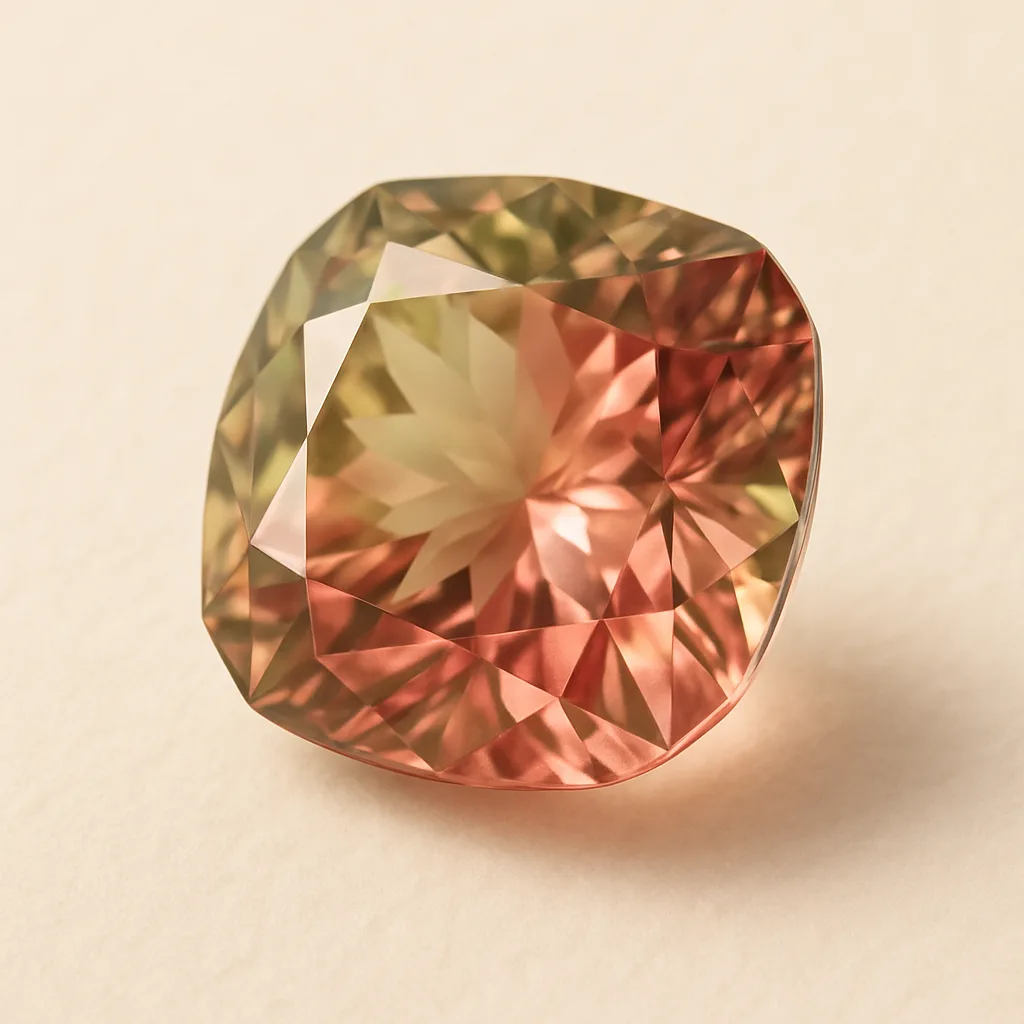
identified this stone yet
Zultanite / Csarite / Diaspore
| Hardness | 6.5-7 |
| Specific gravity | 3.30-3.50 |
| Refractive index | 1.702-1.750 |
| Crystal system | 斜方晶系 |
Daylight: kiwi-green, celadon, pale yellow-green. Mixed light: champagne, pink, rose. Incandescent: raspberry-rose, salmon. Iron and manganese are the principal chromophores.
- planes visible at 10× — diagnostic of diaspore
- Liquid-filled feathers along the basal
- Healed fractures with fingerprint patterns
- Generally eye-clean in fine material
- Doubly refractive, biaxial positive
- Refractive index 1.700–1.722
- 0.018
- Strong trichroic — kiwi-green, raspberry-pink, and yellow along the three optical directions
- Specific gravity 3.34–3.39
- 01Color change from kiwi-green (daylight) to raspberry-rose (incandescent) — softer than alexandrite's emerald-to-ruby but more dramatic in mixed lighting
- 02Strong perfect in one direction visible at 10×
- 03Refractive index 1.70–1.72 and specific gravity 3.36 separate from alexandrite (RI 1.74–1.76, SG 3.71)
- 04Trichroic with the kiwi-green direction usually face-up in a well-cut stone
- Mohs 6.5–7 — suitable for protective settings rather than daily-wear rings
- Perfect in one direction — avoid hard knocks, prong settings should protect the plane
- Avoid ultrasonic and steam cleaning — the makes thermal shock and vibration dangerous
About thirty thousand yen per carat for entry-grade material under 1 ct up to several hundred thousand yen per carat for top-color clean stones above 5 ct with dramatic three-light color change.
Note: No treatments are applied — Zultanite is sold as-cut and the color change is a natural property of the chemistry. The exclusive single-source mining license keeps supply tightly controlled. Cleavage and orientation make rough-to-finished yields very low (often under 5%), which justifies the relatively high per-carat prices for clean stones above 1 ct.
aceting demanding and limits sizes, but well-cut stones above 5 ct exist and command serious prices.
Origins
The İlbir Mountains in Muğla Province of southwestern Turkey — specifically the mine at Pinarcik village near Milas — is the only commercial source on earth. The deposit is a metasomatic bauxite-derived emery body, and the gem-quality crystals occur in pockets within the host rock. The exclusive license is held by Akgün Madencilik (Zultanite Gems LLC for international distribution).
History
Diaspore was named by René Just Haüy in 1801 from the Greek diaspora — Haüy noted the dramatic way the mineral decrepitates when heated, scattering fragments across the workbench. Industrial diaspore from Turkish, Russian, and American bauxite deposits had been known for two centuries before gem-quality color-change material was identified at İlbir in the 1970s by a Turkish geological survey. Initial production was sporadic and the material moved as 'Turkish diaspore' through Idar-Oberstein cutters in the 1980s and 1990s. The 2006 launch of the Zultanite® trade name and the opening of a dedicated cutting and marketing operation transformed the species from a mineralogical curiosity into a recognized luxury gem, with major auction-house sales since 2010.
Lore & symbolism
The name Zultanite derives from sultan, alluding to the 36 sultans of the Ottoman Empire — the trade name was registered to evoke a Turkish heritage for the stone. There is no classical lore, but contemporary marketing positions the stone as a symbol of Turkish geological uniqueness and as a connoisseur alternative to alexandrite.
Tools to confirm this stone
Tools that help confirm Zultanite / Csarite / Diaspore. Tap any item to jump to the matching section on the gem tools page.
- 10× loupeDETAILS →
Essential 10× tool to read inclusions, polish marks, and color zoning
- DichroscopeDETAILS →
Strong pleochroism — confirm both axes through twin windows
- RefractometerDETAILS →
Refractive index (1.7–1.722) narrows the species
- PolariscopeDETAILS →
Polariscope confirms double refraction (optical anisotropy)
- Last reviewed
- April 28, 2026
- Bibliography
- Gem Encyclopedia / GIA (Gemological Institute of America)
- Gem Identification Standards / Central Gem Laboratory (CGL), Tokyo
- Mineral & Gem Database / Mindat.org / Gemdat.org
- Introduction to Gemology / Gemmological Association of All Japan (GAAJ)
The gemological data on this page (refractive index, specific gravity, hardness, crystal system, etc.) is cross-checked against the authoritative primary sources listed above. Values may be revised as gemological research advances.