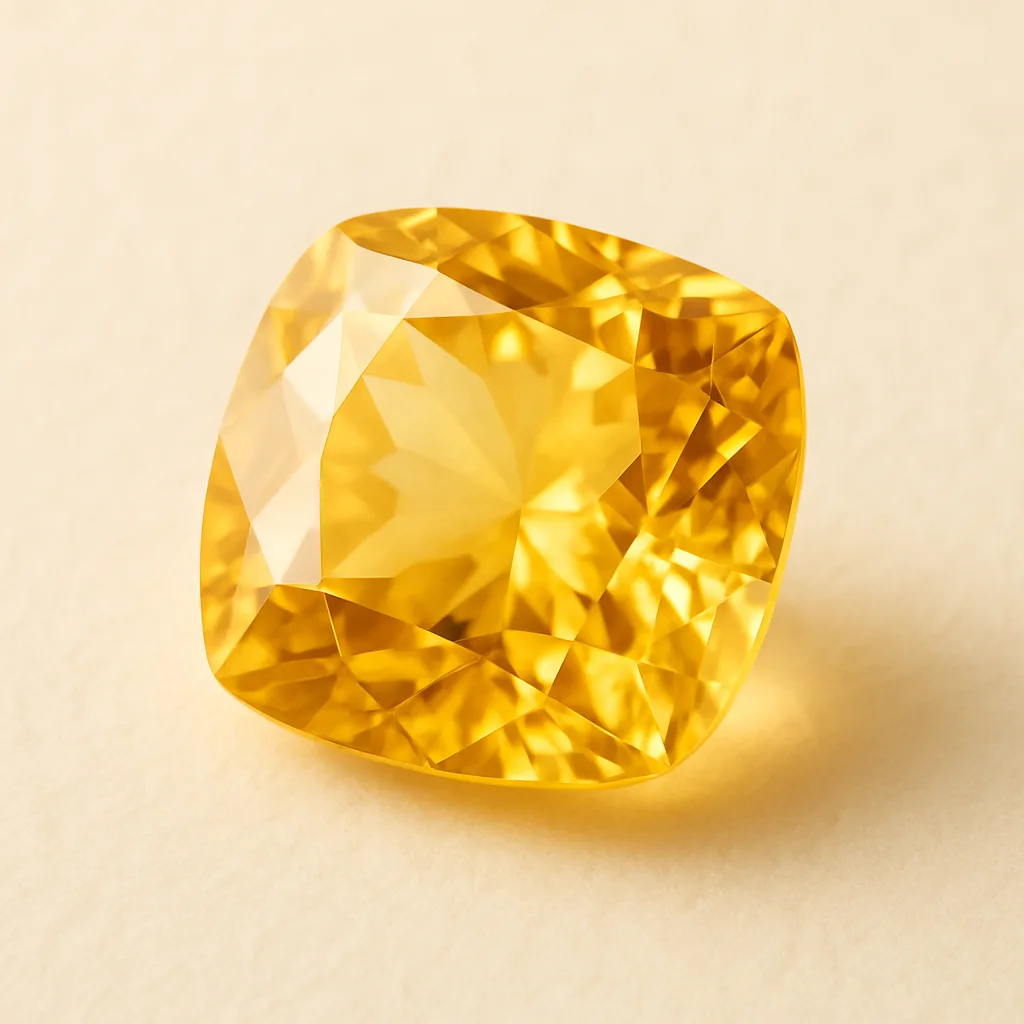
identified this stone yet
Yellow Topaz
| Hardness | 8 |
| Specific gravity | 3.50 |
| Refractive index | 1.619-1.627 |
| Crystal system | 斜方晶系 |
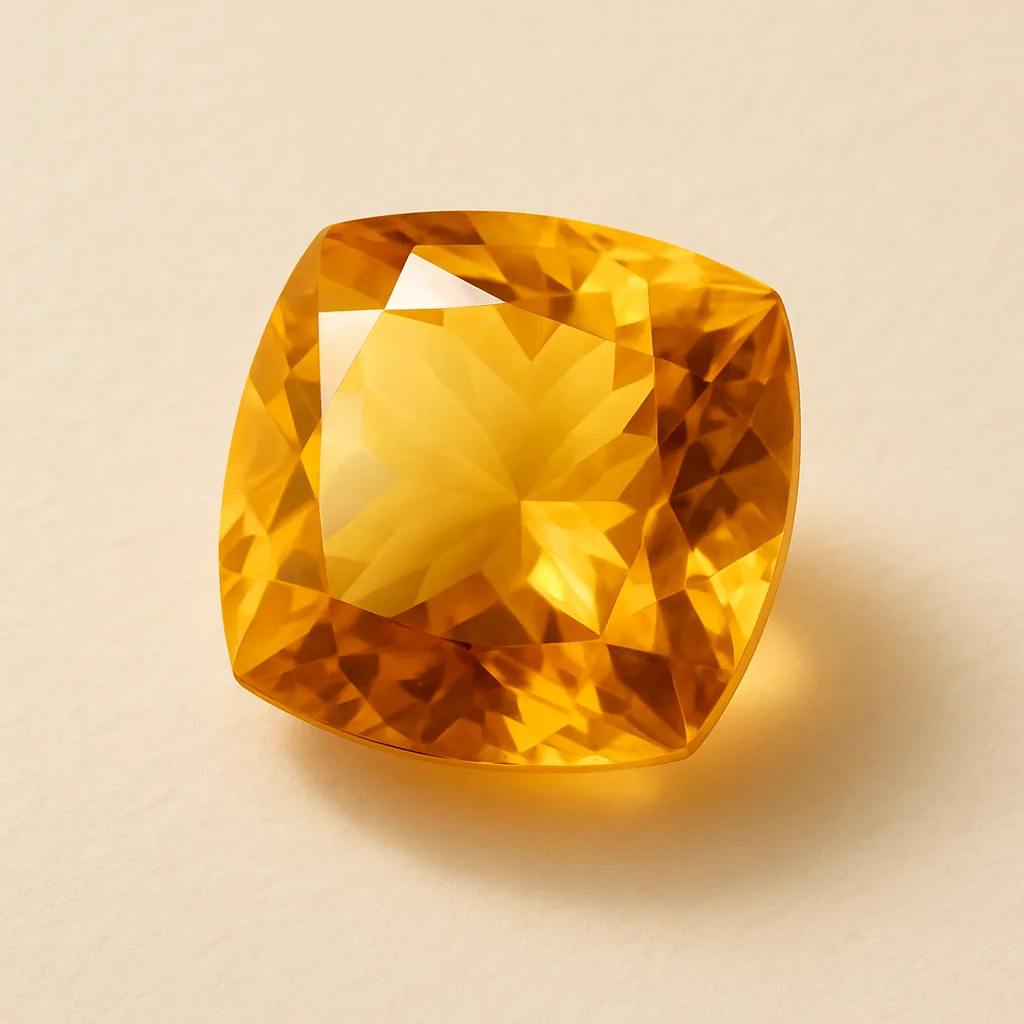
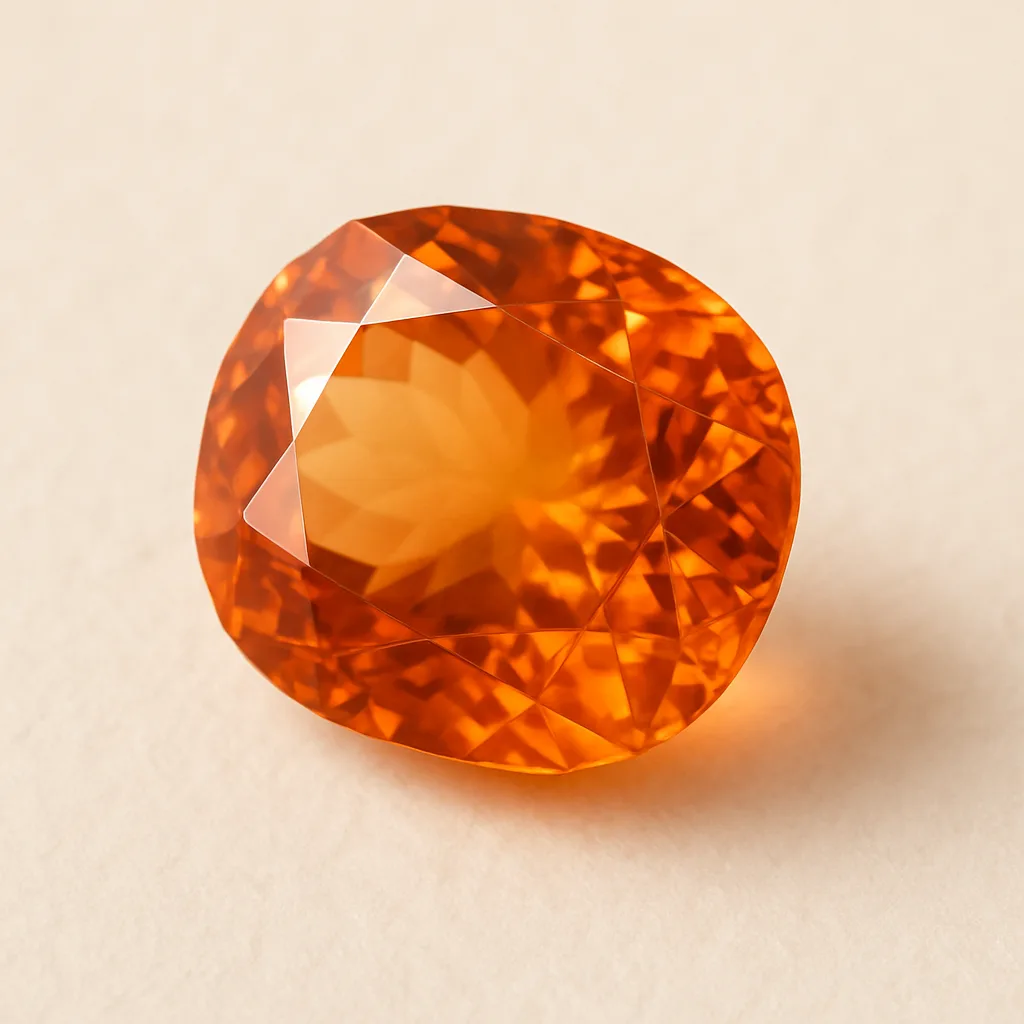
Pale lemon yellow through saturated golden yellow, sherry-gold, honey-amber, and deep cognac. The most prized tones are saturated pure golden yellow without brown or green modifiers, especially in clean stones above 5 carats. Color stability under sustained sunlight is good but not absolute — some yellow topaz fades slightly with extended UV exposure.
- nclusions, elongated parallel to the c-axis
- Healed fractures with fluid-filled tubes
- Color zoning along the c-axis — pale and saturated bands
- Pre-existing planes visible under 10×
- Doubly refractive (biaxial positive)
- 0.008–0.010 — moderate visible at 10×
- Moderate dichroism — yellow and pale yellowish-cream along different optical directions
- Perfect basal — diagnostic of topaz
- 01SG 3.50–3.57 — feels noticeably heavy in hand compared with citrine (SG 2.65) at equal size
- 02RI 1.610–1.638 — clearly higher than citrine (1.544) and heliodor (1.57)
- 03 visible under 10× as a flat reflective plane perpendicular to the c-axis
- 04Moderate dichroism distinguishes from singly-refractive yellow stones like glass
- Mohs 8 with perfect basal — avoid sharp impacts along the c-axis
- Never use ultrasonic or steam cleaning; warm soapy water with a soft brush only
- Some yellow topaz fades slightly with prolonged direct sunlight — store away from continuous UV exposure
- Avoid sudden thermal shock to prevent propagation
Roughly $20–$80/ct for commercial faceted yellow topaz under 3 ct, $100–$400/ct for clean stones in the 5–10 ct range with rich sherry-gold body, and $500–$2,000+/ct for exceptional unheated Ouro Preto material above 10 ct with vivid pure golden saturation and high transparency.
Note: The 'topaz' trade-name abuse problem is largely historical but persists in lower-tier markets: cheap citrine is still occasionally sold as 'topaz' or 'Madeira topaz' to consumers unfamiliar with the distinction. Heat treatment of yellow topaz to deepen color or shift toward pink is common — disclosure standards vary by source country, and lab reports are recommended for stones above $500/ct. Untreated Ouro Preto material with strong sherry color commands premium prices.
Yellow topaz is Al₂SiO₄(F,OH)₂ in which a combination of chromium and crystal-lattice defects produces yellow-to-golden body color. The material runs from pale lemon-yellow through saturated sherry-gold to deep honey, and the warmer tones blend gradually into the orange-pink imperial topaz category — there is no sharp gemological boundary, only a trade convention. Mohs 8 with SG 3.50, yellow topaz feels distinctly heavy in the hand compared to citrine, which is the fastest way to separate the two without instruments.
Origins
Brazil's Ouro Preto district in Minas Gerais is the world's premier source of golden and sherry topaz, with mining traditions going back to the early 18th century. Sri Lanka's Ratnapura, Russia's Ural Mountains, Pakistan's Gilgit, Nigeria's Jos Plateau, Mexico's San Luis Potosí, and Utah's Topaz Mountain all produce yellow material in lesser quantities. The Utah deposits are notable for producing naturally faded crystals that range from sherry through colorless in a single specimen, owing to UV exposure during their geological history.
History
Topaz was named in antiquity by Pliny the Elder in his Naturalis Historia, though his 'topazos' from the Red Sea island of Topazios (modern Zabargad) was almost certainly peridot rather than the mineral we now call topaz — the name transferred to the modern species only in the late 18th century after mineralogical reclassification. Brazilian sherry topaz from Ouro Preto reached European markets in the early 1700s under direct Portuguese crown patronage; the district's wealth helped fund Portuguese baroque architecture and Catholic Church commissions. In the 19th century, dealers used the trade name 'precious topaz' for yellow material to distinguish it from cheaper smoky quartz being mislabeled 'smoky topaz' and citrine sold as 'Madeira topaz' or 'Spanish topaz' — abuses partially curbed by 20th-century trade-naming standards.
Lore & symbolism
November's traditional birthstone. The 23rd wedding anniversary gem under the 'Imperial Topaz' tradition. Yellow topaz appears in medieval European lapidary writing as a stone of mental clarity, royal favor, and protection against fevers, sometimes called 'the gem of the setting sun.' Hindu Jyotish astrology associates yellow stones broadly with Jupiter (Brihaspati), though pukhraj specifically refers to yellow sapphire, with yellow topaz used as a more affordable substitute.
Tools to confirm this stone
Tools that help confirm Yellow Topaz. Tap any item to jump to the matching section on the gem tools page.
- 最終確認日
- 2026年4月28日
- 参 考 文 献
- Gem Encyclopedia/ GIA (Gemological Institute of America)
- 宝石鑑別基準/ 中央宝石研究所 (CGL)
- Mineral & Gem Database/ Mindat.org / Gemdat.org
- 宝石学入門/ 全国宝石学協会
本ページの物性値(屈折率・比重・硬度・結晶系等)は、上記の権威ある一次資料を相互参照して編集しています。最新の鑑別研究の進展により値が更新される場合があります。