identified this stone yet
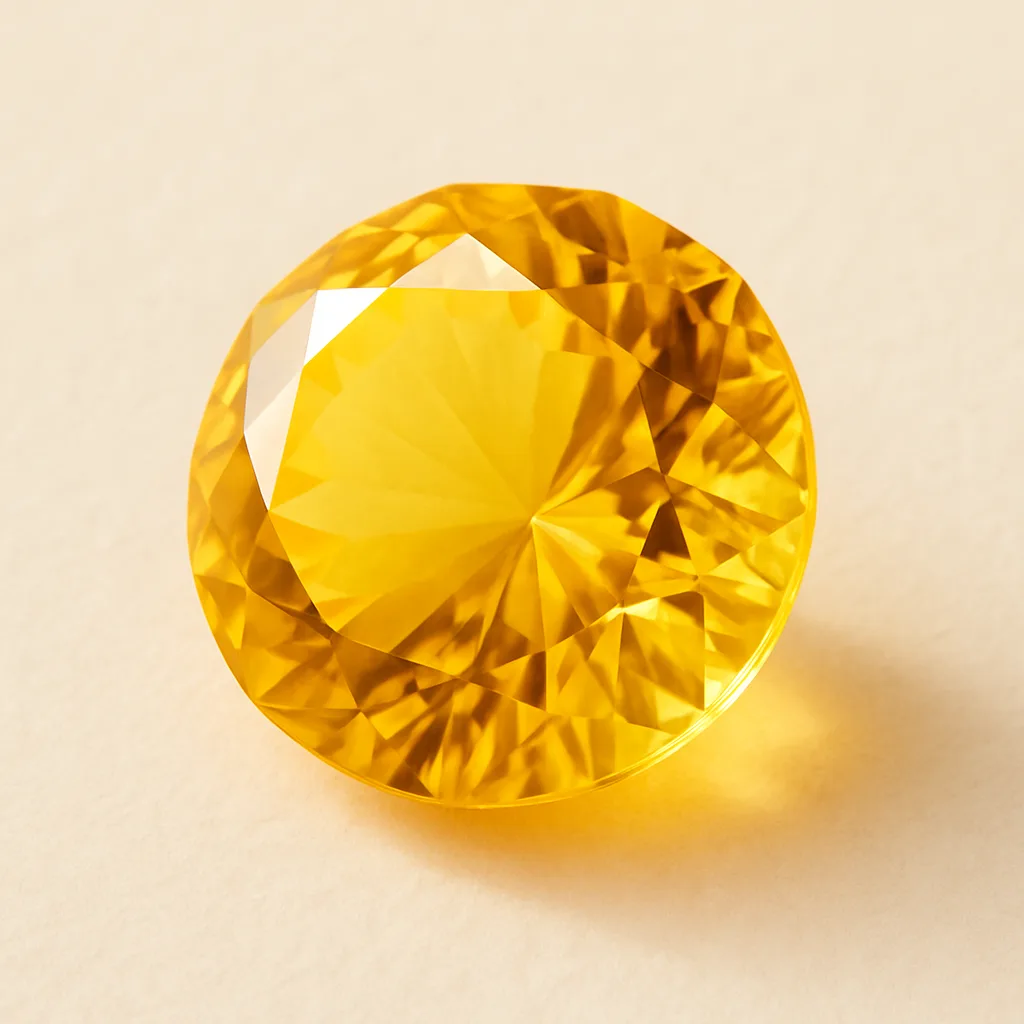
Yellow Glass
| Hardness | 5-6 |
| Specific gravity | 2.3-4.5 |
| Refractive index | 1.44-1.70 |
| Crystal system | 非晶質(アモルファス) |
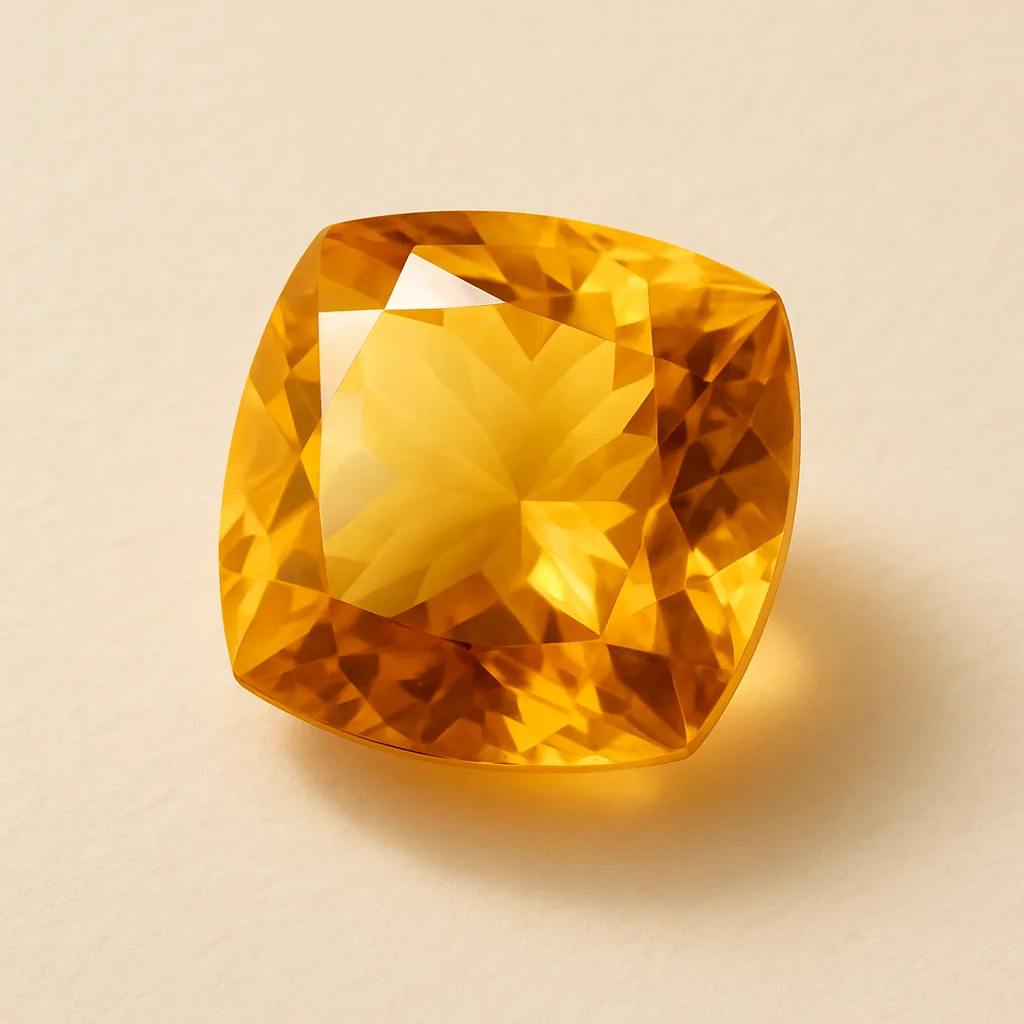
Pale lemon-yellow (silver-yellow, cadmium-yellow), classical 'topaz yellow' to 'citrine yellow' (cadmium sulfide), warm honey-yellow (iron-and-sulfur), canary-yellow (uranium glass), and the rare 'Vauxhall amber' English specialty tone. Cadmium-doped material closely approximates citrine and yellow sapphire saturation; uranium-doped material is unmistakably canary-yellow with characteristic strong green diagnostic.
- Regular round gas bubbles distributed evenly through the matrix — diagnostic of pressed or molded glass at 10×
- Surface molding seams and press-die parting lines on backs
- Color zoning streaks from incomplete batch mixing
- Devitrification crystallites in older or heat-stressed material
- Silver-yellow medieval church glass: silver-nitrate stain layer visible on one surface only as a diffused diffusion-zone yellow color penetrating ~50–200 μm into the glass body
- Lampwork beads: spiral flow lines from molten-glass winding
- Singly refractive (amorphous glass structure) — no
- Refractive index 1.50–1.70 depending on lead content
- Specific gravity 2.4–4.5 — lead-crystal at the high end
- Mohs 5–6 — easily scratched by quartz (Mohs 7)
- Conchoidal fracture
- Uranium glass: characteristic strong green under 365 nm UV (uranyl ion UO₂²⁺ transition) — diagnostic single-test identifier visible without specialized equipment
- Chelsea filter: most yellow glass shows no significant response
- 01Regular round gas bubbles visible at 10× — immediately diagnose pressed or molded glass; natural citrine and yellow sapphire never show this signature
- 02Singly refractive (no ) versus natural citrine's clear at 30× immersion
- 03Refractometer reads 1.50–1.70 versus natural citrine 1.544–1.553 (overlapping but diagnostic combined with polariscope) or yellow sapphire 1.762–1.770 (clean separation)
- 04Mohs 5–6 scratches against a steel knife; natural citrine (Mohs 7) and yellow sapphire (Mohs 9) are unaffected
- 05Uranium glass: strong green at 510–530 nm under 365 nm UV — diagnostic single-test identifier, no other yellow gem (natural or synthetic) shows this signature
- 06Specific gravity 2.4–4.5 versus natural citrine 2.65 (overlap) or yellow sapphire 3.99–4.01 (clean separation)
- Mohs 5–6 — stores separately to avoid scratches
- Avoid ultrasonic cleaning — vibration can crack the brittle matrix
- Stable to light and mild detergent; warm soapy water and soft brush
- Avoid thermal shock — conchoidal fracture risk
- Uranium glass: no special handling required (US NRC 10 CFR 40.13 exemption for jewelry-scale quantities); contact dose rates ~0.5–1.0 μSv/h are within natural background range
- Cadmium-bearing glass: REACH-restricted for consumer use; avoid prolonged skin contact and pediatric exposure
Modern molded and faceted yellow-glass cabochons trade at $0.30–$3 per piece wholesale (Indian and Chinese mass production); Swarovski Crystal Light Topaz and Topaz components at $0.50–$5 per piece; Czech Gablonzer pressed-glass material at $2–$25 per piece. Murano lampwork yellow beads in silver-yellow technique reach $50–$300 per bead at gallery prices. Pre-1942 Bohemian uranium-glass jewelry (Annagelb) trades at $200–$3,000 per piece at vintage and estate auctions; American Vaseline-glass dating to the Northwood and Fenton periods reaches $100–$1,500 per piece. Genuine 18th- and 19th-century silver-yellow paste (Strass-tradition French, Vauxhall English) trades at $200–$3,000 per piece.
Note: Disclosure as 'glass' or 'imitation citrine/yellow sapphire/heliodor' is mandatory under FTC Jewelry Guides §23.25 and CIBJO Blue Book. Uranium-glass jewelry requires no specific radiological disclosure under US Nuclear Regulatory Commission rules (uranium glass is exempt under 10 CFR 40.13 'unimportant quantities of source material'); the typical pre-1942 uranium glass at 2 wt% UO₂ produces approximately 0.5–1.0 microsieverts per hour at contact (well below the 1 millisievert/year public dose limit and roughly equivalent to natural background radiation from soil). Beware of cadmium-rich yellow glass from non-REACH-compliant sources for children's jewelry — EU REACH Annex XVII Entry 23 restricts cadmium to below 0.01 wt% in consumer applications. Czech Gablonzer pressed-glass yellow cabochons and Bohemian uranium glass retain collector value.
Yellow glass is amorphous SiO₂-based paste colored yellow by various chromophores. Silver (Ag⁺ in a soda-lime base, the 'silver staining' or 'silver yellow' tradition) at 0.01–0.10 wt% Ag produces the brilliant lemon-to-amber yellow tones used in medieval and post-medieval church-glass production; iron-and-sulfur combinations yield the classical Roman 'beer-yellow' to medieval Bohemian honey-yellow shades; cadmium sulfide (CdS) at 0.1–0.5 wt% produces the modern industrial 'cadmium yellow' saturated tones, commercialized at Schott Jenaer Glaswerke from the 1890s; uranium oxide (UO₂/UO₃) at 0.05–2.0 wt% in soda-lime glass produces the characteristic 'uranium glass' canary-yellow or yellow-green tones with diagnostic strong green under LW-UV (the 'vaseline glass' tradition, in continuous production from Franz Xaver Riedel's 1830s Bohemian works until 1942 when uranium supplies were redirected to the Manhattan Project). Non-crystalline, isotropic, Mohs 5–6, SG 2.4–4.5, RI 1.50–1.70, singly refractive, conchoidal fracture.
Origins
abochons; the Bohemian uranium-glass tradition originated at Franz Xaver Riedel's 1830s Joachimsthal (Jáchymov) works and continued at the Bohemian crystal works until 1942. Italy (Murano, Venice — Cima, Salviati, Effetre) supplies lampwork beads using silver-yellow and cadmium-yellow colorants. Germany (Schott Jenaer Glaswerke, Jena) is the historical centre for cadmium-sulfide colorant chemistry. France (Saint-Gobain, Baccarat) produced silver-yellow medieval church glass and 18th-century Strass paste. England (Stourbridge, Bristol) produced 'Vauxhall amber' decorative glass. The United States (Northwood Glass Works, Wheeling, West Virginia, 1880s–1908; Fenton Art Glass, Williamstown, West Virginia, 1905–2011) developed the American uranium-glass tradition. India (Firozabad) and China (Shandong, Hebei) dominate modern mass production. Uranium-glass production largely ceased in 1942 when supplies were redirected to the Manhattan Project; limited specialty production resumed post-1958 but at much-reduced uranium concentrations.
History
Roman yellow glass appears at Pompeii from the first century CE using iron-and-sulfur colorants; Pliny's Naturalis Historia Book 36 (c. 77 CE) describes the technique. The medieval 'silver staining' or 'silver yellow' technique for stained-glass windows was developed in France c. 1300 and perfected at Bourges Cathedral and Chartres Cathedral by the early 14th century — applied as a silver-nitrate paint on the back surface of colorless or pale-blue glass and fired at 600°C to produce a diffused yellow stain. Bohemian uranium glass was developed by Franz Xaver Anton Riedel (1786–1844) at his Joachimsthal (Jáchymov, Bohemia) works in the 1830s, using uranium oxides from the local pitchblende deposits (the same deposits that Marie and Pierre Curie would mine for radium isolation in 1898). Riedel's Eleonorenhain (Lenora) and Polaun glassworks scaled uranium-glass production to industrial levels by the 1840s; the resulting 'Annagelb' (after Riedel's daughter Anna) canary-yellow and 'Annagrün' (yellow-green) colors became the standard Bohemian uranium-glass shades. The American uranium-glass tradition was established by Northwood Glass Works (Harry Northwood, 1880s) and Fenton Art Glass (Frank L. Fenton, 1905) at the West Virginia glass-manufacturing belt. The Schott Jenaer Glaswerke commercialization of cadmium-sulfide colorants from 1890 provided cheaper non-radioactive alternatives. Uranium-glass production worldwide was largely halted in 1942 as uranium supplies were redirected to the Manhattan Project; limited specialty production resumed post-1958 at greatly reduced uranium concentrations (0.05–0.5 wt% versus the 2.0+ wt% pre-1942 standard). The 1968 US FTC Jewelry Guides §23.25 disclosure rules apply.
Lore & symbolism
No birthstone designation (synthetic/imitation material). The citrine association — the natural species most often imitated by yellow glass — carries cultural symbolism: citrine is the November alternative birthstone (alongside topaz) and the modern Western 'Merchant's Stone' or 'Success Stone' in commercial lore. Uranium glass (Bohemian Annagelb and American Vaseline glass) holds a separate collector subculture organized around the Vaseline Glass Collectors Inc. (founded 1998, Pennsylvania) and the characteristic strong green under handheld 365 nm UV torches. The Bohemian Gablonzer regional craft tradition is preserved under UNESCO intangible cultural heritage.
Tools to confirm this stone
Tools that help confirm Yellow Glass. Tap any item to jump to the matching section on the gem tools page.
- 最終確認日
- 2026年4月28日
- 参 考 文 献
- Gem Encyclopedia/ GIA (Gemological Institute of America)
- 宝石鑑別基準/ 中央宝石研究所 (CGL)
- Mineral & Gem Database/ Mindat.org / Gemdat.org
- 宝石学入門/ 全国宝石学協会
本ページの物性値(屈折率・比重・硬度・結晶系等)は、上記の権威ある一次資料を相互参照して編集しています。最新の鑑別研究の進展により値が更新される場合があります。