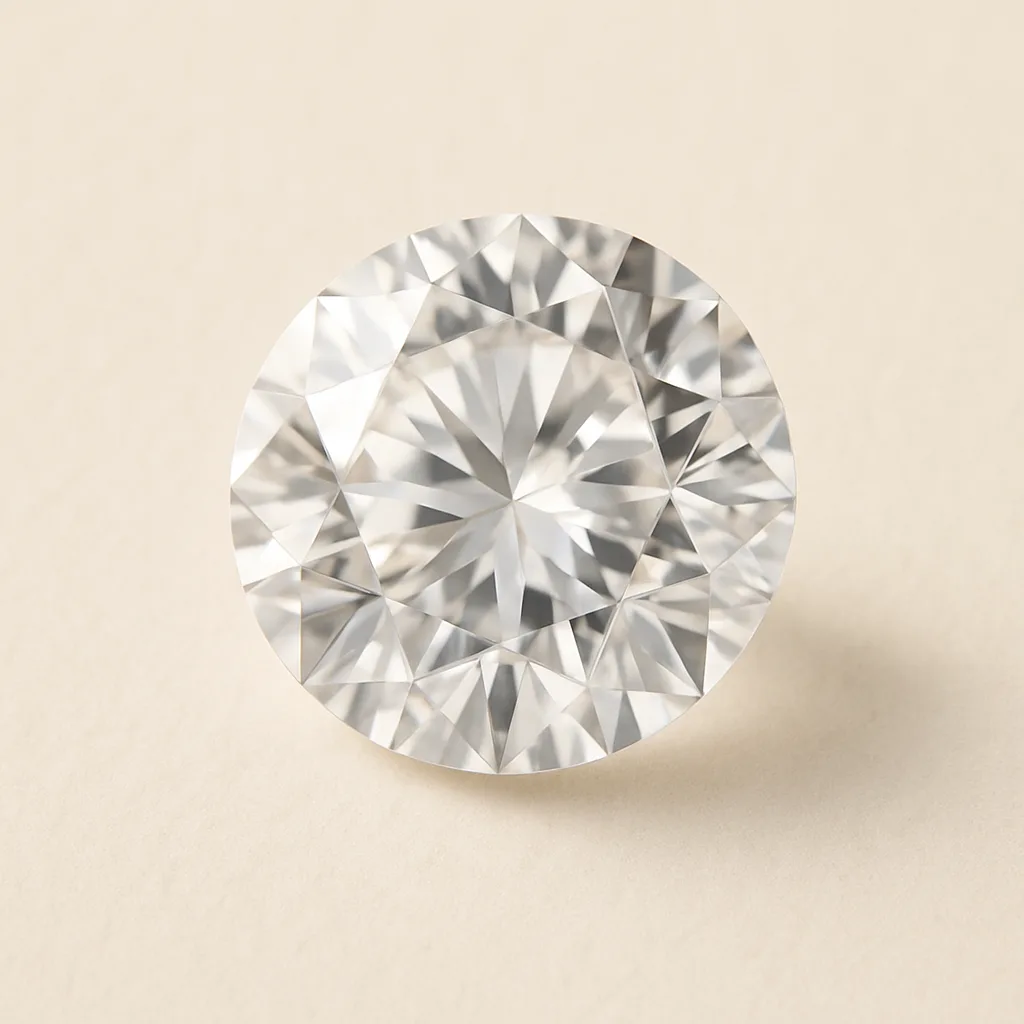
identified this stone yet
YAG (Yttrium Aluminum Garnet)
| Hardness | 8.25 |
| Specific gravity | 4.55-4.65 |
| Refractive index | 1.830-1.836 |
| Crystal system | 等軸晶系 |
aceted to round-brilliant proportions optimized for diamond-style brilliance. Color-doped variants — chromium-green YAG, holmium-pink YAG, neodymium-violet YAG (which shows a striking color change between daylight and incandescent illumination, sometimes marketed as 'synthetic alexandrite' — a misleading name since YAG is not chrysoberyl) — exist as small-volume fancy-color production. Most commercial supply has been the colorless variety throughout YAG's brief gem-jewelry life.
- Czochralski-process seed-crystal residue at the boule core — sometimes visible as a faint axial line
- nclusion-poor material by design
- nclusions by spherical morphology
- Singly refractive (cubic garnet structure) — no at any orientation
- Refractive index 1.83 — moderate, below diamond (2.42) and CZ (2.15) but above natural garnet (1.74–1.89)
- 0.028 — lower than diamond's 0.044 and significantly lower than CZ (0.058) — produces more 'tame' optical signature without the rainbow over-fire of CZ
- Specific gravity 4.55–4.65 — heavier than diamond (3.52) but lighter than CZ (5.6–6.0)
- Mohs 8.25 — durable enough for ring wear but softer than corundum (9) or diamond (10)
- 01Specific gravity 4.55–4.65 separates YAG from CZ (5.6+) and from white sapphire (4.00) and white spinel (3.6) — hand-heft is diagnostic at 1 ct and above
- 02Singly refractive (no ) separates YAG from natural zircon and moissanite, both of which double conspicuously
- 03 0.028 produces more diamond-natural fire intensity than CZ's 0.058 over-coloured rainbow effect — visually 'tame' compared to CZ
- 04Diamond thermal-conductivity probe reads negative on YAG (low thermal conductivity)
- 05Vintage 1969–1976 production typically shows minor color-zoning and seed-crystal residue artifacts that modern production might not
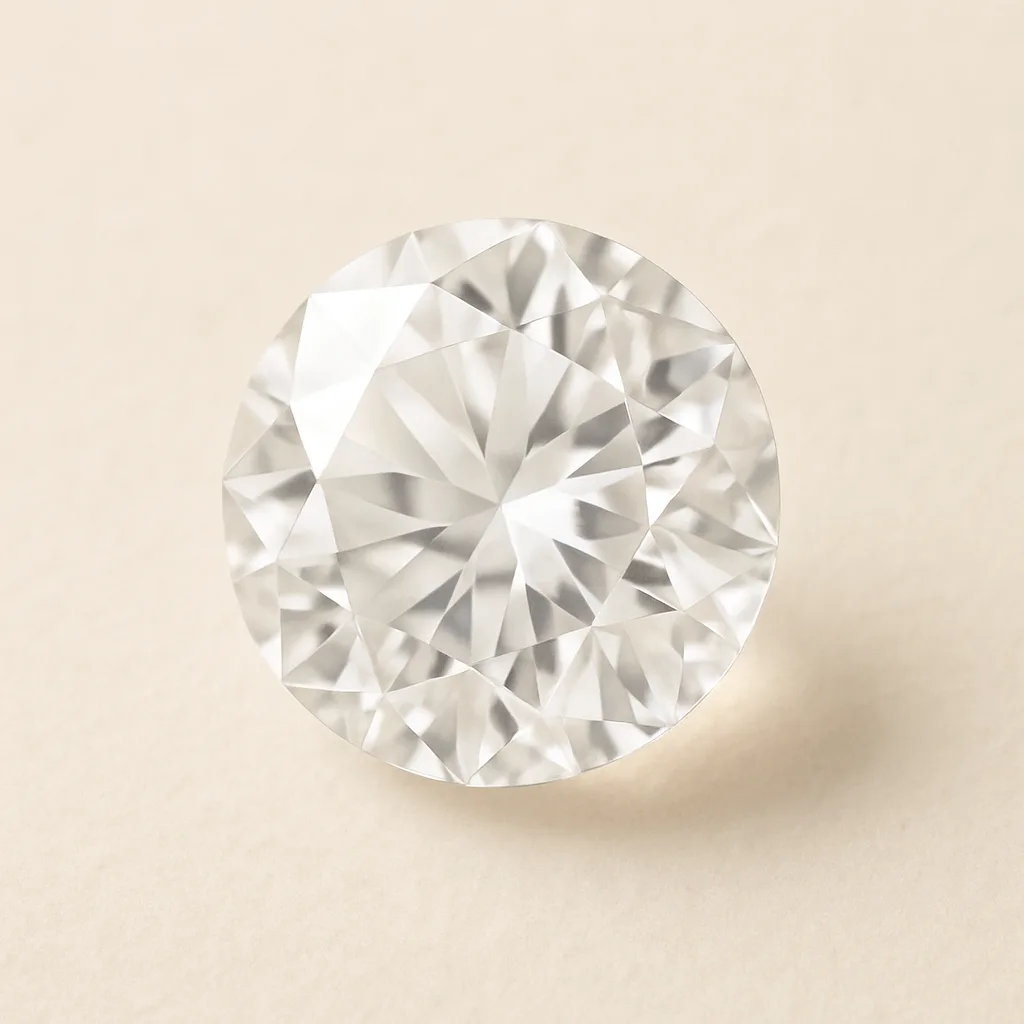
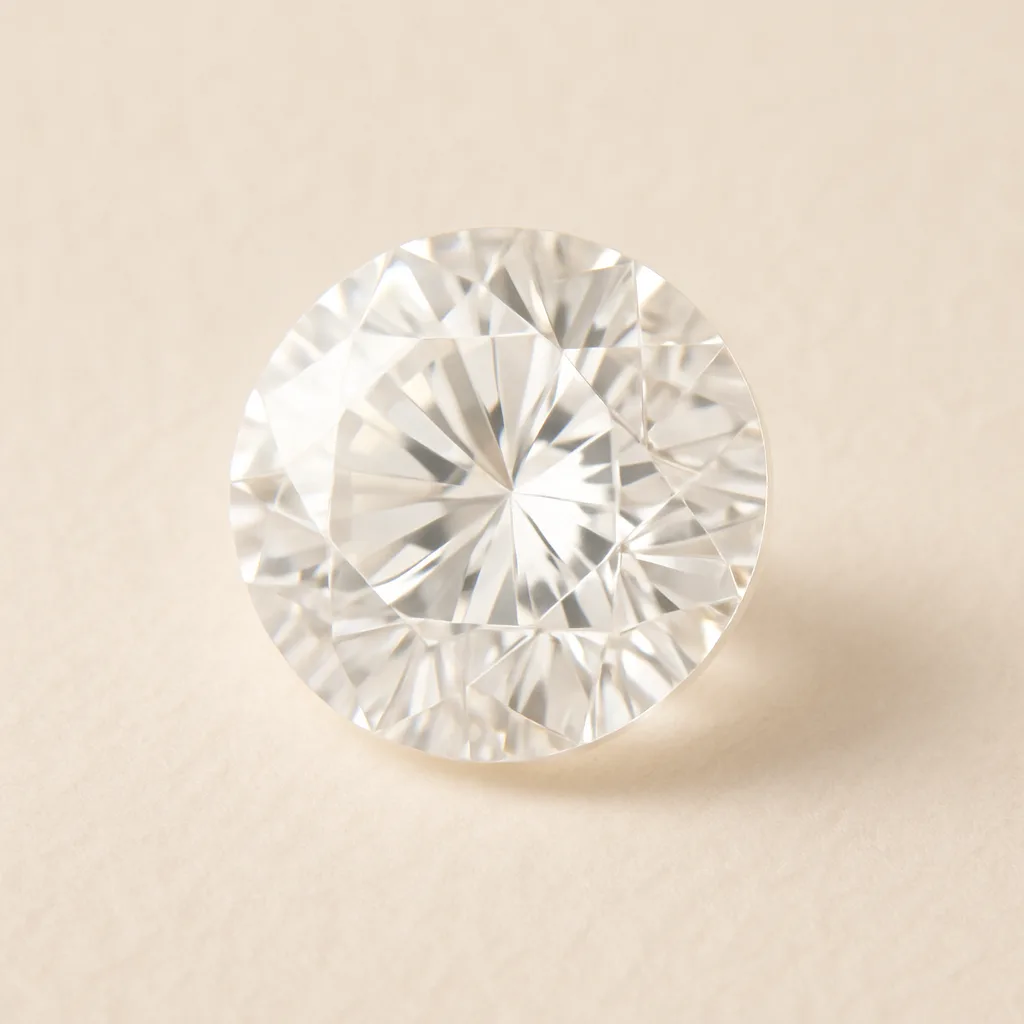
- Mohs 8.25 — durable enough for ring wear with reasonable care; surface scratches accumulate slowly over years
- Ultrasonic and steam cleaning are safe
- Stable to light and standard household cleaning chemicals
- Stable to jeweller's torch repair work — Czochralski-grown YAG is thermally robust
Loose YAG from boutique and vintage sources trades at $20–$150 per carat for clean, well-cut faceted stones. Vintage 1969–1976 costume-jewelry pieces in original setting trade in estate auction at $50–$500 depending on setting metal and designer attribution. Industrial Nd:YAG laser-host crystals trade at very different price levels reflecting precision-machining and doping costs ($200–$5,000 per piece for laboratory-grade rods).
Note: Commercial gem supply is essentially limited to vintage-jewelry inventory; new YAG production today is overwhelmingly for industrial laser-host applications. Disclosure as 'YAG,' 'yttrium aluminum garnet,' or 'synthetic' is mandatory where the material is sold under FTC Jewelry Guides and CIBJO Blue Book. Important retail-language correction: YAG is a synthetic garnet (cubic-garnet structure with yttrium on the A site and aluminum on B and C sites); it is not chemically related to natural pyrope, almandine, or other gem garnets despite the shared crystal structure. Vintage 'Diamonair' and 'Diamondite' branded pieces from Litton Industries are now collected as 1970s costume-jewelry signifiers; estate auctions occasionally bring exceptional pieces to market.
YAG is synthetic Y₃Al₅O₁₂ — yttrium aluminum garnet, a complex oxide crystallizing in the cubic garnet structure (space group Ia-3d) with yttrium occupying the dodecahedral A site and aluminum occupying both the octahedral B and tetrahedral C sites. Grown commercially by the Czochralski method (a single seed crystal pulled from a 1970 °C iridium-crucible melt under inert atmosphere), YAG yields large, clean, single-crystal boules suitable for both laser host applications (where Nd³⁺ substitutes for Y³⁺ at carefully controlled doping levels) and gem cutting. Mohs 8.25, SG 4.55–4.65, RI 1.83 (singly refractive, cubic), 0.028 (lower than diamond's 0.044), no . The cubic-garnet crystal structure means YAG is optically isotropic — no , no — and the lack of combined with the moderate makes YAG visually a 'tame' diamond substitute compared to the over-fire of CZ or moissanite. Color-doped variants (Cr³⁺ for green, Ho³⁺ for pink, mixed rare-earth for blue-violet) have minor commercial presence as fancy-color novelty.
Origins
The 1962 development at Bell Telephone Laboratories (Murray Hill, New Jersey) under Joseph E. Geusic, Hubert Marcos, and Le Grand Van Uitert produced the first Nd:YAG laser-host crystals — work that earned a place in the foundational laser-physics literature and led directly to the now-universal Nd:YAG industrial laser. Allied Chemical's Crystal Products Division (Morristown, New Jersey) and Litton Industries (Beverly Hills, California) developed commercial-scale Czochralski production through the late 1960s, and gem-quality cut stones reached the retail market between 1969 and 1971 under the Diamonair (Litton), Diamondite, and Geminair trade names. Union Carbide (Linde Division), Allied Chemical, and General Electric all maintained YAG production lines through the early 1970s. Japanese producers (Sumitomo Electric, Sumitomo Special Metals, Tokyo Shibaura Electric / Toshiba) entered the market in the mid-1970s. Commercial gem production largely collapsed within months of the 1976 Soviet CZ commercial debut; industrial Nd:YAG laser-host production continues to the present day at companies including II-VI Incorporated (Saxonburg, Pennsylvania) and the Russian Federal State Unitary Enterprise (FSUE) NII NPO Luch.
History
The 1960 Theodore Maiman ruby laser at Hughes Research Laboratories in Malibu, California, opened a search for better solid-state laser host crystals. Joseph E. Geusic and colleagues at Bell Labs identified yttrium aluminum garnet as a promising host for trivalent neodymium, and demonstrated the first Nd:YAG laser in 1964 — a result that immediately became foundational to industrial and military laser systems. Allied Chemical and Litton Industries scaled the Czochralski-growth process for both laser-host applications and the secondary gem-jewelry market; trade-name marketing ('Diamonair,' 'Diamondite,' 'Geminair,' 'Diamogem,' and the original 'Diamonique' subsequently transferred to QVC's CZ line) saturated the 1969–1975 American costume-jewelry market. YAG offered diamond-style optics — adamantine luster, brilliant return, hardness suitable for ring wear — at unprecedented price points: a 1-ct YAG retailed at $20–$50 in 1971 dollars when comparable-clarity diamonds traded at $400–$1,000. The 1976 Soviet skull-melt CZ commercial debut destroyed YAG's price/performance niche within eighteen months: CZ offered higher (0.058 vs YAG's 0.028, producing more diamond-like fire) at lower cost (CZ skull-melt growth is roughly an order of magnitude cheaper than YAG Czochralski growth at gem-quality scales). By 1980 commercial gem-jewelry YAG was essentially gone from the new-stone market; vintage 1969–1976 pieces persist in estate-jewelry circulation. Industrial Nd:YAG laser-host production continues robustly to the present, supplying everything from medical-grade surgical lasers to military rangefinders, materials-processing cutters, and the laser ignition systems on the National Ignition Facility at Lawrence Livermore.
Lore & symbolism
Not assigned to any traditional birthstone list (synthetic, twentieth-century origin). Modern crystal-writing essentially ignores YAG given its brief commercial gem-jewelry life; the marketing of the 1969–1976 period emphasized technological modernity ('the laser stone,' 'born of physics'), price accessibility, and adamantine brilliance rather than spiritual or symbolic meanings. Vintage-jewelry collectors and laser-physics enthusiasts today value YAG specifically as a documentary artifact of the early-laser-era gem-jewelry trade and the broader Bell Labs / Allied Chemical / Litton crystal-growth industrial heritage.
Tools to confirm this stone
Tools that help confirm YAG (Yttrium Aluminum Garnet). Tap any item to jump to the matching section on the gem tools page.
- 最終確認日
- 2026年4月28日
- 参 考 文 献
- Gem Encyclopedia/ GIA (Gemological Institute of America)
- 宝石鑑別基準/ 中央宝石研究所 (CGL)
- Mineral & Gem Database/ Mindat.org / Gemdat.org
- 宝石学入門/ 全国宝石学協会
本ページの物性値(屈折率・比重・硬度・結晶系等)は、上記の権威ある一次資料を相互参照して編集しています。最新の鑑別研究の進展により値が更新される場合があります。