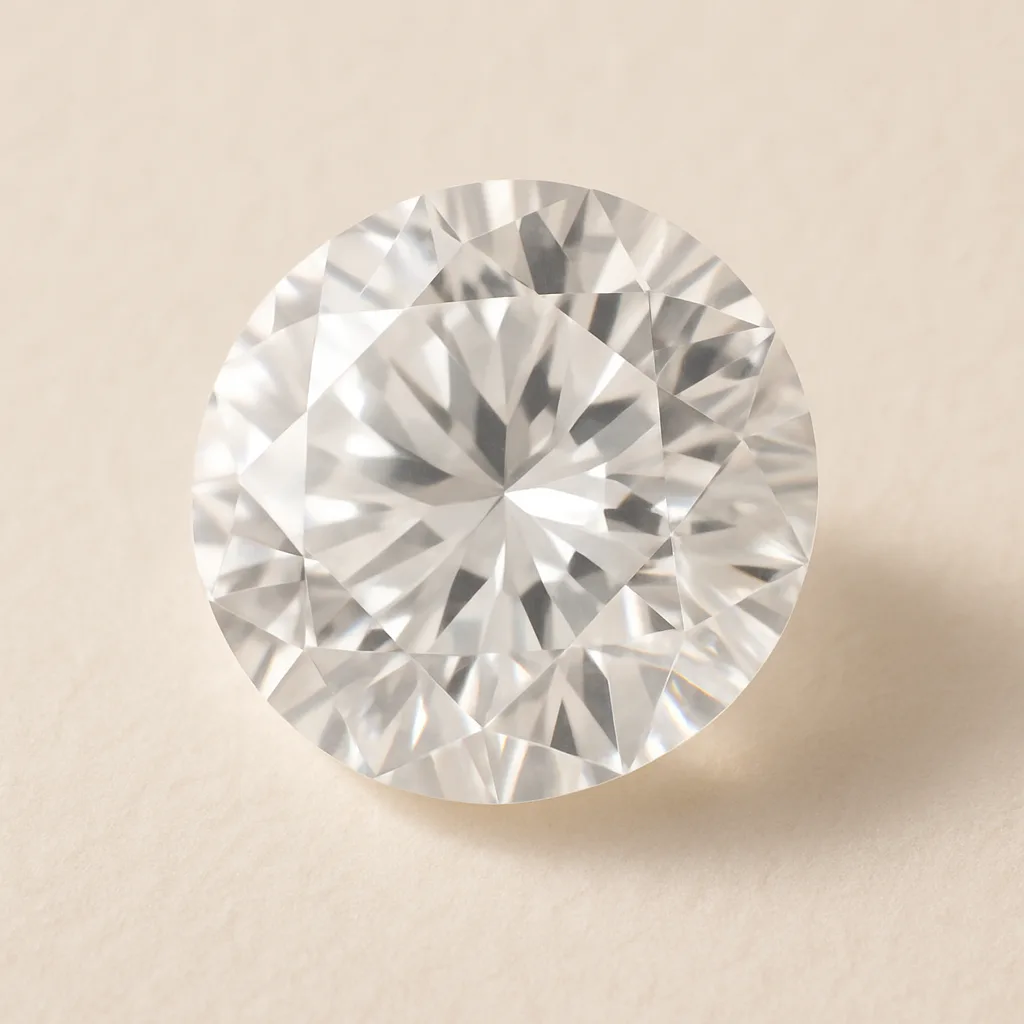
identified this stone yet
Synthetic White Sapphire
| Hardness | 9 |
| Specific gravity | 3.99-4.01 |
| Refractive index | 1.760-1.770 |
| Crystal system | 三方晶系 |
Colorless to near-colorless (D–F equivalent on a diamond color scale). Higher-purity Czochralski and Kyropoulos material is consistently water-clear; flame-fusion material can show very faint yellowish or pinkish tint in some boules.
- Curved growth striae (Verneuil) — diagnostic at 10× immersion
- Round gas bubbles, occasional and less common than in colored Verneuil
- Czochralski-pulled: interface striae and seed-crystal residue
- Otherwise water-clear in high-quality industrial material
- Doubly refractive (uniaxial negative) — identical to natural corundum
- RI 1.760–1.770, 0.008
- Vitreous to sub-adamantine luster
- 0.018 — significantly less than diamond (0.044), comparable to natural sapphire
- 01Curved growth striae diagnostic of flame-fusion Verneuil at 10× immersion
- 02Mohs 9 — distinctly harder than cubic zirconia (8.5), YAG (8.25), and most diamond simulants
- 03RI 1.760–1.770 separates from diamond (RI 2.42), moissanite (RI 2.65–2.69), cubic zirconia (RI 2.15–2.18), and quartz (RI 1.54)
- 04 0.018 — much less fire than diamond (0.044) or moissanite (0.104), a key visual marker against diamond simulant competition
- 05A thermal-conductivity probe separates from moissanite (which conducts heat like diamond) and identifies sapphire as a poor heat conductor
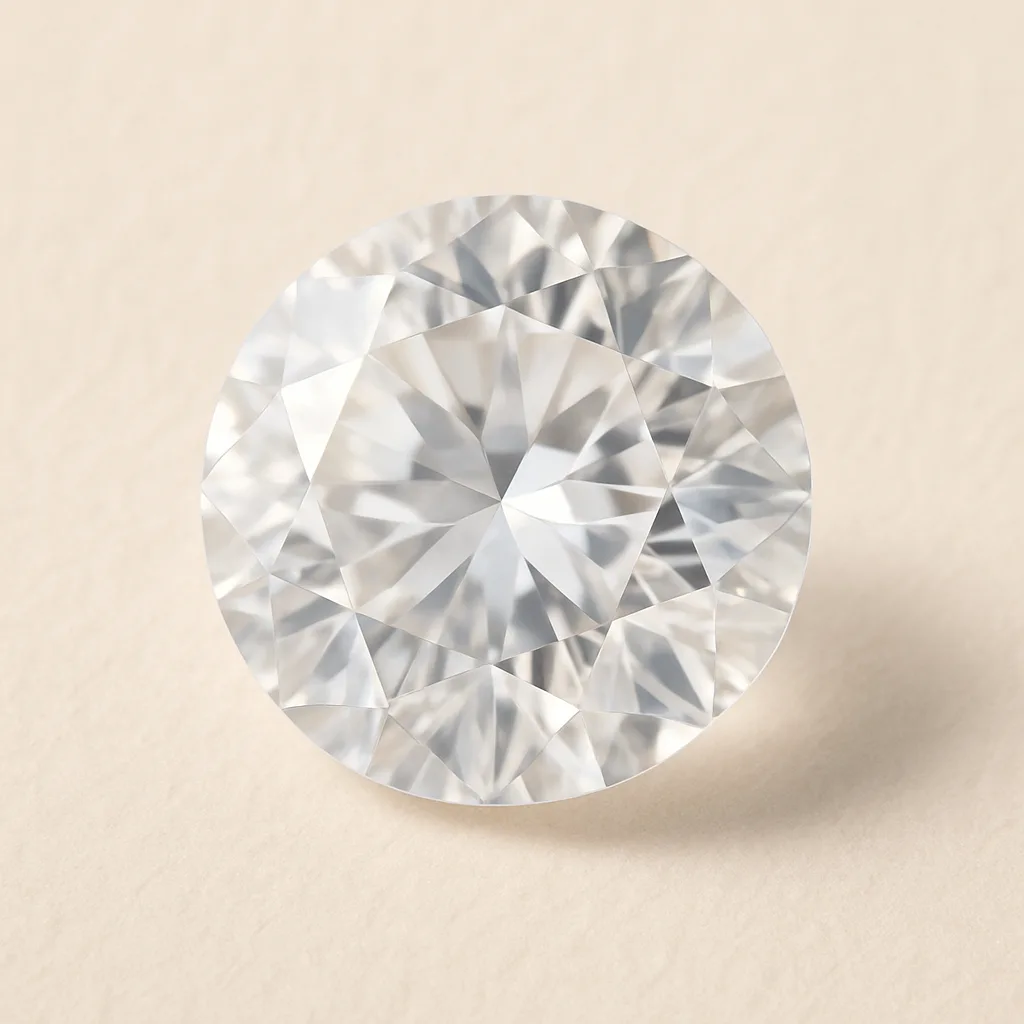
- Mohs 9 — extremely durable, excellent for everyday wear and engagement applications
- Ultrasonic and steam safe
- Stable to all standard cleaning chemicals
- No fade or color shift under light or heat
$5–$30/ct for commercial flame-fusion synthetic white sapphire in standard sizes; $30–$80/ct for premium Czochralski-pulled material with selected clarity. Genuine natural colorless sapphire above 3 ct in clean stones runs $100–$500/ct.
Note: The principal commercial use of synthetic white sapphire is industrial — watch jewels, laser substrates, LED window material, scratch-resistant optics — vastly outweighing the jewelry market in volume. Where used in jewelry, the principal selling point is the Mohs-9 durability vs. moissanite (Mohs 9.25), cubic zirconia (Mohs 8.5), and YAG (Mohs 8.25), combined with optical properties intermediate between glass and diamond in dispersion. Disclosure as 'synthetic,' 'lab-grown,' or 'created' is required under FTC, CIBJO, and JIS rules. Industrial Czochralski-pulled colorless sapphire is sometimes faceted into jewelry-grade pieces and is gemologically equivalent to flame-fusion material.
Synthetic white sapphire is pure Al₂O₃ — colorless corundum with no chromophore dopants. Mohs 9, SG 3.99–4.01, RI 1.760–1.770, 0.008. Curved growth striae are visible at 10× immersion in flame-fusion material; round gas bubbles are less common in colorless than colored Verneuil material due to higher-purity feedstock requirements. The optical properties are identical to natural colorless sapphire, but morphology and growth structure discriminate the two reliably. Czochralski-pulled and Kyropoulos-method colorless corundum (the industrial growth processes for sapphire substrates in LED and laser applications) is also gem-quality in many cuts; flame-fusion and Czochralski material together dominate the commercial market.
Origins
rystal Systems, Rubicon Technology for industrial Czochralski-pulled material), Japan (Kyocera), and China. Djeva remains the historic gem-grade Verneuil producer; industrial sapphire substrate manufacturing is concentrated in the US, Russia, Japan, and Taiwan.
History
Auguste Verneuil announced his flame-fusion process for ruby at the French Academy of Sciences in 1902 — the breakthrough that founded the entire synthetic gem industry. The colorless variant for industrial use (watch jewel bearings, instrument pivots, microscope optics) scaled commercially within five years; the Swiss watch industry's adoption was decisive in establishing Djeva (Monthey, 1914) and the Idar-Oberstein cutting community as the historic centers of Verneuil production. The 1960s development of Czochralski-pulled corundum at Bell Telephone Laboratories and at the Soviet research institutes opened industrial-scale single-crystal sapphire boules for substrate applications. The 2010s consumer adoption of sapphire watch crystals, smartphone lens covers (notably the failed Apple iPhone 6 sapphire screen project of 2013–2014, after the GT Advanced Technologies Mesa plant collapse), and camera filter glass drove industrial production to billions of carats annually — orders of magnitude above the entire colored gem trade. Modern jewelry-grade white sapphire is a tiny fraction of total Verneuil corundum production; engagement-ring marketing under brands like Brilliant Earth and James Allen has nonetheless built a small specialty market for synthetic white sapphire as a 'conflict-free diamond alternative.'
Lore & symbolism
September's birthstone (synthetic versions accepted as substitutes for natural in modern lay practice). The 5th and 45th wedding anniversary sapphire associations apply to all colors of corundum, including colorless. Modern crystal writing extends the 'wisdom,' 'purity,' and 'spiritual clarity' associations of natural white sapphire to lab-grown stones.
Tools to confirm this stone
Tools that help confirm Synthetic White Sapphire. Tap any item to jump to the matching section on the gem tools page.
- 最終確認日
- 2026年4月28日
- 参 考 文 献
- Gem Encyclopedia/ GIA (Gemological Institute of America)
- 宝石鑑別基準/ 中央宝石研究所 (CGL)
- Mineral & Gem Database/ Mindat.org / Gemdat.org
- 宝石学入門/ 全国宝石学協会
本ページの物性値(屈折率・比重・硬度・結晶系等)は、上記の権威ある一次資料を相互参照して編集しています。最新の鑑別研究の進展により値が更新される場合があります。