identified this stone yet
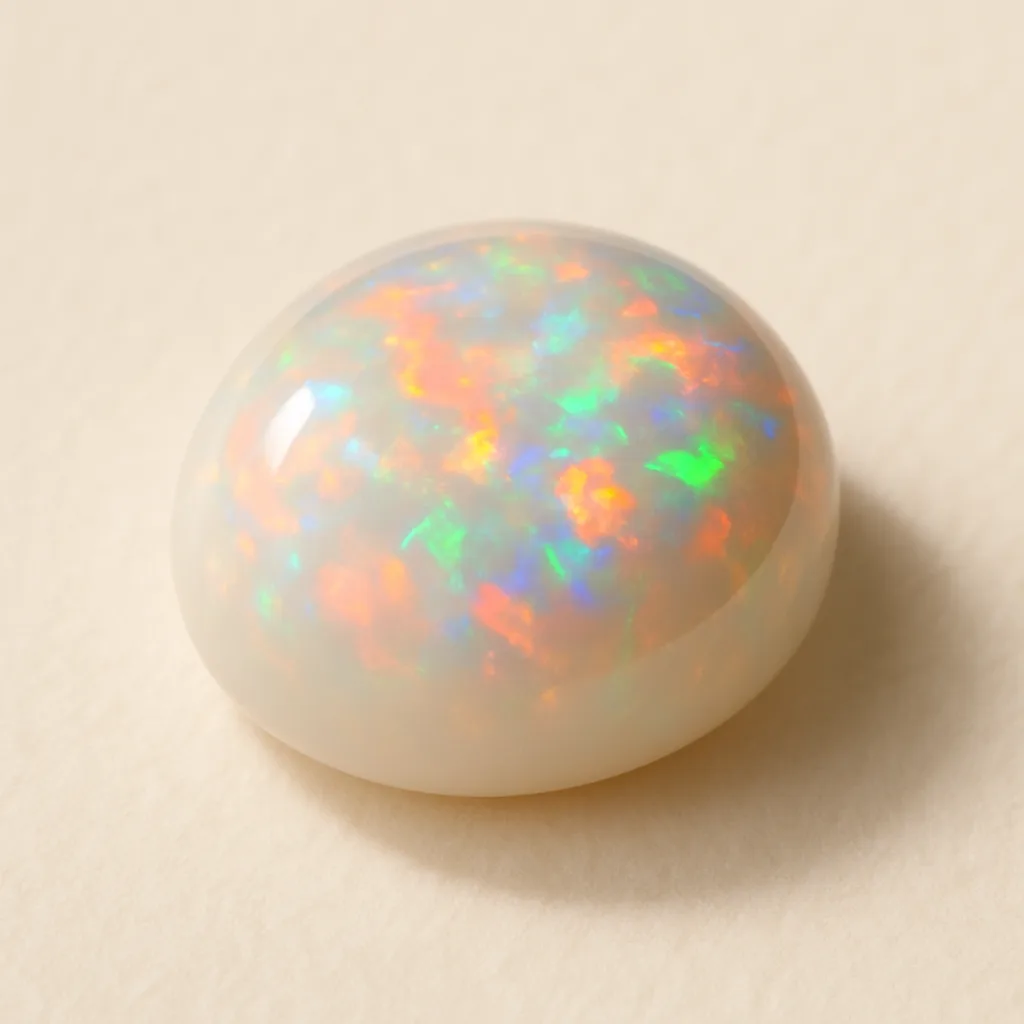
White Opal
| Hardness | 5.5-6 |
| Specific gravity | 1.98-2.20 |
| Refractive index | 1.37-1.47 |
| Crystal system | 非晶質(含水シリカ) |
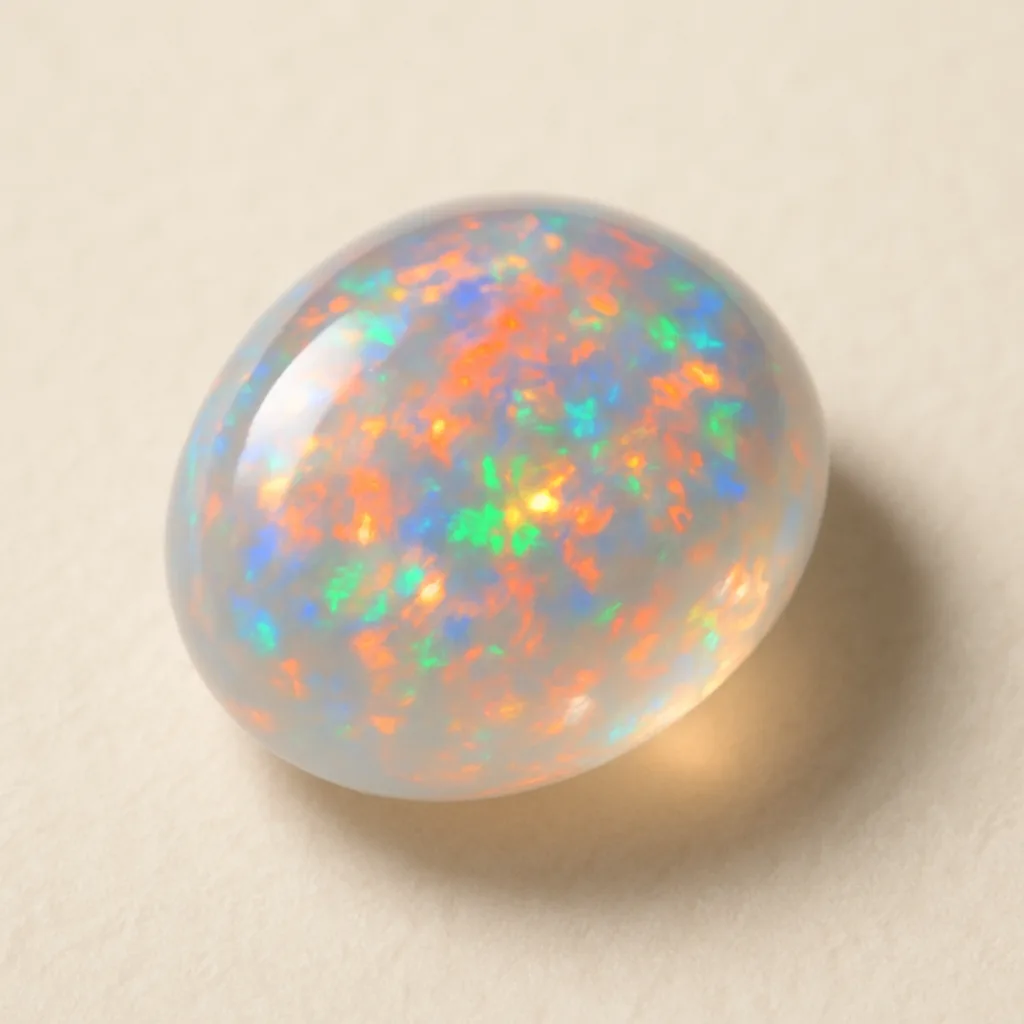
Body color from milky white through pale cream to soft gray. Play-of-color flashes in green, blue, orange, red, and violet — the rarer the red, the higher the value. Pattern types include pinfire (small dots), flash (large sheets), and harlequin (square mosaic, extremely rare).
- Internal cracks called 'crazing' — a major defect that can develop after mining if drying is uneven
- Matrix or ironstone bands at the base in Australian boulder-adjacent material
- Sandstone particles in lower-grade Coober Pedy stones
- Color zoning of play-of-color in patches
- Amorphous (no crystal structure, hence singly refractive)
- Play-of-color from diffraction by ordered silica spheres
- Vitreous to resinous luster
- No but conchoidal fracture
- 01Play-of-color in discrete patches that shift abruptly with angle confirms opal — different from moonstone's smooth sheen or labradorite's broad flashes
- 02RI 1.43–1.47 and SG 1.98–2.20 are diagnostically low
- 03Synthetic opal shows columnar 'snake skin' pattern under 10× from the side
- 04Doublet/triplet construction is visible as a straight join line at the girdle
- Mohs 5.5–6.5 — softer than common gems, easily scratched and chipped
- Never ultrasonic, steam, or harsh chemicals — opal is porous and contains structural water
- Avoid sudden temperature changes — thermal shock causes crazing
- Store with a damp cotton ball in dry climates to prevent water loss and crazing
Roughly $10–$80/ct for commercial Australian white opal with modest play, $150–$500/ct for fine Coober Pedy with bright multicolor flash, and $1,000–$5,000+/ct for exceptional red-on-white stones over 5 ct. Ethiopian Welo of fine quality runs $50–$300/ct depending on hydrophane stability.
Note: Untreated Australian opal is the gold standard. Ethiopian hydrophane opal is sometimes 'smoke-treated' or sugar/acid-treated to darken the body and intensify play-of-color; these treatments must be disclosed. Doublets (opal slice on dark backing) and triplets (with clear quartz cap) are common assembled stones — legitimate but at far lower price points. Synthetic opal (Gilson, Kyocera) shows characteristic 'lizard skin' or columnar play-of-color patterns under magnification.
Opal is hydrous silica (SiO₂·nH₂O) — a non-crystalline mineraloid composed of submicron silica spheres in a 3D lattice. Where those spheres are uniform in diameter and tightly packed, they diffract light into spectral colors — the prized play-of-color. White opal has a light-toned body (white through pale gray); contrast with black opal (dark body) and crystal opal (transparent body). Coober Pedy in South Australia is the dominant source, supplying roughly 70% of global opal production.
Origins
Coober Pedy in South Australia (mined since 1915) produces most of the world's white opal — typically milky-white bodies with green and blue dominant play, occasional red flashes. Mintabie, also in South Australia, supplied stronger color until effectively closing in 2019. Andamooka yields white opal with crystal-like translucency. Ethiopia's Welo deposit (since 2008) now competes strongly with white-bodied 'hydrophane' opal — beautiful but more porous and treatment-sensitive. Brazilian and Mexican white opals exist in smaller quantities.
History
Opal has been a treasured gem since Roman times — Pliny called it a stone 'in which the splendor of all stones is gathered into one.' The 1829 Walter Scott novel 'Anne of Geierstein' inadvertently saddled opal with a bad-luck reputation that suppressed the European market for decades. The 1875 discovery of Australian opal fields restored its fortunes; Queen Victoria's championship of opal in royal jewelry helped break the superstition.
Lore & symbolism
October's traditional and modern birthstone, and the 14th wedding anniversary gem. Symbolizes hope, purity, and creativity in modern lapidary lore. The Walter Scott bad-luck association is firmly historical, not traditional.
Tools to confirm this stone
Tools that help confirm White Opal. Tap any item to jump to the matching section on the gem tools page.
- 最終確認日
- 2026年4月28日
- 参 考 文 献
- Gem Encyclopedia/ GIA (Gemological Institute of America)
- 宝石鑑別基準/ 中央宝石研究所 (CGL)
- Mineral & Gem Database/ Mindat.org / Gemdat.org
- 宝石学入門/ 全国宝石学協会
本ページの物性値(屈折率・比重・硬度・結晶系等)は、上記の権威ある一次資料を相互参照して編集しています。最新の鑑別研究の進展により値が更新される場合があります。