identified this stone yet
Welo Opal / Ethiopian Opal
| Hardness | 5.5-6 |
| Specific gravity | 1.80-2.20 |
| Refractive index | 1.370-1.470 |
| Crystal system | 非晶質 |
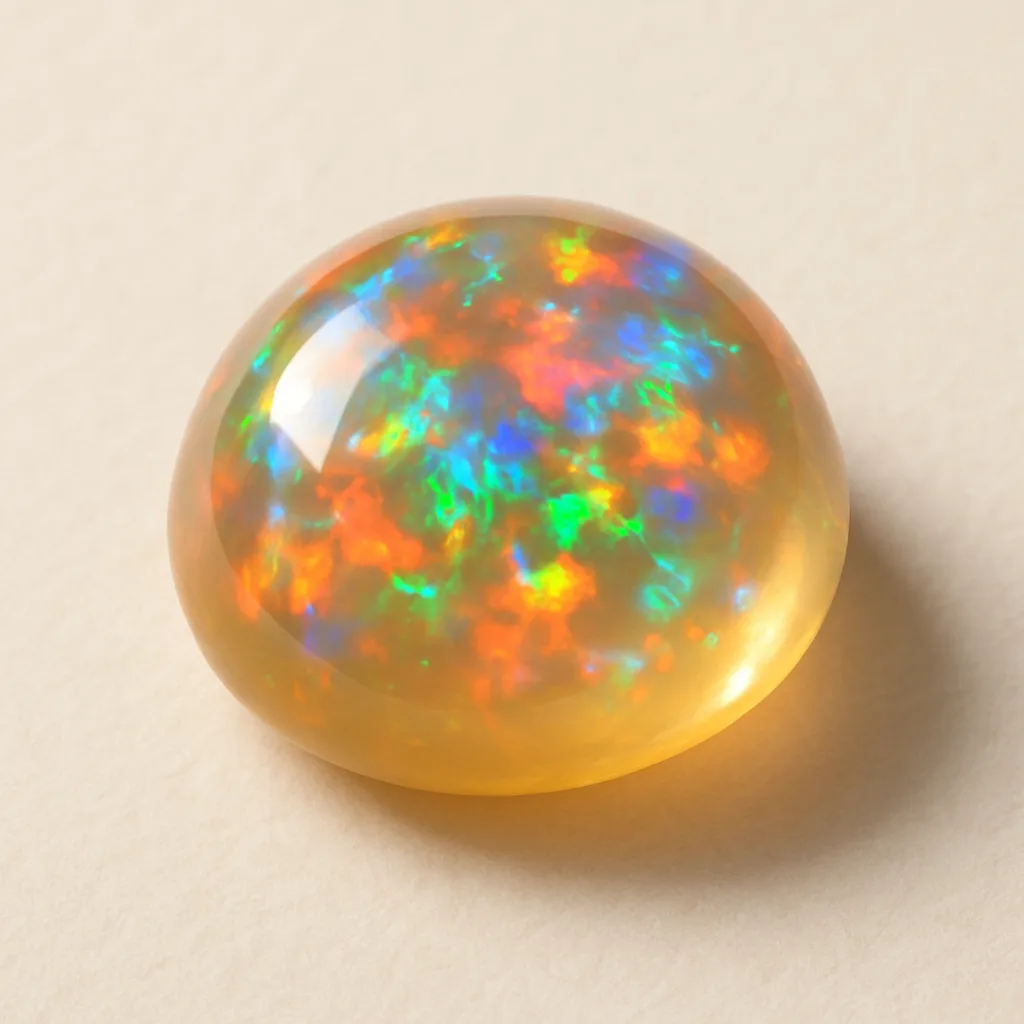
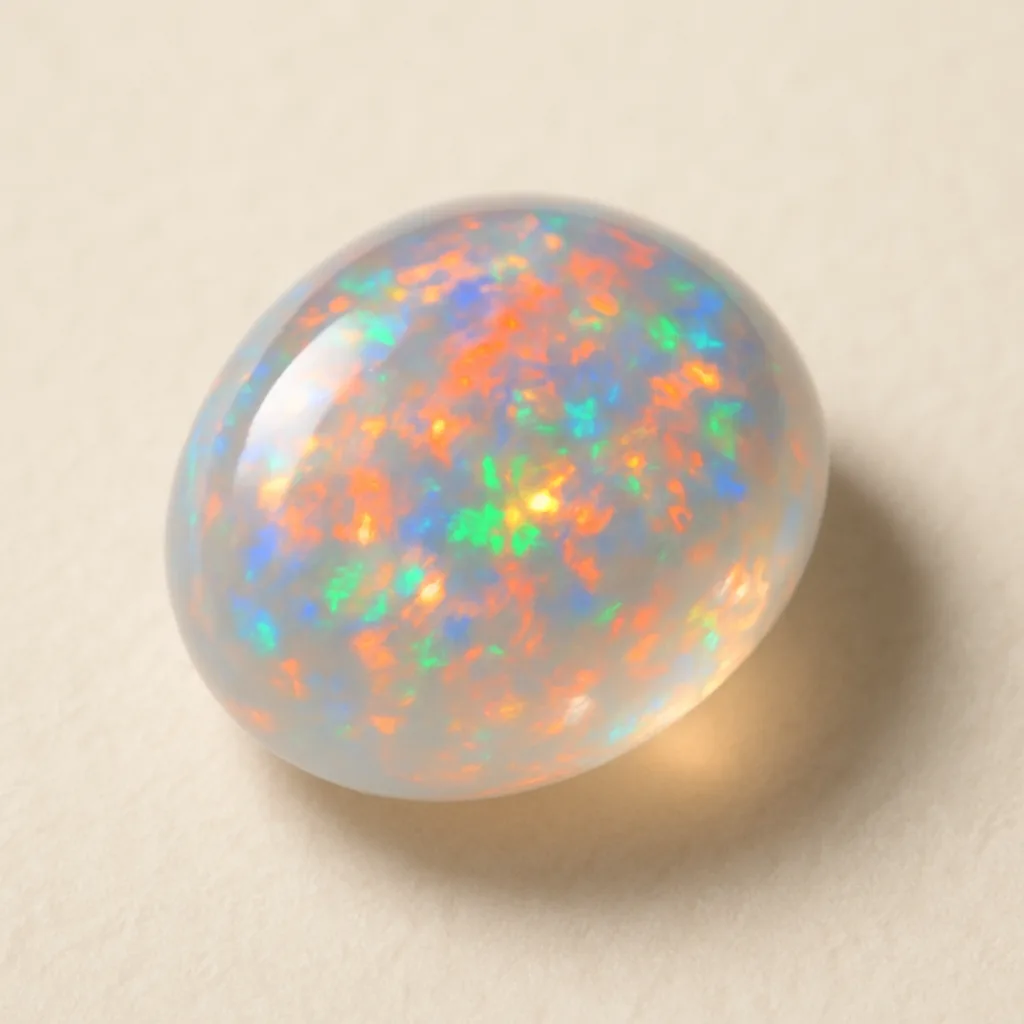
Body colors from water-clear through honey-amber, chocolate-brown, and milky white, with play-of-color spanning every spectral hue. Welo material is famous for unusually broad, bright color flashes at modest prices.
- Micro-pores responsible for hydrophane behavior
- Aligned silica spheres producing play-of-color (visible only under SEM)
- Brown iron oxide staining and dendritic patterns
- Occasional matrix relics from the ignimbrite host
- Amorphous, singly refractive
- Hydrophane — temporarily becomes more transparent in water
- Vitreous to resinous luster
- Play-of-color visible across a wide spectral range
- 01Hydrophane test — a small drop of water on an inconspicuous area should darken or temporarily clarify Welo opal within seconds; Australian opal does not respond
- 02Lower SG (~1.8–2.2) compared to Australian opal — a noticeably lighter hand-feel
- 03Distinctive long-wave UV (often yellow or green)
- 04Brown dendrites or iron oxide staining are typical of Wollo material
- Never expose to water, oils, perfumes, cosmetics, or solvents — they can permanently alter body color or cause crazing on drying
- Never use ultrasonic or steam cleaners
- Store flat in stable humidity and away from sunlight
- Wipe only with a dry soft cloth
Roughly $10–$50/ct for commercial Welo with average play-of-color, $100–$500/ct for stones above 1 ct with bright, broad flashes, and $1,000–$3,000/ct for top contraluz or fully transparent crystal Welo opal with red-dominant play. Even the highest grades remain a fraction of equivalent Australian crystal opal prices.
Note: Hydrophane behavior is the single most important disclosure for Welo opal — buyers and wearers must understand that the stone changes appearance when wet and that improper exposure (long water contact, dyes, perfumes) can cause permanent body-color staining. Some Welo material is intentionally smoke-treated or sugar-treated to mimic black opal — laboratories detect this via UV reaction and surface analysis. Untreated Wegel Tena material remains the safest buy.
Welo opal is hydrated silica (SiO₂·nH₂O) with the standard ordered silica-sphere lattice that produces play-of-color, but with an unusually porous structure that allows water to permeate the stone. This hydrophane behavior is diagnostic — immersion turns most Welo stones glassy-transparent within minutes and temporarily shifts or extinguishes play-of-color, with the original appearance returning over hours or days as the water evaporates. The discovery was made in 2008 at Wegel Tena (north Wollo), and a second deposit at Stayish was reported in 2013.
Origins
Wegel Tena village (Delanta district, North Wollo, Amhara Region) at roughly 2,700 m elevation is the primary deposit, discovered in mid-2008. The Stayish mine, also in Wollo, opened in 2013 and produces a distinctive smoky brown 'chocolate opal.' An earlier Shewa-region Ethiopian opal find from 1994 produced different, less stable material. Wollo opal is hosted in volcanic ignimbrite layers within a 5–10 million-year-old basaltic sequence.
History
Ethiopia had no documented opal trade before the 1990s. The 1994 Shewa find introduced 'Ethiopian opal' to the trade but was plagued by crazing issues. The 2008 Wegel Tena discovery produced material orders of magnitude more stable and attractive, profiled by Benjamin Rondeau and colleagues in the GIA Gems & Gemology Spring 2010 issue. Within five years Welo opal had reshaped global opal pricing, pulling Australian opal into the premium tier as it filled the affordable market.
Lore & symbolism
The October birthstone, symbolizing new beginnings, hope, and joy of life. Welo opal's relative newness has kept it out of ancient lore, but its African origin and water-responsive character have given it a distinct identity in modern crystal writing as 'the stone of renewal.' The 14th wedding anniversary gem.
Tools to confirm this stone
Tools that help confirm Welo Opal / Ethiopian Opal. Tap any item to jump to the matching section on the gem tools page.
- 最終確認日
- 2026年4月28日
- 参 考 文 献
- Gem Encyclopedia/ GIA (Gemological Institute of America)
- 宝石鑑別基準/ 中央宝石研究所 (CGL)
- Mineral & Gem Database/ Mindat.org / Gemdat.org
- 宝石学入門/ 全国宝石学協会
本ページの物性値(屈折率・比重・硬度・結晶系等)は、上記の権威ある一次資料を相互参照して編集しています。最新の鑑別研究の進展により値が更新される場合があります。