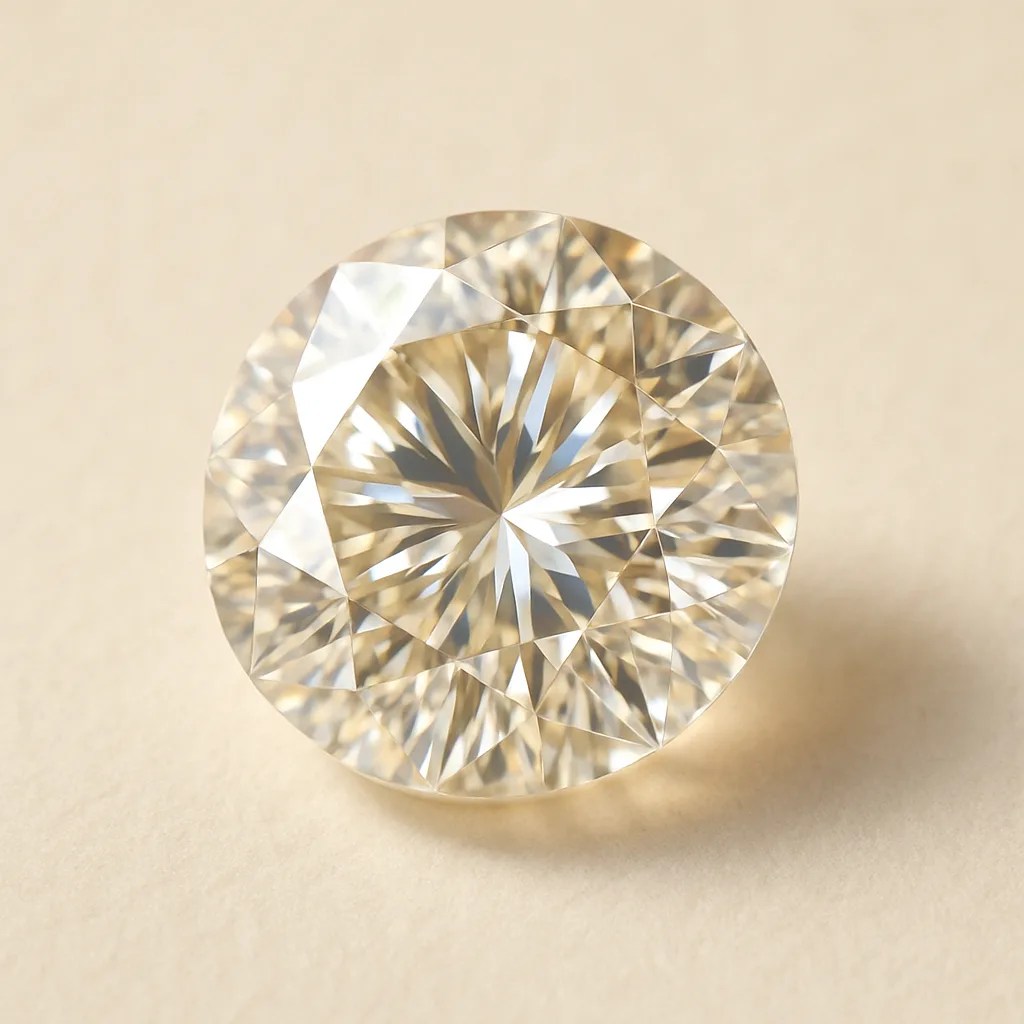
identified this stone yet
Synthetic Rutile / Titania
| Hardness | 6-6.5 |
| Specific gravity | 4.20-4.30 |
| Refractive index | 2.616-2.903 |
| Crystal system | 正方晶系 |
Pale yellow to greenish-yellow; the body color cannot be fully eliminated by the re-oxidation step. Cut stones display violent rainbow fire from the 0.280–0.330 aceted girdle or table surface reveals the underlying yellow cast. Color-treated variants in deeper yellow, blue, and red have been produced experimentally but never reached commercial scale.
- Verneuil-process and growth banding visible at 10× immersion — diagnostic of flame-fusion origin
- Residual gas bubbles spherical or elongated along growth direction
- Faint internal swirls from the reduction-oxidation processing sequence
- Tetragonal (uniaxial positive) — extreme acet visible to the naked eye
- Refractive index 2.62–2.90 — comparable to diamond (2.42) but with much wider range
- 0.280–0.330 — six-to-seven times diamond's 0.044, the highest of any commercial gemstone
- Specific gravity 4.25
- Adamantine luster
- Mohs 6.0–6.5 — much softer than diamond (10) and even softer than quartz (7)
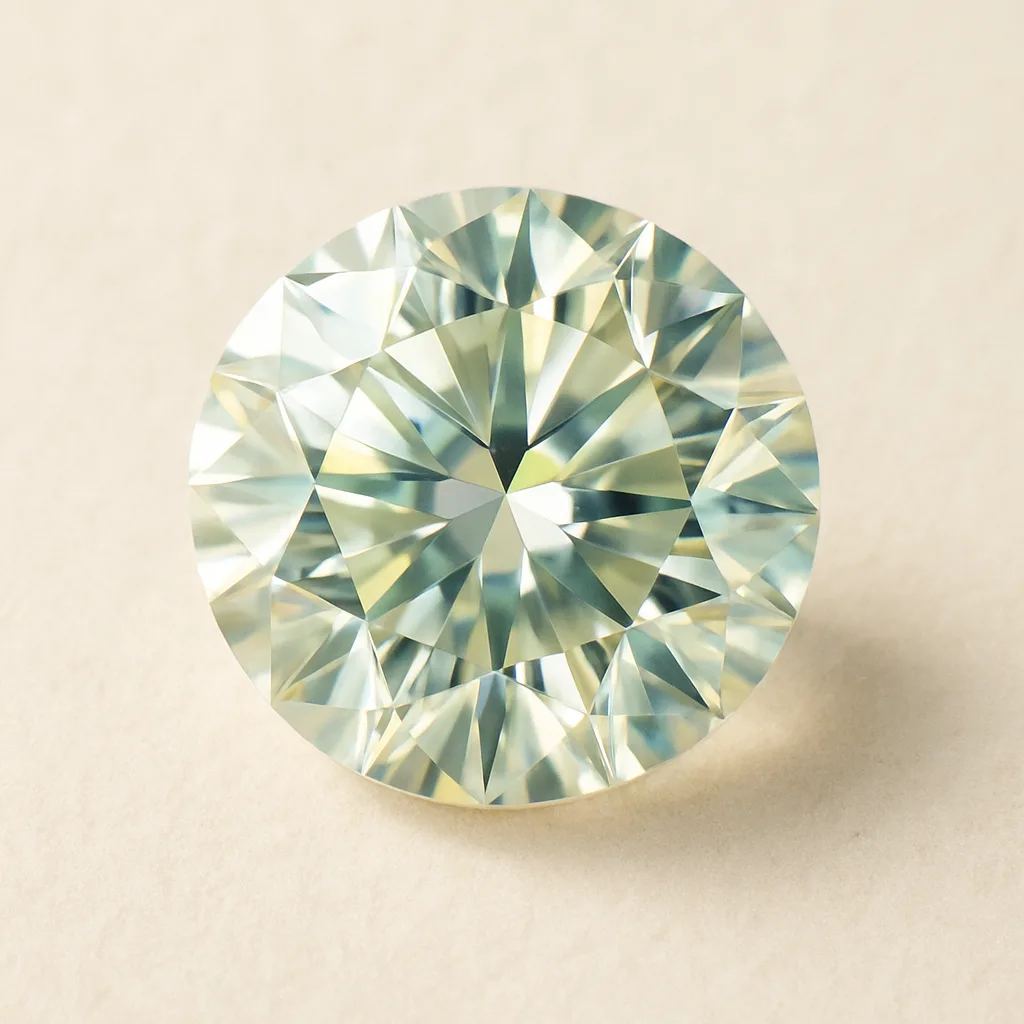
- 01Excessive, saturated rainbow fire that exceeds any other commercial gemstone — visually unmistakable to a trained gemologist within seconds
- 02acet visible to the naked eye in larger stones (>1 ct) — the textbook example of birefringent , exceeded only by ruti's natural cousin
- 03Mohs 6.5 hardness — surface scratches and edge chips accumulate visibly even in lightly-worn settings
- 04Yellow body-color tint visible at the girdle and through the table at certain angles
- 05Verneuil visible at 10× immersion confirm synthetic flame-fusion origin
- Mohs 6.5 — far too soft for ring wear; pendants and earrings are the period-appropriate settings
- Avoid ultrasonic cleaning (the body-color may shift if stones contain trapped reduction products)
- Stable to light and standard cleaning chemicals at room temperature
- Avoid heat from jeweller's torch — re-reduction of TiO₂ to dark blue-black suboxides can occur and is essentially irreversible without re-oxidation furnace treatment
Loose synthetic rutile from boutique and vintage sources trades at $50–$300 per carat for clean, well-cut faceted stones. Vintage 1950s–1960s costume-jewelry pieces in original setting trade in estate auction at $100–$1,000 depending on setting metal, designer attribution, and condition; pieces with documented Hollywood studio publicity provenance command significant premium as costume-jewelry collectibles. Mineralogical-specimen-grade boules from the original National Lead production have appeared in collector markets at $200–$2,000.
Note: Commercial supply today is essentially limited to vintage-jewelry inventory and specialist mineralogical-collector channels. Disclosure as 'synthetic rutile' or 'titania' is required under FTC Jewelry Guides and CIBJO Blue Book where the material is sold. Buyers should be aware that the soft Mohs 6.5 hardness makes synthetic rutile unsuitable for ring use; period-correct settings are typically pendants, brooches, or earrings where the wear environment is gentler. Estate auctions occasionally surface 1950s–1960s synthetic-rutile pieces as documentary mid-century costume jewelry; values reflect the period and setting more than the stone itself. The material also has a small presence in mineral-collector circles as a beautiful demonstration specimen of high-dispersion gem optics.
Synthetic rutile is TiO₂ in its tetragonal rutile structure — the high-temperature stable polymorph of titanium dioxide, also occurring naturally as the dark-red mineral rutile in metamorphic rocks. Synthetic gem-quality material is grown by the Verneuil flame-fusion method modified for the unusual chemistry of TiO₂: the powder is first reduced to suboxides (Ti₂O₃ and Ti₃O₅) during melting in the hydrogen-oxygen flame, producing dark blue-black 'boules' that are then re-oxidized in a furnace at 1000 °C to convert the suboxides back to TiO₂ and yield the final near-colorless or pale-yellow gem material. Mohs 6.0–6.5 (much softer than diamond's 10), SG 4.25, RI 2.62–2.90 (uniaxial positive, 0.287 — among the highest of any gemstone), 0.280–0.330 depending on measurement protocol. The pale-yellow body color characteristic of synthetic rutile arises from residual Ti³⁺ centers that the re-oxidation step does not fully eliminate; this body color is the principal visual reason synthetic rutile failed as a colorless-diamond substitute despite its otherwise spectacular optical properties.
Origins
The 1948 commercial breakthrough at Linde Air Products Division of Union Carbide Corporation (then in Tonawanda, New York) was led by N. C. Hibma and S. Tarnopol, who modified Auguste Verneuil's 1902 flame-fusion apparatus to handle TiO₂'s unusual reduction-oxidation requirements. National Lead Company's TAM Ceramics division (Niagara Falls, New York) entered commercial production in the early 1950s under the trade name Titania. Schwartz Aluminum Castings and the Swiss firm Djevahirdjian (Monthey) added European production. Mid-century commercial supply was concentrated in the United States, Switzerland, and West Germany; some Indian and Thai production continued into the 1970s on a small scale. Production largely ceased commercially by the late 1970s as CZ took over the diamond-substitute market. Modern boutique production for vintage-jewelry restoration and mineralogical-collector demand continues at very low volume.
History
Auguste Verneuil's 1902 flame-fusion apparatus, developed in Paris and demonstrated to the French Academy of Sciences for synthetic ruby and sapphire production, established the technological baseline that Hibma and Tarnopol modified for TiO₂ in 1948. The post-WWII boom in synthetic gemstone development saw substantial industrial-research investment in diamond substitutes — Linde Air Products under Union Carbide had previously pioneered Verneuil synthetic ruby and the celebrated Linde Star Sapphire (1947 commercial debut). Synthetic rutile entered the market in 1948 with promotional language focused on its 'unbelievable rainbow fire' (genuinely true: the 0.280 acets and excessive yellow-tinted rainbow fire.
Lore & symbolism
Not assigned to any traditional birthstone list (synthetic, mid-twentieth-century origin, never widely circulated long enough to develop folkloric associations). Modern crystal-writing essentially ignores synthetic rutile given its commercial obsolescence; the marketing of the 1950s emphasized scientific modernity, technological progress, and 'rainbow brilliance' rather than spiritual or symbolic meanings. Vintage-jewelry collectors today value synthetic rutile pieces specifically as documentary artifacts of the post-WWII costume-jewelry trade rather than for any folkloric or spiritual significance.
Tools to confirm this stone
Tools that help confirm Synthetic Rutile / Titania. Tap any item to jump to the matching section on the gem tools page.
- 最終確認日
- 2026年4月28日
- 参 考 文 献
- Gem Encyclopedia/ GIA (Gemological Institute of America)
- 宝石鑑別基準/ 中央宝石研究所 (CGL)
- Mineral & Gem Database/ Mindat.org / Gemdat.org
- 宝石学入門/ 全国宝石学協会
本ページの物性値(屈折率・比重・硬度・結晶系等)は、上記の権威ある一次資料を相互参照して編集しています。最新の鑑別研究の進展により値が更新される場合があります。