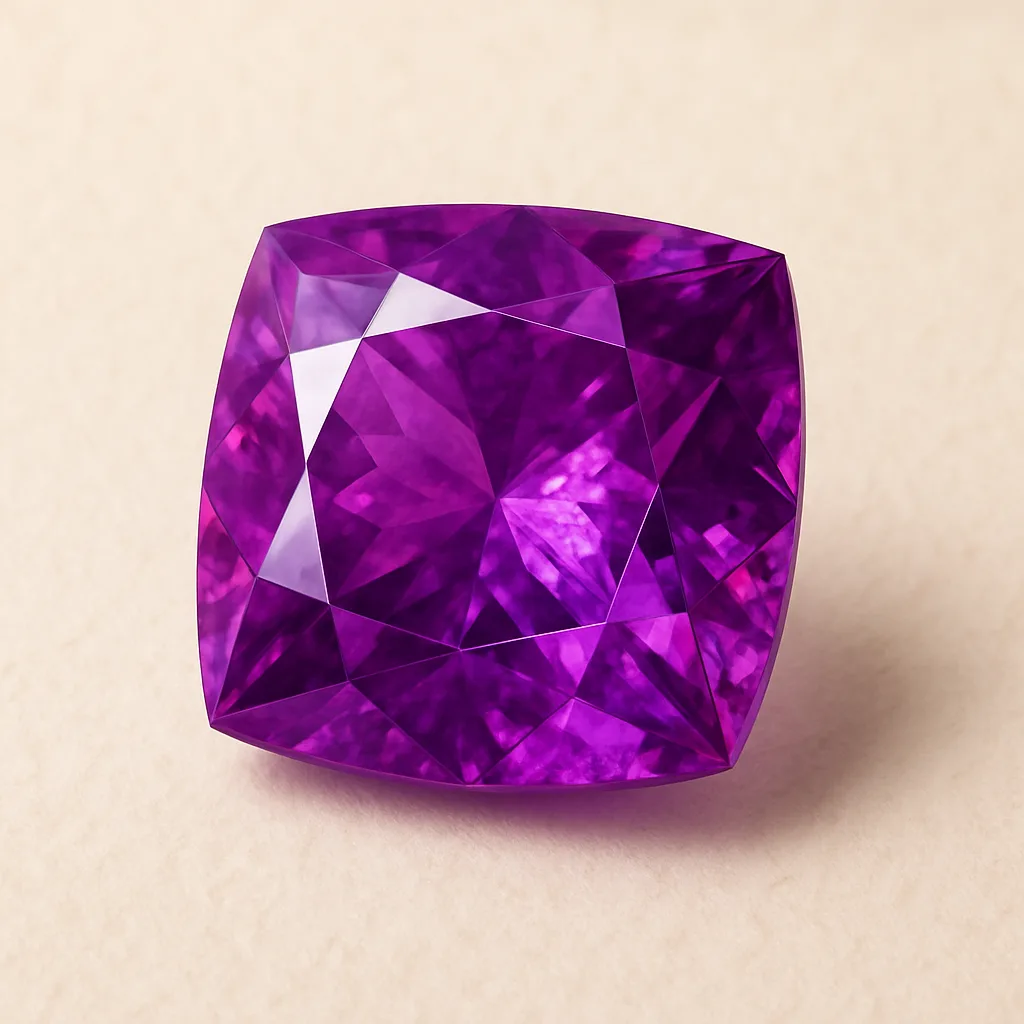
identified this stone yet
Sugilite
| Hardness | 6-6.5 |
| Specific gravity | 2.74-2.79 |
| Refractive index | 1.607-1.610 |
| Crystal system | 六方晶系 |
Reddish purple, deep grape-purple, and lavender. The most valuable grade — 'gel sugilite' — is translucent and shows an even, saturated magenta-purple.
- Black manganese-oxide veining and dendrites
- White quartz seams along the host-rock contact
- Microscopic granular structure visible at 10× in translucent material
- Opaque to translucent
- Uniaxial negative
- Refractive index 1.607–1.610
- Specific gravity 2.75–2.80
- 01Uniform saturated reddish-purple — no banding, no fibers
- 02Massive, sugary microcrystalline structure rather than the fibrous appearance of charoite
- 03Mohs 6–6.5 — resists a fingernail but yields to a steel blade
- 04Refractometer reading near 1.61
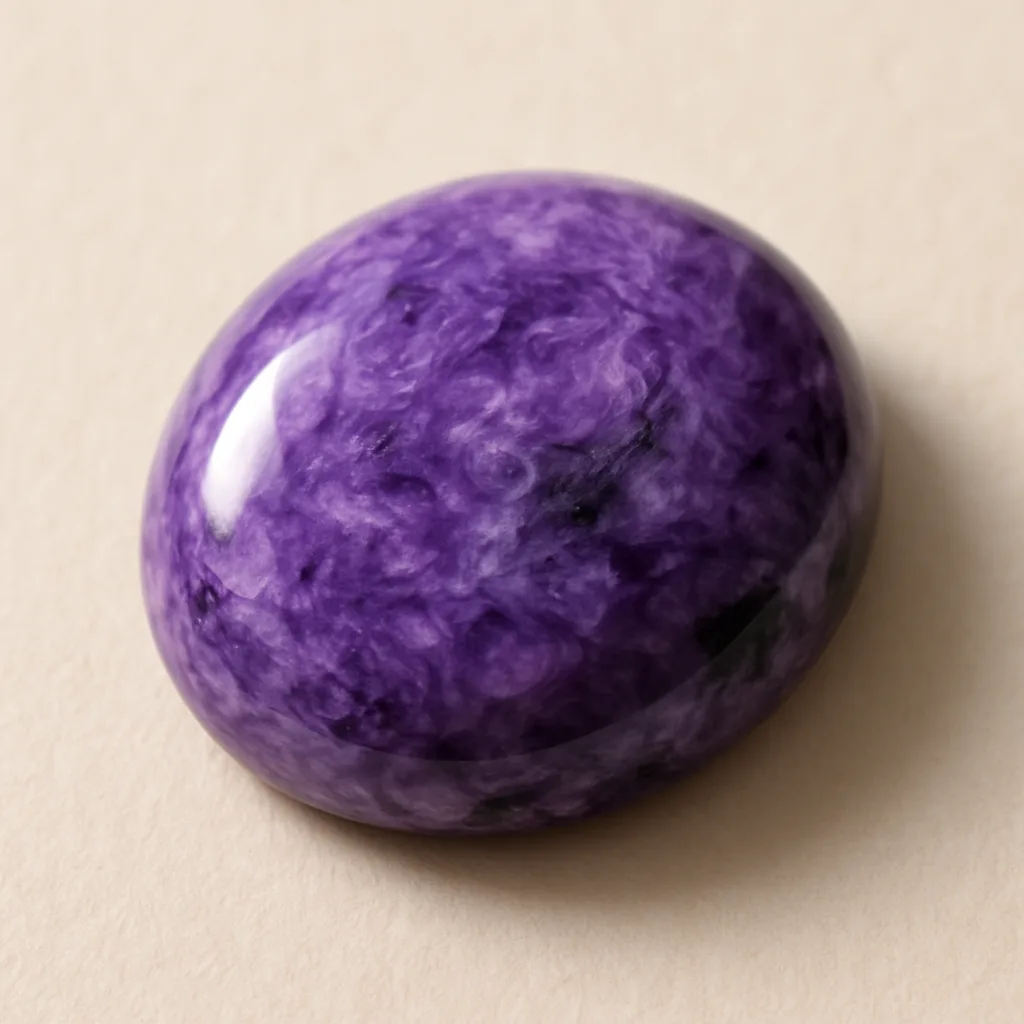
- Mohs 6–6.5 — durable enough for most jewelry uses
- Ultrasonic cleaning is generally safe for solid, unfractured material
- Protect from sharp impacts — is poor but the stone is brittle
From a few thousand yen per piece for opaque cabochons to several hundred thousand yen per carat for top-quality translucent gel sugilite.
Note: Almost all gem-grade sugilite on the market comes from the Wessels Mine; mine production has been intermittent, and prices have risen sharply since the early 2010s. Translucent 'gel' material commands a strong premium over the more common opaque grade. Dyed chalcedony and resin imitations exist but are easily distinguished by density and refractometer reading.
Sugilite is a complex potassium-sodium-lithium cyclosilicate — KNa₂(Fe,Mn,Al)₂Li₃Si₁₂O₃₀ — that owes its violet-to-magenta color to manganese in the trivalent state. The world's only commercial source of gem-grade material is the Wessels manganese mine in the Northern Cape Province of South Africa, where translucent 'gel sugilite' is recovered in thin seams within a manganese host rock. Tiffany & Co. introduced the South African material to the Western market in the early 1980s under the trade names 'Royal Azel' and 'Royal Lavulite,' positioning it as a premium designer stone.
Origins
aceting or material.
History
The Japanese petrologist Ken-ichi Sugi found the original specimens on Iwagi Island in 1944, but the mineral was not formally described until 1976, by Murakami, Bunno, and others, who named it sugilite in his honor. The decisive moment came in 1979 when the South African Wessels Mine, then producing manganese ore, hit a rich lens of translucent purple sugilite. Tiffany & Co. acquired and marketed the material in the 1980s as 'Royal Azel' and 'Royal Lavulite,' and the stone became a fixture of late-twentieth-century power-crystal and metaphysical markets, where it is sometimes called 'luvulite' or 'wesselite.'
Lore & symbolism
No official birthstone designation. Often called the 'healer's stone' in metaphysical literature for its association with spiritual awakening and emotional balance. Its deep grape-purple is read in both Eastern and Western traditions as the color of contemplation, intuition, and the crown chakra.
Tools to confirm this stone
Tools that help confirm Sugilite. Tap any item to jump to the matching section on the gem tools page.
- 最終確認日
- 2026年4月28日
- 参 考 文 献
- Gem Encyclopedia/ GIA (Gemological Institute of America)
- 宝石鑑別基準/ 中央宝石研究所 (CGL)
- Mineral & Gem Database/ Mindat.org / Gemdat.org
- 宝石学入門/ 全国宝石学協会
本ページの物性値(屈折率・比重・硬度・結晶系等)は、上記の権威ある一次資料を相互参照して編集しています。最新の鑑別研究の進展により値が更新される場合があります。