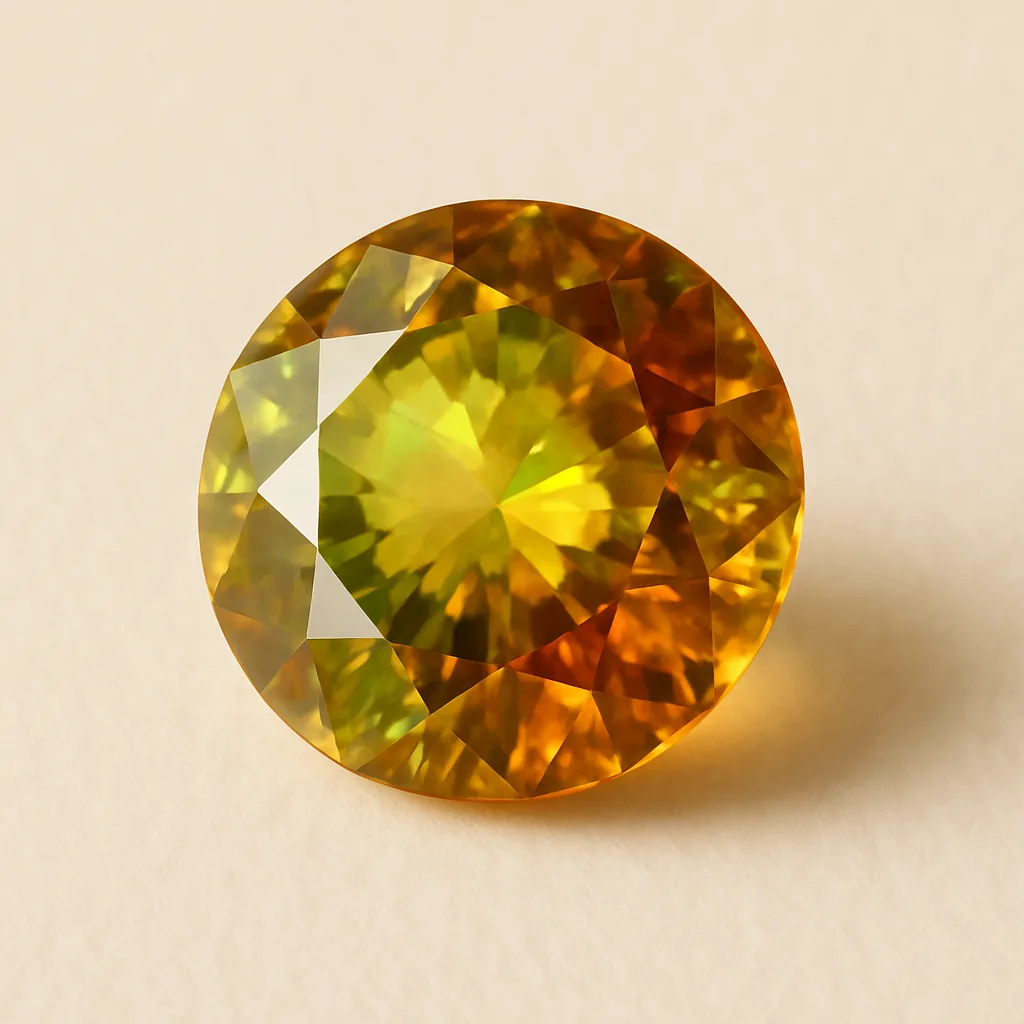
identified this stone yet
Sphene / Titanite
| Hardness | 5-5.5 |
| Specific gravity | 3.48-3.60 |
| Refractive index | 1.843-2.110 |
| Crystal system | 単斜晶系 |
Yellow, green, brown, and orange, often with strong trichroism showing two or three of these colors in a single stone.
- nclusions
- nclusions
- nclusions
- Biaxial positive
- Very strong visible at 10× from edges
- 0.105–0.135 — exceptionally high
- 0.051 — exceeds diamond (0.044)
- 01Rainbow fire ( 0.051) exceeds diamond's 0.044
- 02Visible acet edges at 10× — diagnostic
- 03Strong trichroism showing yellow, green, and orange/brown in different directions
- 04acets
- Mohs 5 — too soft for ring use; reserve for earrings, pendants, and brooches
- Avoid ultrasonic and steam cleaning — use only warm soapy water with a soft brush
- Two directions of distinct make sharp blows dangerous
From a few thousand yen for small clean stones up to several tens of thousands of yen per carat for top-color chrome-rich greens above 5 ct.
Note: Madagascar and Pakistan supply most of today's gem market. The chrome-rich green Pakistani material from the Skardu region commands a premium and is sometimes called 'Sphene of Skardu' or 'Pakistani chrome sphene' in lapidary catalogs. Heat treatment to deepen color is occasionally encountered.
Sphene is calcium titanium silicate, CaTiSiO₅, named in 1795 by the German mineralogist Abraham Gottlob Werner from the Greek sphēn ('wedge') for its sharply wedge-shaped crystals. The International Mineralogical Association officially renamed it titanite in 1982, but the gem trade has kept 'sphene' for cut stones. Optically, sphene is extreme on every axis: refractive index 1.84–2.11, 0.051 (the highest of any common gem), and 0.105–0.135 — strong enough that doubled edges are easily visible at 10×.
Origins
The Itrafotsy deposit in Madagascar is currently the leading gem source, producing the bright yellow-green material that defines the modern market. Skardu and the Baltistan region of northern Pakistan supply most of the deeper green and chrome-rich material. Capelinha and Conquista in Brazil's Minas Gerais state, the Sludyanka district near Lake Baikal in Russia, the Renfrew County deposits in Ontario, and the Salzburg region of Austria (the type locality, where Werner first described the species) round out the sources. Switzerland's Tavetsch valley is famous for collector-grade twinned crystals.
History
Werner described sphene in 1795 from Austrian Alpine specimens, naming it for its wedge-shaped crystal habit. For most of the 19th and 20th centuries it remained a mineralogical curiosity — too soft for setting in rings, too rare to support a market. The discovery of the Madagascar and Pakistani gem deposits in the late 1980s and 1990s transformed it into a small but vigorous collector market, where it is sometimes nicknamed the 'hidden fire king' for its ability to throw rainbow flashes that exceed those of diamond.
Lore & symbolism
No traditional birthstone designation. Within modern lapidary and collector culture, sphene is associated with creativity, inspiration, and the rainbow — a stone for artists and writers because of the spectral flash it produces in even the smallest movement.
Tools to confirm this stone
Tools that help confirm Sphene / Titanite. Tap any item to jump to the matching section on the gem tools page.
- 最終確認日
- 2026年4月28日
- 参 考 文 献
- Gem Encyclopedia/ GIA (Gemological Institute of America)
- 宝石鑑別基準/ 中央宝石研究所 (CGL)
- Mineral & Gem Database/ Mindat.org / Gemdat.org
- 宝石学入門/ 全国宝石学協会
本ページの物性値(屈折率・比重・硬度・結晶系等)は、上記の権威ある一次資料を相互参照して編集しています。最新の鑑別研究の進展により値が更新される場合があります。