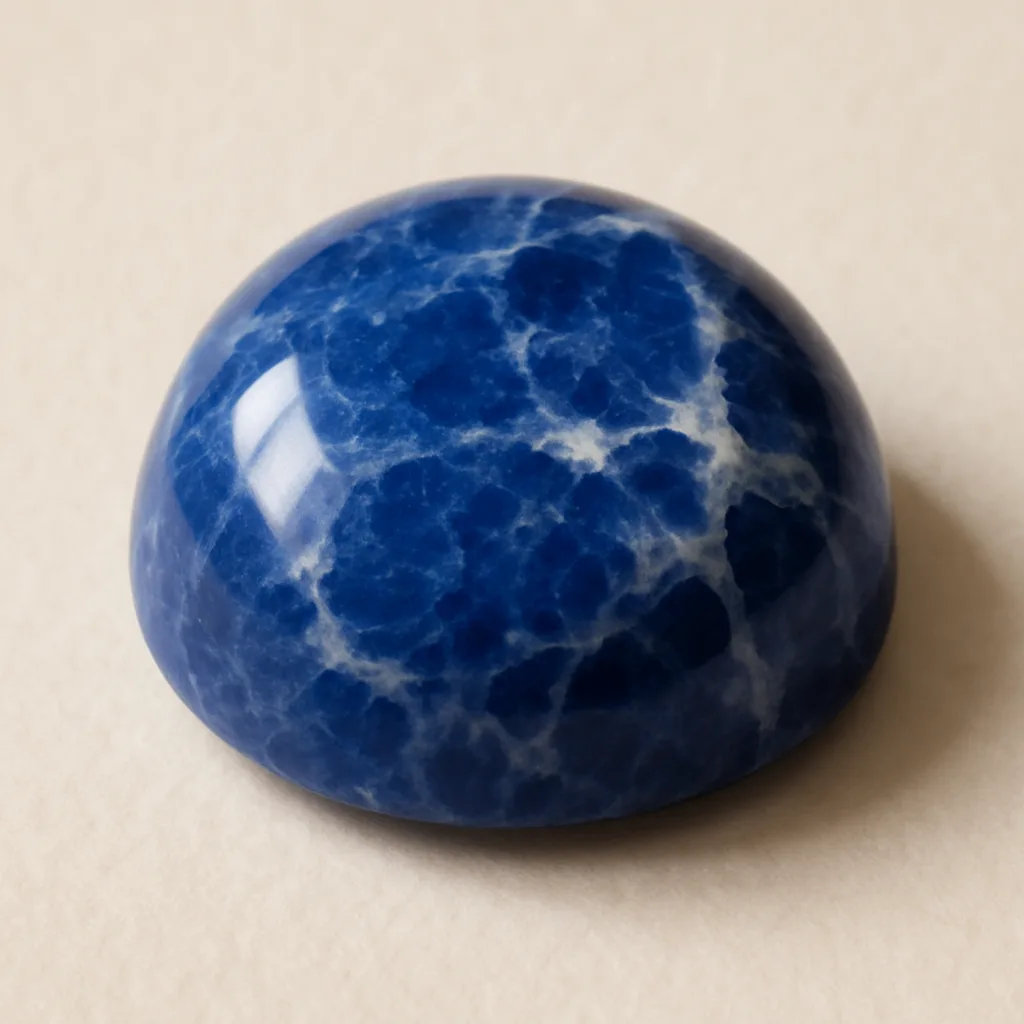
identified this stone yet
Sodalite
| Hardness | 5.5-6 |
| Specific gravity | 2.28 |
| Refractive index | 1.483 |
| Crystal system | 等軸晶系 |
Deep royal blue, violet-blue, and sometimes grey-blue, traversed by white calcite veins. The finest material is a pure intense blue with minimal white veining; lower grades show heavy white matrix.
- White calcite veins and patches — the characteristic visual signature
- nclusions of pyroxene or amphibole
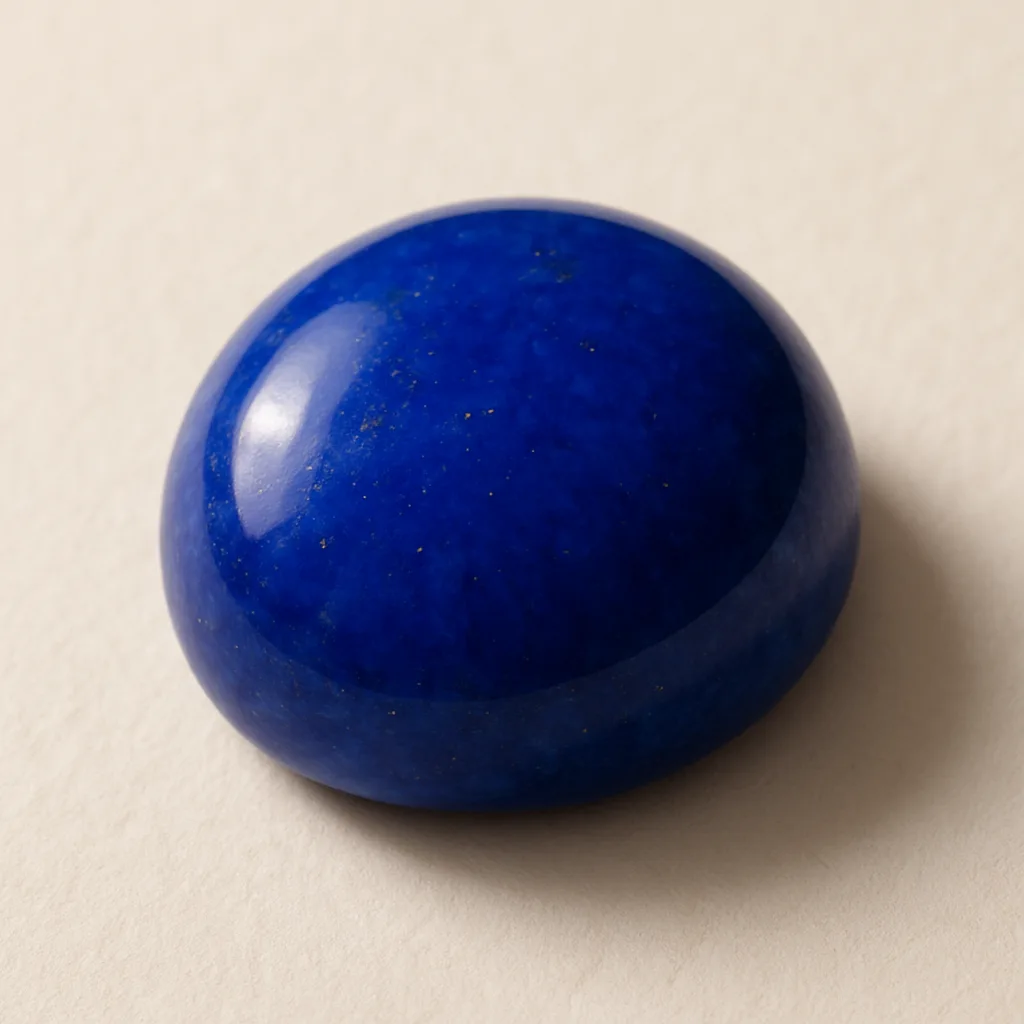
- Absence of pyrite specks (distinguishing from lapis lazuli)
- Singly refractive (cubic)
- Refractive index 1.483
- Specific gravity 2.27–2.33
- Opaque; vitreous to greasy luster on polished surfaces
- 01Royal-blue color with white calcite veins and no pyrite — the at-sight separation from lapis lazuli
- 02Specific gravity 2.27–2.33 — markedly lower than lapis lazuli (2.7–2.9), which feels noticeably heavier in the hand
- 03Refractive index 1.483 — measurable on polished surfaces if smooth enough for the refractometer
- 04Orange under UV in many specimens — diagnostic when present (lapis lazuli typically inert)
- Mohs 5.5–6 — softer than lapis; protect from impact and abrasion in mounted jewelry
- Avoid ultrasonic and steam cleaning — calcite veins are vulnerable to thermal shock and vibration
- Sensitive to acids — avoid jewelry cleaners containing citric acid or vinegar
Several hundred yen per carat for commercial Canadian or Brazilian material up to ¥2,000–3,000/ct for fine deep-blue stones with minimal white veining. As a decorative material (tiles, beads, carvings), priced by weight or piece rather than per carat.
Note: No treatments are commonly applied — sodalite is sold in its natural state. The chief market discriminator is sodalite versus lapis lazuli; the two are sometimes substituted by unscrupulous dealers, but the absence of pyrite specks and the brighter, more 'electric' blue of sodalite (compared to the darker, more textured blue of lapis) usually identify it at sight. Density also separates them: sodalite SG 2.27–2.33, lapis SG 2.7–2.9.
nclusions that mark lapis lazuli. Mohs 5.5–6, SG 2.27–2.33, RI 1.483. Workability and color make it a popular semi-precious carving and inlay stone.
Origins
Greenland (the Ilimaussaq alkaline complex, southwest coast) is the type locality and continues to produce specimens of mineralogical importance. Canada (the Princess Sodalite Mine, Bancroft, Ontario) is the dominant commercial source, in continuous production since 1891. Brazil (Bahia), Namibia, Bolivia, Russia (the Kola Peninsula), and Maine in the United States contribute additional production. Ontario material is the standard for jewelry and decorative use; Greenlandic material is collector-only.
History
Sodalite was first described scientifically in 1811 by the Scottish chemist Thomas Thomson from Greenlandic specimens collected at Ilimaussaq, and named for its sodium content — natrium → soda → sodalite. For most of the 19th century it remained a rare mineralogical curiosity. In 1891, during a royal tour of Canada, Princess Louise of Wales — wife of the Duke of Connaught and Governor General — visited the Bancroft mining district, was given a sodalite specimen, and ordered substantial quantities for the redecoration of Marlborough House in London. The 'Princess Sodalite Mine' name dates from that royal patronage, and the resulting commercial supply opened the stone to the global decorative and jewelry trade.
Lore & symbolism
Without medieval European lore — the species was identified too late for the lapidary tradition — sodalite has acquired its symbolism entirely in the 20th-century New Age and 'power stone' movements. Modern marketing associates the stone with rational thought, intuition, and 'the third eye,' often pairing it with lapis lazuli in chakra-stone sets. The 1990s Japanese 'power stone' boom established sodalite as 'the stone of intuition' (直感の石) in domestic retail.
Tools to confirm this stone
Tools that help confirm Sodalite. Tap any item to jump to the matching section on the gem tools page.
- 最終確認日
- 2026年4月28日
- 参 考 文 献
- Gem Encyclopedia/ GIA (Gemological Institute of America)
- 宝石鑑別基準/ 中央宝石研究所 (CGL)
- Mineral & Gem Database/ Mindat.org / Gemdat.org
- 宝石学入門/ 全国宝石学協会
本ページの物性値(屈折率・比重・硬度・結晶系等)は、上記の権威ある一次資料を相互参照して編集しています。最新の鑑別研究の進展により値が更新される場合があります。