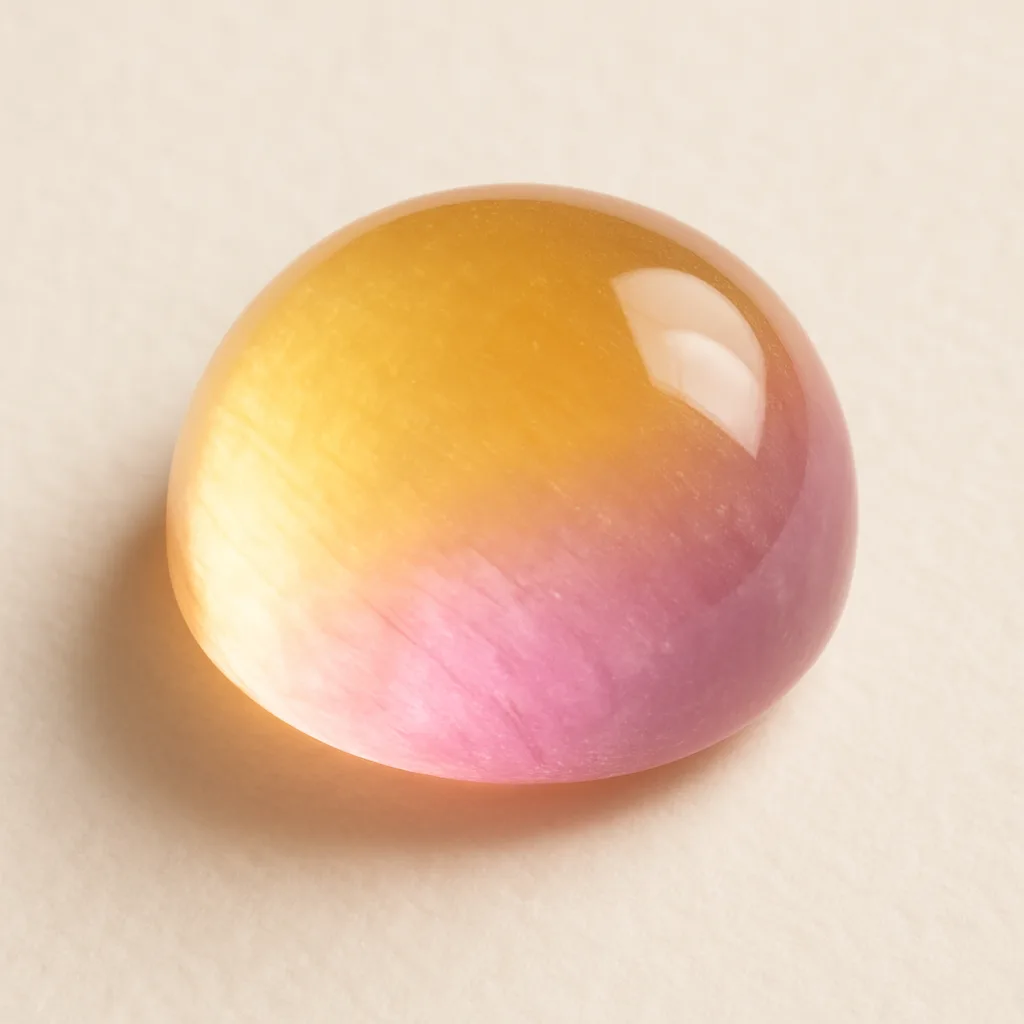
identified this stone yet
Scapolite
| Hardness | 5.5-6 |
| Specific gravity | 2.50-2.78 |
| Refractive index | 1.540-1.579 |
| Crystal system | 正方晶系 |
Pale to medium yellow (the most commercial color), colorless, pink, violet, orange, occasionally green. Cat's-eye varieties show a sharp single chatoyant band on a yellow, pink, or violet body color. Tenebrescent Greenland material reversibly darkens to violet under UV or sunlight.
- abochons
- nclusions in transparent crystals
- nclusions of apatite, calcite, or pyrite in pegmatite-derived material
- Healing fractures and 'fingerprint' fluid features
- Doubly refractive, uniaxial negative
- Refractive index 1.54–1.58 (varies with Na/Ca composition)
- 0.004–0.037 (the upper range produces visible at 10×)
- Specific gravity 2.55–2.74 (varies with composition)
- Strong dichroism in colored material: yellow shows greenish-yellow and orange-yellow; pink shows pinkish-purple and pale pink
- 01Refractive index 1.54–1.58 — separates scapolite from citrine (1.54–1.55, but no on a refractometer reading), yellow beryl (1.57–1.60), and yellow topaz (1.62–1.64)
- 02Specific gravity 2.55–2.74 — lighter than topaz (3.49–3.57) and chrysoberyl (3.68–3.78), distinctively heavier than citrine (2.65)
- 03Tenebrescent color change under UV (Greenland material only) — diagnostic for that specific origin
- 04nclusions oriented along the c-axis — sharp single band on material
- 05Two directions at 90° (often visible as parting on rough crystals) — diagnostic for the tetragonal habit
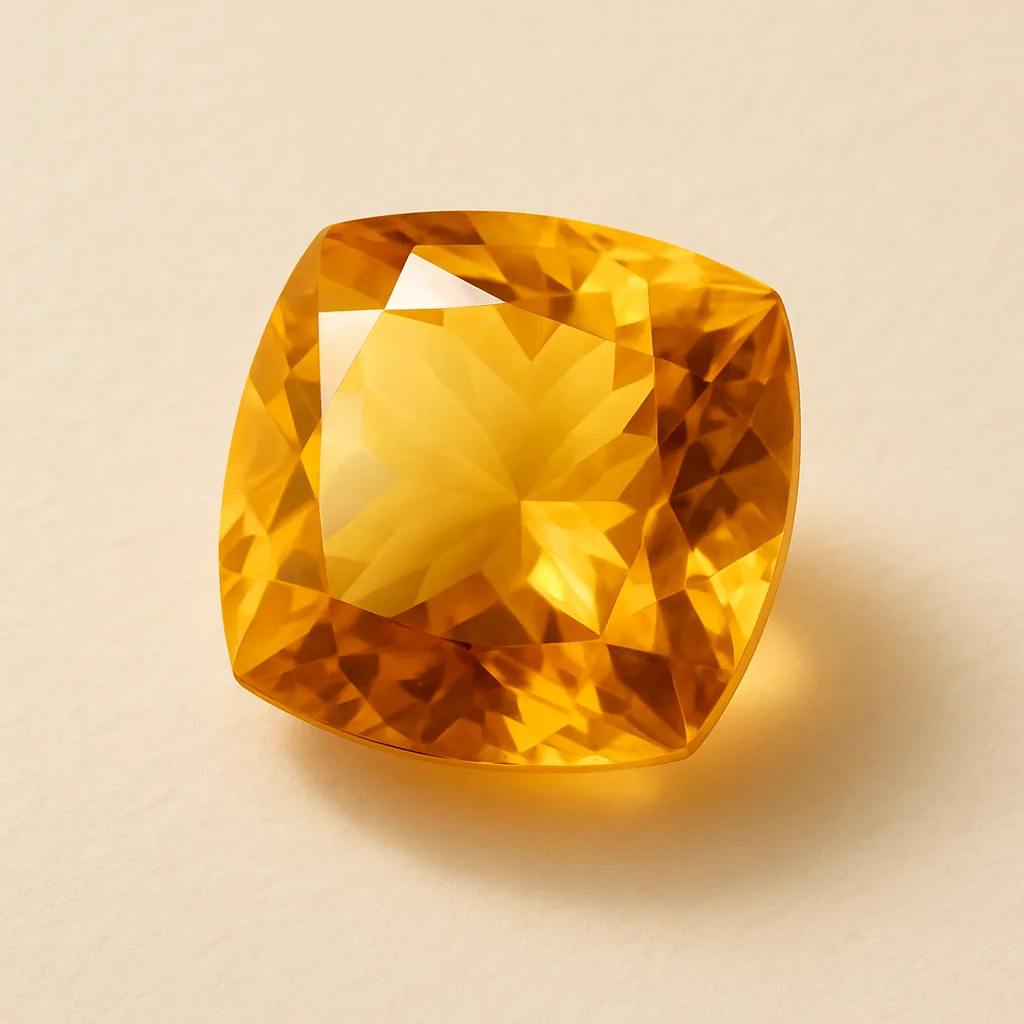
- Mohs 5.5–6 — moderate durability; suitable for pendants and earrings, less ideal for daily-wear ring stones
- Two directions at 90° — vulnerable to impact along the planes; bezel settings are safer than prong settings
- Generally safe to warm soapy water; avoid ultrasonic and steam ( and brittle behavior both vulnerable)
- Photochromic varieties may slowly fade with extended sunlight exposure — store when not worn
- Stable to most jeweler's chemicals; avoid hydrofluoric acid
$20–80/ct for commercial Madagascar yellow material; $100–400/ct for fine cat's-eye chatoyants from Mogok or Tanzania; tenebrescent Greenland material is a collector specialty with prices set by individual mineral dealers rather than by an established market.
Note: Scapolite is generally sold untreated, though some yellow and golden material may be irradiated or heated to deepen color — disclosure is uneven and most retail dealers do not specify treatment status. The principal market discriminators are: (1) cat's-eye scapolite, particularly Mogok pink and violet chatoyants, commands a substantial premium; (2) tenebrescent Greenland material is sold as a collector specialty; (3) transparent yellow Madagascar material is the standard commercial offering. Scapolite is fairly soft and brittle, and clean transparent stones above 5 ct are uncommon — most Madagascar production is in the 1–3 ct range.
nclusions is the most prized variety. The tenebrescent Greenland material (Ilimaussaq alkaline complex) shows photochromism — colorless or pale violet , intensifying to deep violet under sunlight or shortwave UV exposure, reverting over hours to days — a behavior caused by F-center electron trapping in the chlorine-rich marialite endmember.
Origins
Mogok, in northern Burma (Myanmar), produces the world's premier cat's-eye scapolite — the chatoyant pink and violet stones first described scientifically by Max Bauer in his 1913 monograph Edelsteinkunde. The Madagascar deposits at Ilakaka and Sakaraha, opened in the 1990s, supply most of the modern transparent gem-grade rough — yellow, colorless, and occasional pink. Tanzania's Tunduru-Songea belt and the Umba River area produce yellow and pink material. Brazil (Espírito Santo and Minas Gerais) yields large transparent yellow crystals. Canada's Eganville and Renfrew districts in Ontario, and Quebec's Otter Lake, produce the classical large prismatic yellow scapolite specimens used in 19th-century mineralogy textbooks. Greenland's Ilimaussaq complex (Tunulliarfik / Tugtutoq area) produces the tenebrescent violet variety, discovered to be photochromic in 1958. Afghanistan's Sar-e-Sang area produces lapidary-grade pink scapolite, often associated with the lazurite deposits.
History
aceted material for the broader gem trade.
Lore & symbolism
Scapolite carries no significant classical, medieval, or early-modern lore — the species was identified only in 1800 and remained a mineralogical curiosity for the next century and a half. Contemporary New Age literature, lacking historical material to draw from, has positioned scapolite as a 'stone of inspiration' and 'creative manifestation,' associated loosely with self-discipline and personal growth. These positionings are pure marketing inventions from the post-1990s crystal-healing literature. The tenebrescent Greenland variety occasionally circulates among mineral collectors as a curiosity, marketed under the suggestive label 'sunshine stone' for its UV-responsive color shift.
Tools to confirm this stone
Tools that help confirm Scapolite. Tap any item to jump to the matching section on the gem tools page.
- 最終確認日
- 2026年4月28日
- 参 考 文 献
- Gem Encyclopedia/ GIA (Gemological Institute of America)
- 宝石鑑別基準/ 中央宝石研究所 (CGL)
- Mineral & Gem Database/ Mindat.org / Gemdat.org
- 宝石学入門/ 全国宝石学協会
本ページの物性値(屈折率・比重・硬度・結晶系等)は、上記の権威ある一次資料を相互参照して編集しています。最新の鑑別研究の進展により値が更新される場合があります。