identified this stone yet
Rose Quartz
| Hardness | 7 |
| Specific gravity | 2.65 |
| Refractive index | 1.544-1.553 |
| Crystal system | 三方晶系 |
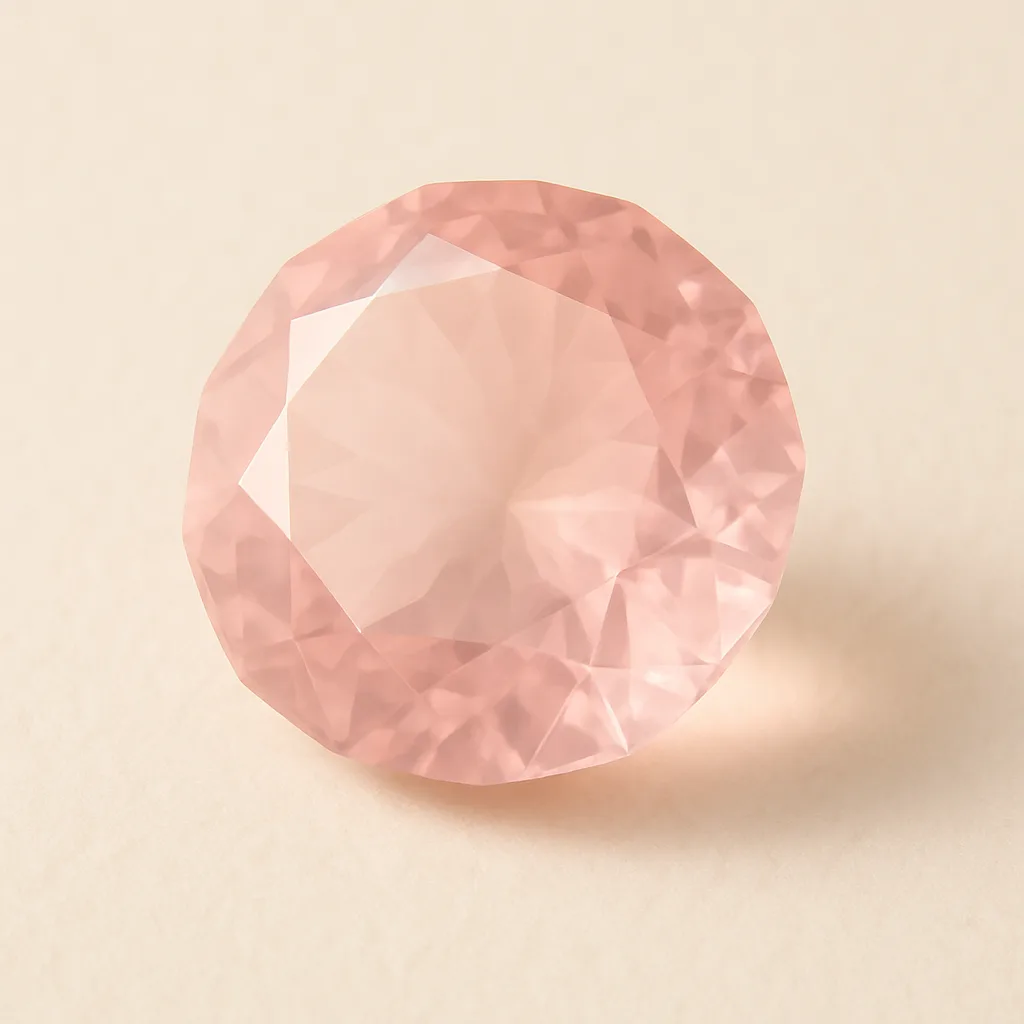
Pale baby pink through soft rosy pink to slightly peachy pink, almost always with a milky or hazy quality. Transparent 'pink quartz' (a separate, much rarer crystallized variety colored by aluminum-phosphorus centers) shows true clarity and is distinguished by gemologists from massive rose quartz.
- Microscopic dumortierite-like fibers — the source of color and haziness, visible only at very high magnification
- Stress cracks and clouds in larger specimens
- Color zoning is rare due to the uniform fiber distribution
- abochons
- Doubly refractive (uniaxial positive)
- Weak dichroism — pink and slightly more violet pink
- Vitreous luster, often slightly greasy or waxy from the included fibers
- Translucent to nearly opaque (rarely transparent in 'pink quartz')
- 01Hazy translucent quality with uniform color throughout is the strongest single identifier — true transparent pink stones are likely pink quartz or another mineral entirely
- 02RI 1.544–1.553 and SG 2.65 confirm quartz
- 03abochons cut with the optic axis perpendicular to the base — diagnostic of dumortierite fibers
- 04Dyed quartz shows color concentration in cracks; acetone swab removes some dye
- Mohs 7 — durable for everyday wear
- Safe in warm soapy water; ultrasonic and steam acceptable if no fractures
- Color can fade slightly under prolonged direct sunlight — store away from windows
Roughly $1–$5/ct for commercial Brazilian cabochon and bead material, $10–$30/ct for clean translucent stones with even color and good polish, and $50–$200+/ct for top-grade Malagasy transparent pink quartz crystals or fine asteriated cabochons over 20 ct. One of the most affordable gem materials in the trade.
Note: Rose quartz is essentially untreated and unsynthesized at the commercial scale. Dyed quartz exists but is detectable by uneven color concentration and acetone testing. The hazy, fiber-induced color is uniform throughout natural rose quartz, which is one easy identification cue. Star rose quartz — showing a six-rayed asterism caused by the parallel dumortierite fibers — commands modest premiums and is cut as cabochons with the optic axis perpendicular to the base.
Rose quartz is quartz (SiO₂) where its characteristic soft pink comes from microscopic fibers of a dumortierite-related mineral suspended throughout the host — a 2001 discovery by John Koivula and George Rossman that overturned the older trace-titanium theory. The fibers scatter light, which is why rose quartz is typically translucent rather than transparent. Brazil's Minas Gerais (Galiléia, Itinga) is the dominant source; Madagascar, India, Namibia, and South Dakota supply additional material.
Origins
Brazil's Minas Gerais state — particularly the Galiléia, Itinga, and Coronel Murta pegmatite districts — is the world's primary source, mined since the 19th century. Madagascar's Sahatany Valley and Antsirabe produce clean material and some of the rarer transparent 'pink quartz' crystals. India's Tamil Nadu yields commercial rough. South Dakota's Custer County and Maine's Mount Mica produced historical specimens. Namibia provides occasional collector-grade transparent crystals.
History
Rose quartz beads have been carved since at least 7000 BCE in Mesopotamia and ancient Egypt, where the stone was associated with beauty rituals — facial mask fragments from Egyptian tombs contain rose quartz powder. Roman and Greek civilizations used the gem in seals and decorative carvings. The modern rose-quartz boom is closely linked to the rise of crystal-healing culture from the 1970s onward; today it is one of the most-sold gem materials worldwide by volume.
Lore & symbolism
Rose quartz has no traditional birthstone status but is one of the central gems of modern crystal lore — associated with love, emotional healing, and the heart chakra. Often given as a 2nd wedding anniversary gift in some traditions.
Tools to confirm this stone
Tools that help confirm Rose Quartz. Tap any item to jump to the matching section on the gem tools page.
- 最終確認日
- 2026年4月28日
- 参 考 文 献
- Gem Encyclopedia/ GIA (Gemological Institute of America)
- 宝石鑑別基準/ 中央宝石研究所 (CGL)
- Mineral & Gem Database/ Mindat.org / Gemdat.org
- 宝石学入門/ 全国宝石学協会
本ページの物性値(屈折率・比重・硬度・結晶系等)は、上記の権威ある一次資料を相互参照して編集しています。最新の鑑別研究の進展により値が更新される場合があります。