identified this stone yet
Rhodonite
| Hardness | 5.5-6.5 |
| Specific gravity | 3.60 |
| Refractive index | 1.73-1.74 |
| Crystal system | 三斜晶系 |
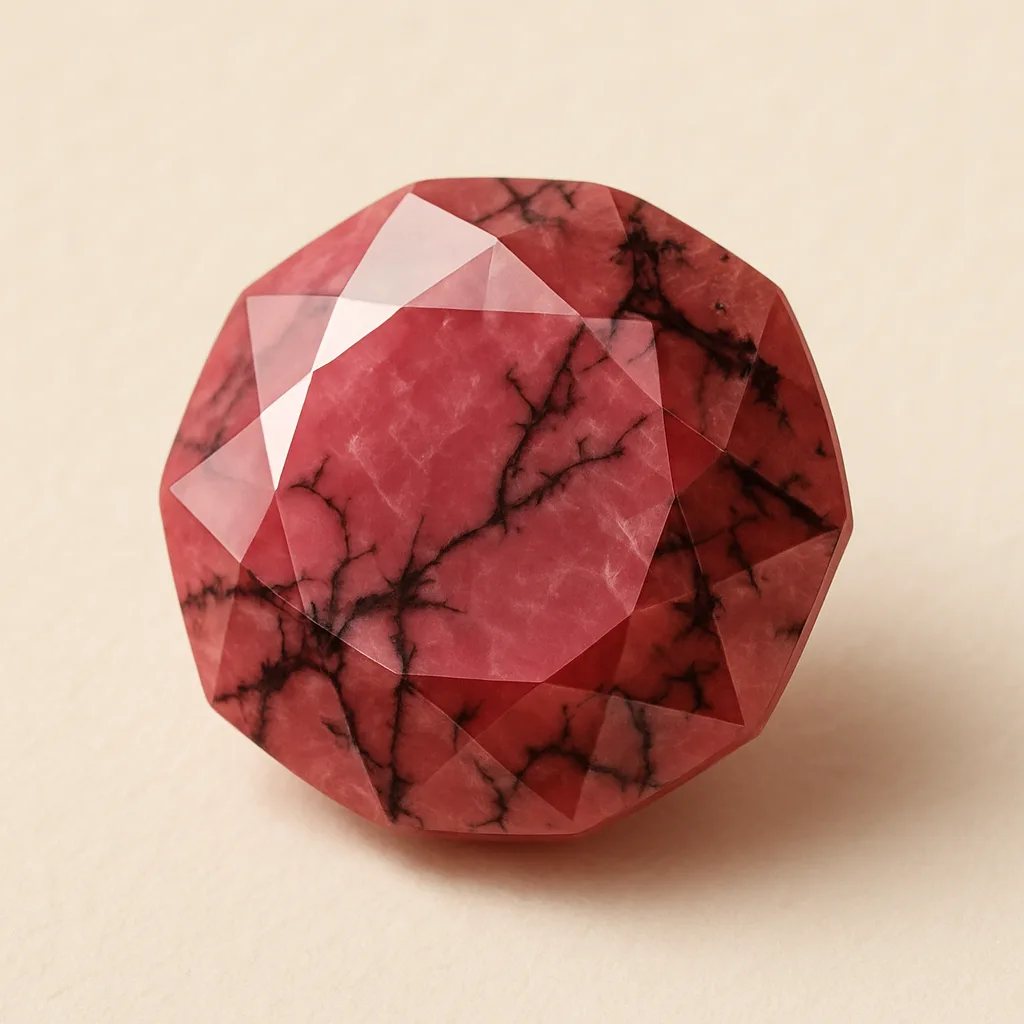
Rose pink, salmon pink, raspberry red, and rare cherry red, almost always with characteristic black dendritic manganese-oxide veining. The most prized material is deep raspberry pink with dramatic black 'tree-branch' veins on the polished surface.
- Black dendritic veins of pyrolusite or other manganese oxides — the visual signature
- Granular interlocking texture visible under magnification
- Occasional pyroxmangite or bustamite intergrowths
- nclusions in the rare transparent Broken Hill crystals
- Doubly refractive, biaxial positive
- Refractive index 1.71–1.73 (massive aggregate behaves as a polycrystalline whole)
- 0.011–0.014
- Specific gravity 3.5–3.7
- in two directions at near-right angles (visible only on transparent crystals)
- 01Black manganese-oxide dendritic veining on pink ground — the diagnostic visual signature
- 02Refractive index 1.71–1.73 — separates rhodonite from rhodochrosite (1.578–1.840 with extreme ) and morganite (1.58–1.60)
- 03Specific gravity 3.5–3.7 — slightly heavier than rhodochrosite (3.45–3.7), much heavier than morganite (2.71–2.90)
- 04Mohs 5.5–6.5 — markedly harder than rhodochrosite (3.5–4), softer than morganite (7.5–8)
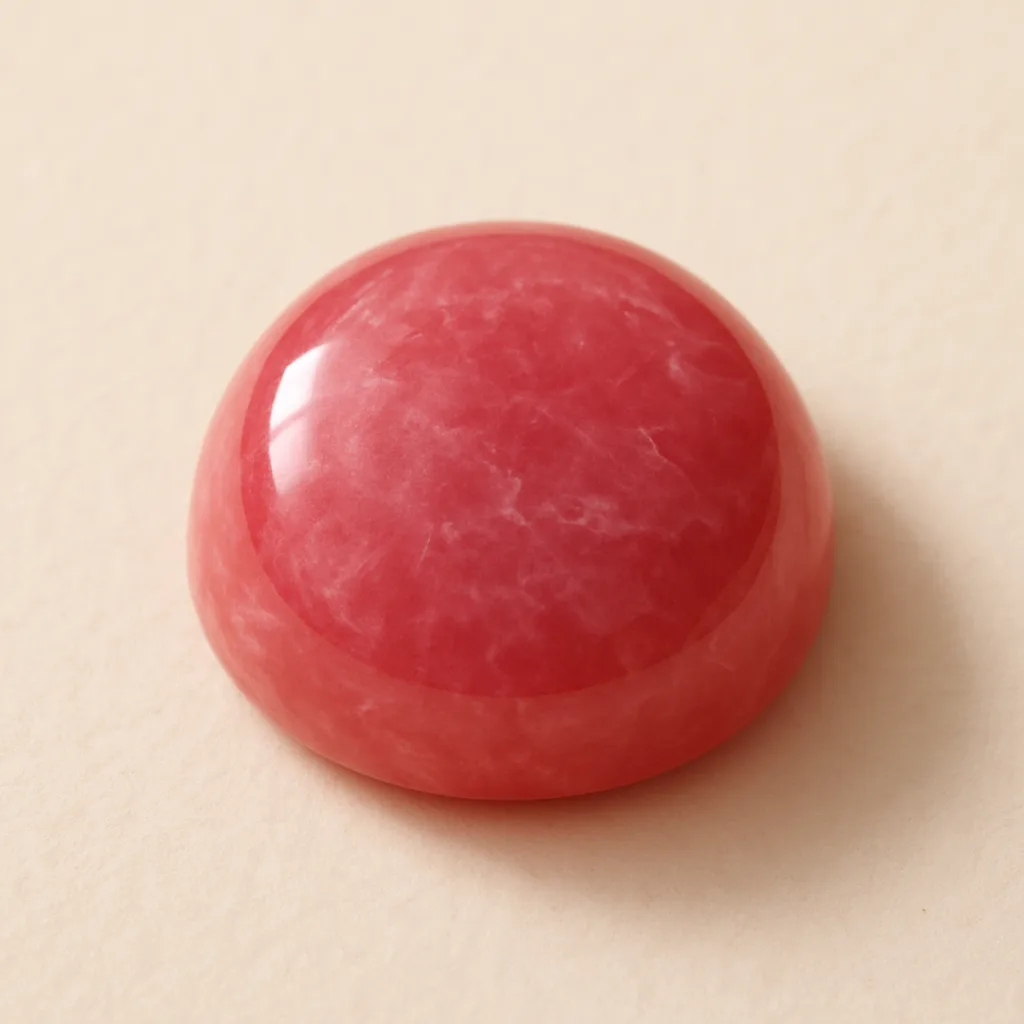
- Mohs 5.5–6.5 — moderately durable; suitable for pendant and earring use, less ideal for daily-wear rings
- Generally safe to warm soapy water; avoid ultrasonic and steam (the granular texture and manganese oxidation are vulnerable to thermal cycling)
- Sensitive to acids — avoid jewelry cleaners with citric acid
Several hundred to several thousand yen per carat for commercial Russian or Peruvian cabochon material, up to ¥30,000–50,000/ct or more for the rare transparent Broken Hill faceted stones.
Note: No standard treatments are applied. The chief market discriminator is the quality of the black veining pattern — material with dramatic, well-distributed dendrites on a saturated pink ground commands premium prices, while heavily veined or mottled material is sold as lower-grade. Transparent rhodonite from Broken Hill is collector-only, with single fine crystals reaching tens of thousands of dollars at major mineral auctions.
Rhodonite is a manganese inosilicate (MnSiO₃, triclinic — pyroxenoid group, related to wollastonite), colored pink to red by its manganese chemistry, almost always associated with black dendritic veins of pyrolusite or other manganese oxides that form as the manganese oxidizes near the surface. The stone occurs principally as massive granular aggregate suitable for carving and inlay; transparent rhodonite crystals are extremely rare and known only from a few localities, principally Broken Hill in Australia. Mohs 5.5–6.5, SG 3.5–3.7, RI 1.71–1.73.
Origins
abochons and inlay work.
History
Rhodonite was described and named in 1819 by Christoph Friedrich Jasche from Russian Ural specimens — the trade name 'orletz' ('eaglestone') in 19th-century Russian gem markets reflects its imperial associations. Tsar Nicholas I declared rhodonite a Russian national stone and ordered its use in Winter Palace and Peterhof interior decoration; the Romanov imperial workshops produced rhodonite columns, mantelpieces, and inlay work that remains in the Hermitage Museum and other former imperial residences. The 1913 funerary sarcophagus of Empress Maria Alexandrovna — wife of Alexander II — was carved from a single 47-ton block of Ural rhodonite over the course of 16 years and remains the largest worked rhodonite object in the world. Carl Fabergé used rhodonite in several of his imperial Easter eggs and decorative objects.
Lore & symbolism
Russian folk tradition associates rhodonite with the morning star and with the awakening of love at dawn — the stone is sometimes called 'the dawn stone' or 'the eagle stone' in Russian lapidary tradition. Modern New Age and power-stone marketing extends these associations into emotional healing, with rhodonite positioned as the stone of compassion, forgiveness, and recovery from emotional trauma — claims that have no historical basis but trade well in the contemporary spiritual retail market.
Tools to confirm this stone
Tools that help confirm Rhodonite. Tap any item to jump to the matching section on the gem tools page.
- 最終確認日
- 2026年4月28日
- 参 考 文 献
- Gem Encyclopedia/ GIA (Gemological Institute of America)
- 宝石鑑別基準/ 中央宝石研究所 (CGL)
- Mineral & Gem Database/ Mindat.org / Gemdat.org
- 宝石学入門/ 全国宝石学協会
本ページの物性値(屈折率・比重・硬度・結晶系等)は、上記の権威ある一次資料を相互参照して編集しています。最新の鑑別研究の進展により値が更新される場合があります。