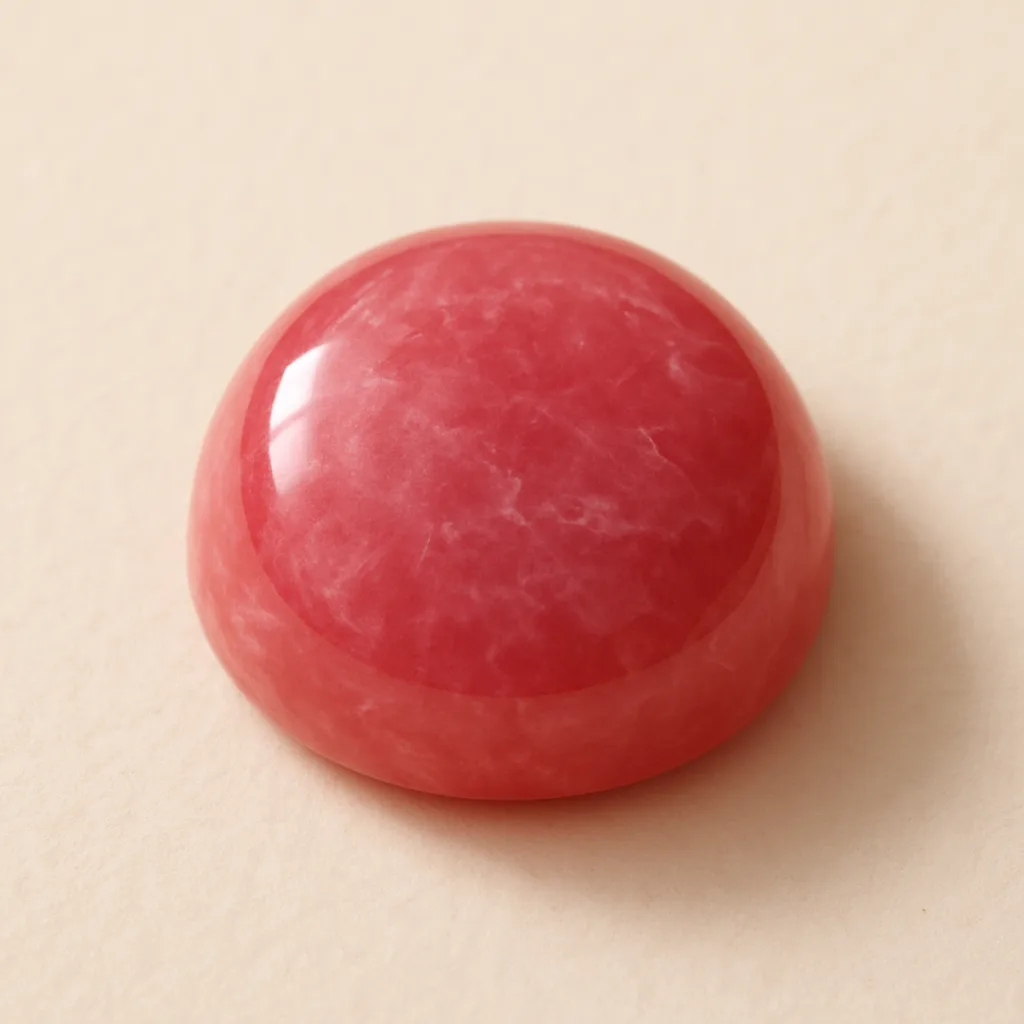
identified this stone yet
Rhodochrosite
| Hardness | 3.5-4 |
| Specific gravity | 3.70 |
| Refractive index | 1.60-1.82 |
| Crystal system | 三方晶系 |
Pale rose pink, salmon pink, raspberry red, and rare cherry red. Argentine banded material shows alternating pink and white concentric rings; transparent crystals from Sweet Home and Capillitas show saturated raspberry color throughout.
- Concentric banding alternating pink and white in the stalactitic Argentine material
- nclusions in transparent material
- planes (perfect rhombohedral in three directions)
- Calcite or quartz overgrowths in matrix specimens
- Doubly refractive, uniaxial negative
- Refractive index 1.578–1.840
- 0.220 — among the highest of any gem species, producing pronounced in transparent stones
- Specific gravity 3.45–3.7
- Perfect rhombohedral in three directions — a major durability constraint
- 01Concentric pink-and-white banding diagnostic of stalactitic Argentine Capillitas material
- 02Extreme (0.220) — pronounced visible at 10× in transparent stones
- 03Specific gravity 3.45–3.7 — heavier than calcite (2.71) and lighter than siderite (3.96)
- 04Effervesces in dilute HCl (manganese carbonate reaction) — a destructive test, only used on tiny chips
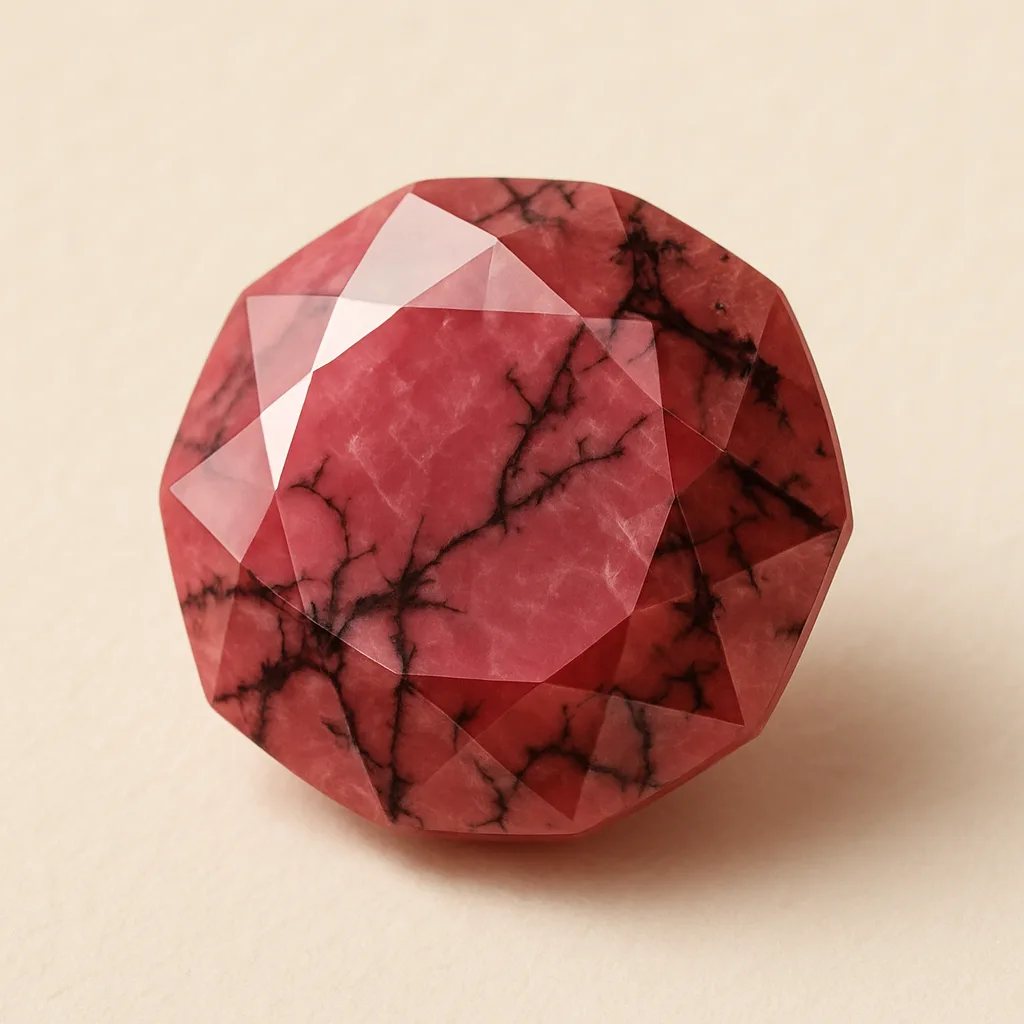
- Mohs 3.5–4 — very soft; avoid daily wear in rings, prefer pendant and earring settings
- Perfect in three directions — avoid hard knocks and stone-on-stone storage
- Never ultrasonic or steam — and thermal sensitivity both rule them out
- Avoid acids and prolonged contact with water — the carbonate chemistry is vulnerable
¥1,000–5,000/ct for commercial banded Argentine material in cabochon, up to several hundred thousand yen per carat for fine transparent Sweet Home crystals in the 5–20 ct range.
Note: No standard treatments are applied. The chief market discriminator is grade: banded Argentine 'Inca Rose' material in even pink-and-white concentric rings without dark mottling commands the highest decorative prices. Transparent Sweet Home crystals, no longer produced since 2003, trade at major auctions in the hundreds of thousands of dollars per piece. The softness of the stone (Mohs 3.5–4) limits its use in everyday jewelry — most pieces are set as pendants or earrings rather than rings.
Rhodochrosite is manganese carbonate (MnCO₃, trigonal — the manganese end-member of the calcite group), colored pink to deep raspberry red by its manganese chemistry, sometimes paled toward white or brown by calcium or iron substitution. It occurs in two principal commercial forms: as opaque banded stalactitic masses with concentric pink-and-white rings (the Argentine 'Inca Rose' material), and as transparent to translucent rhombohedral crystals of museum quality from a small number of localities. Mohs 3.5–4 (very soft), SG 3.45–3.7, RI 1.578–1.840 (extreme ).
Origins
Argentina (the Capillitas mine, Catamarca Province) is the historical and continuing source of banded 'Inca Rose' rhodochrosite — a deposit mined for silver since the 13th-century Inca period, with rhodochrosite recognized as a valuable byproduct. The United States (the Sweet Home Mine, Alma, Colorado) produced gem-quality transparent rhombohedral crystals from the early 1960s until its closure in 2003 — the famous 'Alma King' (16 cm, 7.7 kg) is now in the Denver Museum of Nature & Science. Peru (Pasto Bueno), Mexico (Mapimí), South Africa (the Hotazel and Wessels mines, Northern Cape), Russia, and China contribute additional production. South African material is the world's principal source of banded specimens for the lapidary trade.
History
Rhodochrosite was named in 1813 by the French mineralogist François Sulpice Beudant from Greek rhodon ('rose') + chros ('color') after his examination of specimens from the Romanian Cavnic mine. The Capillitas deposit in Argentina had been mined for silver since the 13th-century Inca period, with the pink banded byproduct accumulated in waste dumps for centuries; the modern 'Inca Rose' jewelry industry developed in the early 20th century from this material. Rhodochrosite was formally adopted as the national gemstone of Argentina in 1938. The Sweet Home Mine in Colorado, originally a silver mine, was reopened in the early 1960s specifically for its rhodochrosite specimens — a rare case of a mine operated for mineral specimens rather than ore — and produced the finest gem rhodochrosite ever recovered until its closure in 2003.
Lore & symbolism
Inca and pre-Columbian traditions in the Argentine northwest associated the pink banded stone with the blood of long-dead Inca kings, said to crystallize beneath the earth from royal sacrifice — the 'Inca Rose' name and lore both reflect this tradition. Modern New Age associations link rhodochrosite with self-love, emotional healing, and the heart chakra; the stone is widely sold in the 20th- and 21st-century power-stone markets.
Tools to confirm this stone
Tools that help confirm Rhodochrosite. Tap any item to jump to the matching section on the gem tools page.
- 最終確認日
- 2026年4月28日
- 参 考 文 献
- Gem Encyclopedia/ GIA (Gemological Institute of America)
- 宝石鑑別基準/ 中央宝石研究所 (CGL)
- Mineral & Gem Database/ Mindat.org / Gemdat.org
- 宝石学入門/ 全国宝石学協会
本ページの物性値(屈折率・比重・硬度・結晶系等)は、上記の権威ある一次資料を相互参照して編集しています。最新の鑑別研究の進展により値が更新される場合があります。