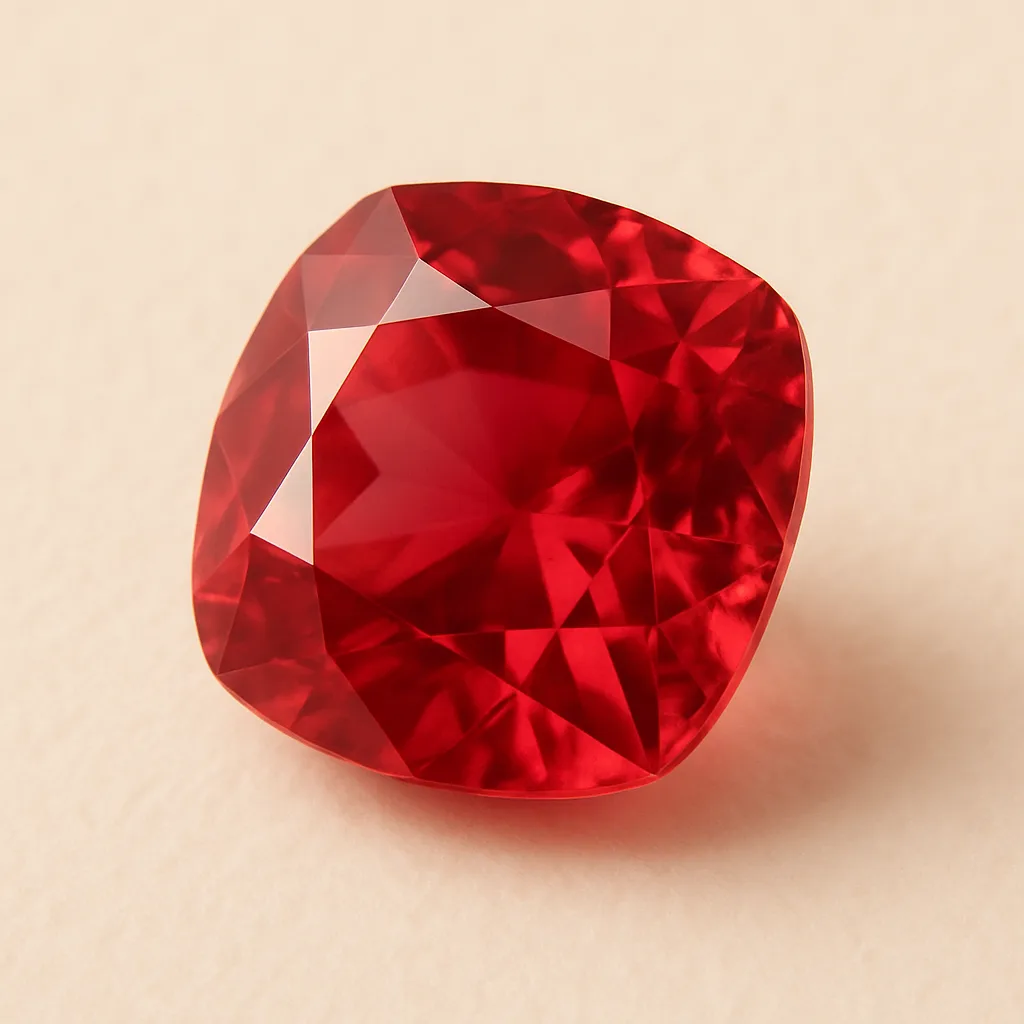
identified this stone yet
Red Spinel
| Hardness | 8 |
| Specific gravity | 3.60 |
| Refractive index | 1.718 |
| Crystal system | 等軸晶系(立方晶系) |
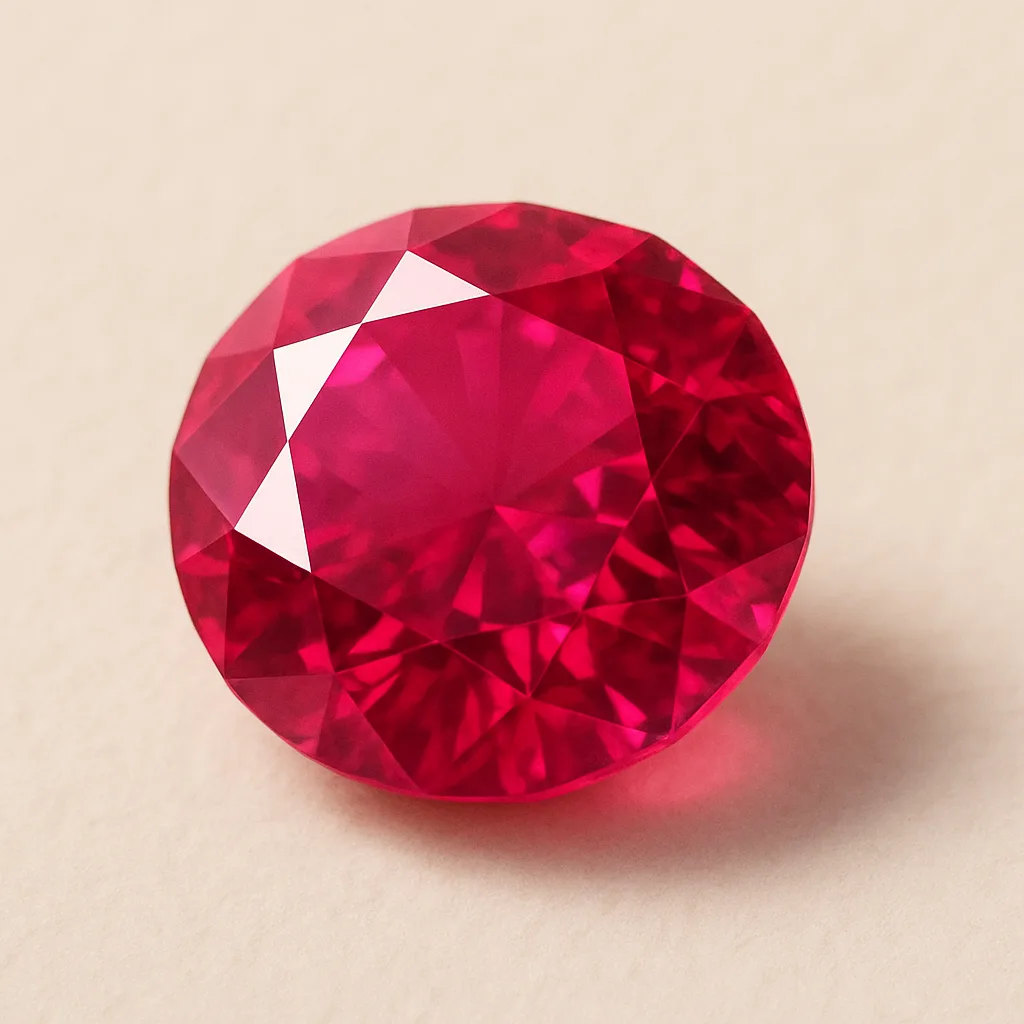
Bright pinkish-red, pure red, slightly orange red and slightly purplish red. The most prized tones are pure, pigeon-blood-style red with no brown undertone.
- egative crystals (the spinel signature)
- Aligned clusters of small octahedra
- nclusions
- Singly refractive — no
- No dichroism (a dichroscope shows the same color in all positions)
- 01nclusions are diagnostic for natural spinel
- 02No and no dichroism separate it from ruby and red tourmaline
- 03 under LW UV is weaker than ruby's
- Mohs 8 — durable for daily wear
- Ultrasonic and steam are generally safe for untreated stones
- No special storage concerns
Roughly $200–$1,000 per carat for commercial reds, $2,000–$8,000 per carat for fine clean reds, and $15,000+ per carat for top Mogok or Mahenge stones over 3 carats.
Note: Untreated material is the market norm — that, plus pure red color and singly refractive optics, is the spinel value proposition. Some lower-grade material is heat-treated, but disclosure is standard. Mogok and Mahenge stones command strong premiums.
Red spinel is magnesium aluminate (MgAl₂O₄) colored red by chromium, the same chromophore as ruby. Unlike ruby it is singly refractive, lacks dichroism, and almost always reaches the market untreated. Burma (Mogok and Mong Hsu), Tajikistan's Kuh-i-Lal, Tanzania's Mahenge district, Sri Lanka and Vietnam are the leading sources.
Origins
nclusions visible under magnification. Tajikistan's Kuh-i-Lal mine in the Pamirs has supplied 'balas ruby' for over a thousand years and is the historical source of many royal stones once called ruby. Tanzania's Mahenge, opened in 2007, gave the world the famous 'neon' red Mahenge spinels. Sri Lanka, Vietnam and Pakistan round out the modern market.
History
Until 1783, when Jean-Baptiste Romé de l'Isle separated spinel from corundum mineralogically, almost every important red stone in European regalia was called 'ruby.' The Black Prince's Ruby (170 ct, set in the British Imperial State Crown) and the 398.72-ct central stone of the Russian Imperial Crown are both red spinels. Awareness of these reclassifications, plus the 2007 Mahenge find, has driven a steady revaluation of spinel since 2010.
Lore & symbolism
August's modern birthstone (added by the American Gem Trade Association in 2016, alongside peridot and sardonyx). Spinel symbolises renewal, success, and inner strength — fitting for a stone that spent centuries hidden in plain sight.
Tools to confirm this stone
Tools that help confirm Red Spinel. Tap any item to jump to the matching section on the gem tools page.
- 10× loupeDETAILS →
Essential 10× tool to read inclusions, polish marks, and color zoning
- Chelsea filterDETAILS →
Quick chrome-content screen — chromium-bearing stones glow red through the filter
- UV lamp (long-wave 365 nm)DETAILS →
Long-wave UV reveals red fluorescence (moderate)
- Handheld spectroscopeDETAILS →
Absorption-line pattern identifies the chromophore (Cr, Fe, or Co)
- RefractometerDETAILS →
Refractive index (1.712–1.736) narrows the species
- Last reviewed
- April 28, 2026
- Bibliography
- Gem Encyclopedia / GIA (Gemological Institute of America)
- Gem Identification Standards / Central Gem Laboratory (CGL), Tokyo
- Mineral & Gem Database / Mindat.org / Gemdat.org
- Introduction to Gemology / Gemmological Association of All Japan (GAAJ)
The gemological data on this page (refractive index, specific gravity, hardness, crystal system, etc.) is cross-checked against the authoritative primary sources listed above. Values may be revised as gemological research advances.