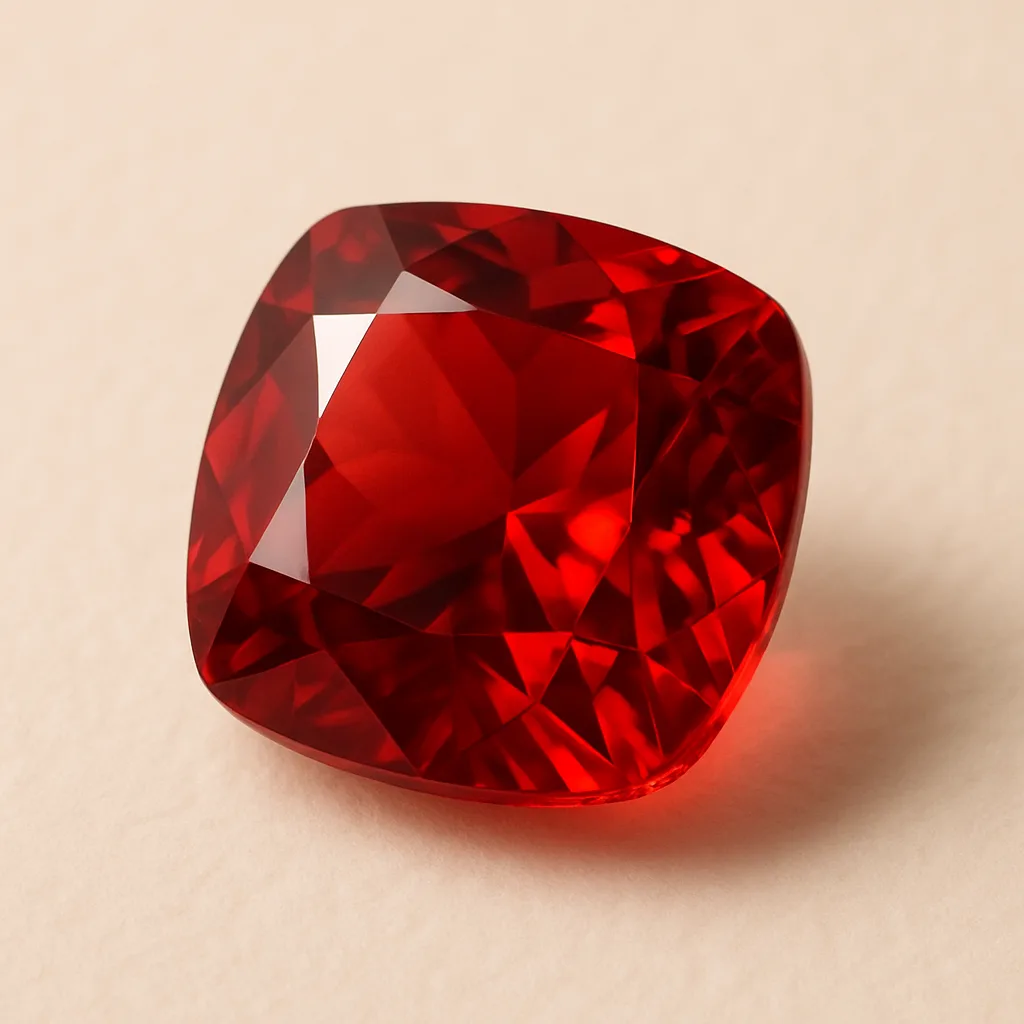
identified this stone yet
Red Glass / Paste
| Hardness | 5-6 |
| Specific gravity | 2.40-4.20 |
| Refractive index | 1.470-1.700 |
| Crystal system | 非晶質 |
Saturated ruby-red (selenium ruby), classical 'pigeon's blood' deep red (colloidal gold with cobalt undertone), warm 'cranberry' pink-red (gold ruby), and the rare Roman/Bohemian 'copper ruby' brick-red. Colloidal-gold-doped material closely approximates the Burmese Mogok pigeon's blood ruby saturation under tungsten light, driving the demand for gold ruby paste in premium costume jewelry since the seventeenth century.
- Regular round gas bubbles distributed evenly through the matrix — diagnostic of pressed or molded glass at 10×
- Surface molding seams and press-die parting lines on backs
- Color zoning streaks from incomplete batch mixing — especially noticeable in gold-ruby where colloidal-gold concentration varies
- Devitrification crystallites in older or heat-stressed material
- Gold-ruby: colloidal-gold nanoparticles (~10–30 nm) visible only by transmission electron microscopy
- Lampwork beads: spiral flow lines from molten-glass winding
- Singly refractive (amorphous glass structure) — no
- Refractive index 1.50–1.70 depending on lead content (gold-ruby Kunckel-tradition typically 1.55–1.65)
- Specific gravity 2.4–4.5 — lead-crystal at the high end
- Mohs 5–6 — easily scratched by quartz (Mohs 7)
- Conchoidal fracture
- Chelsea filter: gold-ruby glass typically shows weak red response from gold-nanoparticle plasmon; selenium-ruby shows no significant response
- 01Regular round gas bubbles visible at 10× — immediately diagnose pressed or molded glass; natural ruby never shows this signature
- 02Singly refractive (no ) versus natural ruby's clear at 30× immersion through the table
- 03Refractometer reads 1.50–1.70 versus natural ruby 1.762–1.770
- 04Mohs 5–6 scratches against a steel knife; natural ruby (Mohs 9) is unaffected
- 05Specific gravity 2.4–4.5 versus natural ruby 3.99–4.01 — hand-heft gives diagnostic difference at 1 ct and above
- 06nclusions and hexagonal color zoning at 10× plus strong under LW-UV (especially Mogok-origin); glass: regular round gas bubbles only
- 07Synthetic ruby (Verneuil): visible at 10× immersion; glass: regular round bubbles (not )
- Mohs 5–6 — stores separately to avoid scratches
- Avoid ultrasonic cleaning — vibration can crack the brittle matrix
- Stable to light and mild detergent; warm soapy water and soft brush
- Avoid thermal shock — conchoidal fracture risk
- Gold-ruby glass: the colloidal-gold color is generally stable indefinitely, unlike some organic-dyed glasses
- Avoid strong acids and bases — surface etching possible
Modern molded and faceted red-glass cabochons trade at $0.30–$3 per piece wholesale (Indian and Chinese mass production); Swarovski Crystal Light Siam and Siam components at $0.50–$5 per piece; Czech Gablonzer pressed-glass material at $2–$25 per piece. Murano lampwork red beads in gold-ruby technique reach $80–$500 per bead at gallery prices. Genuine eighteenth- and nineteenth-century gold-ruby paste (Kunckel-tradition German, Vauxhall English, Strass French) trades at $300–$5,000 per piece at vintage and estate auctions. Kunckel-period gold-ruby glass vessels with documented court provenance can reach $50,000–$500,000 at major decorative-arts auctions.
Note: Disclosure as 'glass' or 'imitation ruby/red spinel' is mandatory under FTC Jewelry Guides §23.25 and CIBJO Blue Book. Beware of red glass marketed as 'created ruby' — true synthetic ruby (Verneuil flame-fusion from 1902 onward, Chatham flux-grown from 1952) is corundum (Al₂O₃) with the same composition as natural ruby and requires 'synthetic' rather than 'imitation' disclosure. The lead-glass-filled composite ruby (Mong Hsu fracture-filled material from the 1990s) is a separate category — fractured natural ruby cemented with high-lead glass at the cavity surface — requiring specific 'lead-glass-filled' disclosure. Gold-ruby glass (Kunckel-tradition Goldrubinglas) retains significant collector premium in the decorative-arts and antique-jewelry trades. Czech Gablonzer pressed-glass red cabochons command collector value.
Red glass is amorphous SiO₂-based paste colored red by various chromophores. Colloidal gold (Au⁰ nanoparticles ~10–30 nm) at 0.001–0.005 wt% Au produces the 'gold ruby' or 'cranberry glass' tradition — a striking pink-to-red color that exploits surface-plasmon resonance in the gold nanoparticles (the same phenomenon described in the Lycurgus Cup). Copper-and-tin combinations under reducing conditions yield the classical Roman 'copper ruby' brick-red tones documented at Pompeii. Cadmium sulfoselenide (CdS·CdSe) at high selenium ratios produces the modern industrial 'selenium ruby' saturated reds, commercialized at Schott Jenaer Glaswerke from the 1890s. Non-crystalline, isotropic, Mohs 5–6, SG 2.4–4.5, RI 1.50–1.70, singly refractive, conchoidal fracture. Industrial production from Bohemian Gablonzer (Jablonec nad Nisou), Murano (Venice), Swarovski (Wattens), and modern Indian and Chinese factories.
Origins
abochons; the Czech gold-ruby tradition is preserved under UNESCO intangible cultural heritage protection. Germany (Potsdam — Kunckel's original 17th-century workshop) is the historical centre for gold-ruby technology; the modern Schott Jenaer Glaswerke (Jena) and Glashütte Lamberts (Waldsassen) continue the German tradition. Italy (Murano, Venice — Cima, Salviati, Effetre) supplies lampwork beads with gold-ruby and copper-ruby specialties. England (Vauxhall mirror works, London, 18th century; Stourbridge glasshouses, West Midlands) produced the 'Vauxhall ruby' decorative-glass variant. France (Saint-Gobain, Baccarat) produced eighteenth- and nineteenth-century gold-ruby and selenium-ruby paste descended from Strass. India (Firozabad) and China (Shandong, Hebei) dominate twentieth- and twenty-first-century mass production.
History
Roman copper-ruby glass appears at Pompeii from the first century CE; Pliny's Naturalis Historia Book 36 (c. 77 CE) describes the technique using copper-and-tin colorants. The technique was substantially lost in Europe after the Roman period and partially preserved only in Byzantine and Islamic glassworks until its rediscovery by Johann Kunckel von Löwenstern (1630–1703), court alchemist to Friedrich Wilhelm I, Elector of Brandenburg, at Potsdam in 1679–1685. Kunckel's gold-ruby glass — published in his Ars Vitraria Experimentalis (1679, expanded 1689) — exploited Andreas Cassius's 1685 'Purple of Cassius' colloidal-gold-and-tin pigment work in Hamburg. The resulting 'Goldrubinglas' became a luxury product for European princely courts; surviving Kunckel-period pieces at the Schloss Charlottenburg (Berlin), Veste Coburg, and the Corning Museum of Glass document the technique. The eighteenth-century English 'Vauxhall ruby' adapted the gold-ruby technique to mirror glass and decorative jewelry at the Vauxhall mirror works (London, established 1675 by the Duke of Buckingham). Michael Faraday's 1856 Royal Society lecture 'Experimental Relations of Gold (and other Metals) to Light' established the optical principles of colloidal-gold color. Schott Jenaer Glaswerke's 1890s commercialization of cadmium-sulfoselenide colorants provided cheaper alternatives. Daniel Swarovski's 1892 Wattens factory and Coco Chanel's 1920s costume collections drove modern production. The 1968 US FTC Jewelry Guides §23.25 disclosure rules apply.
Lore & symbolism
No birthstone designation (synthetic/imitation material). The ruby-red association in Western lapidary culture symbolizes passion, courage, and royal power — ruby is the July birthstone and was the medieval European 'king of gems' (rubinus rubens). Kunckel's 17th-century gold-ruby glass acquired its own court-luxury status as a symbol of alchemical mastery and princely patronage. The Bohemian Gablonzer regional craft tradition is preserved under UNESCO intangible cultural heritage. Modern crystal-writing assigns no specific spiritual properties to glass imitations.
Tools to confirm this stone
Tools that help confirm Red Glass / Paste. Tap any item to jump to the matching section on the gem tools page.
- 最終確認日
- 2026年4月28日
- 参 考 文 献
- Gem Encyclopedia/ GIA (Gemological Institute of America)
- 宝石鑑別基準/ 中央宝石研究所 (CGL)
- Mineral & Gem Database/ Mindat.org / Gemdat.org
- 宝石学入門/ 全国宝石学協会
本ページの物性値(屈折率・比重・硬度・結晶系等)は、上記の権威ある一次資料を相互参照して編集しています。最新の鑑別研究の進展により値が更新される場合があります。