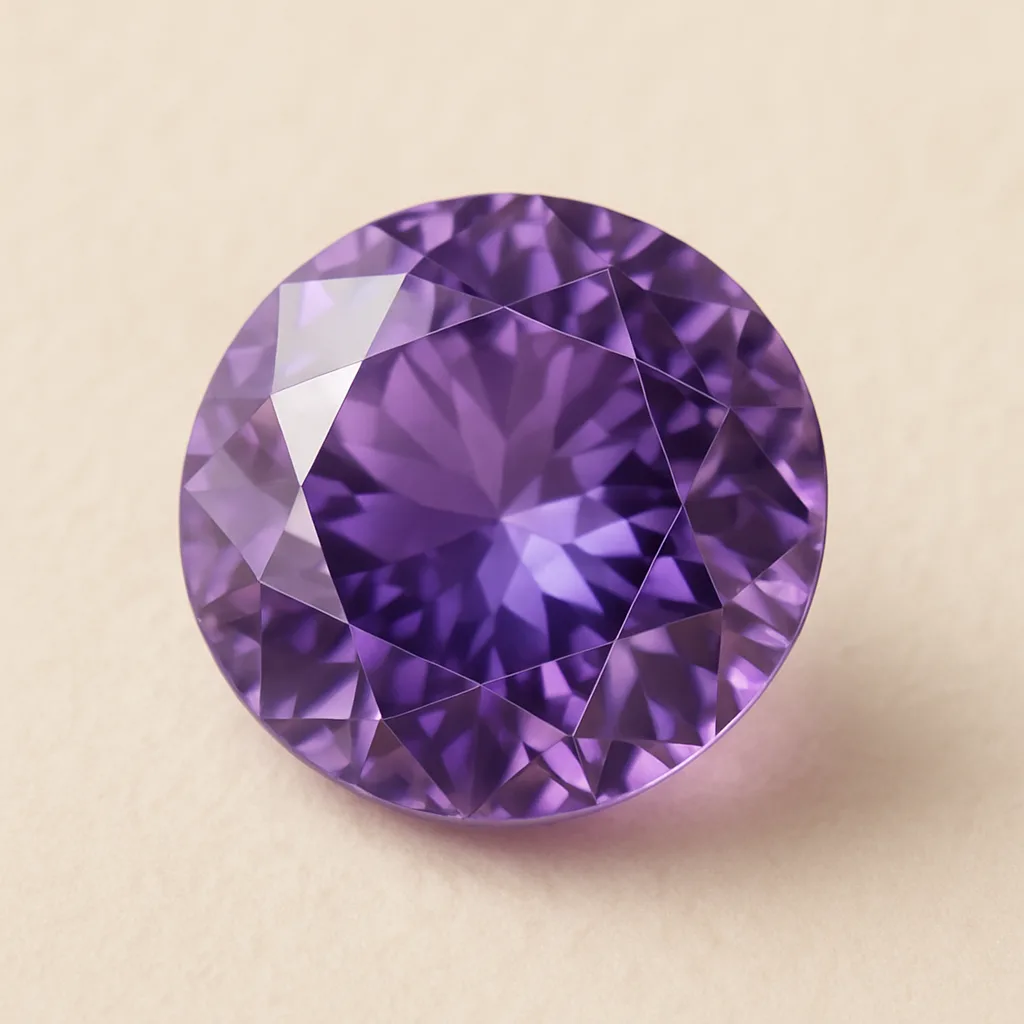
identified this stone yet
Purple Spinel
| Hardness | 8 |
| Specific gravity | 3.60 |
| Refractive index | 1.718 |
| Crystal system | 等軸晶系 |
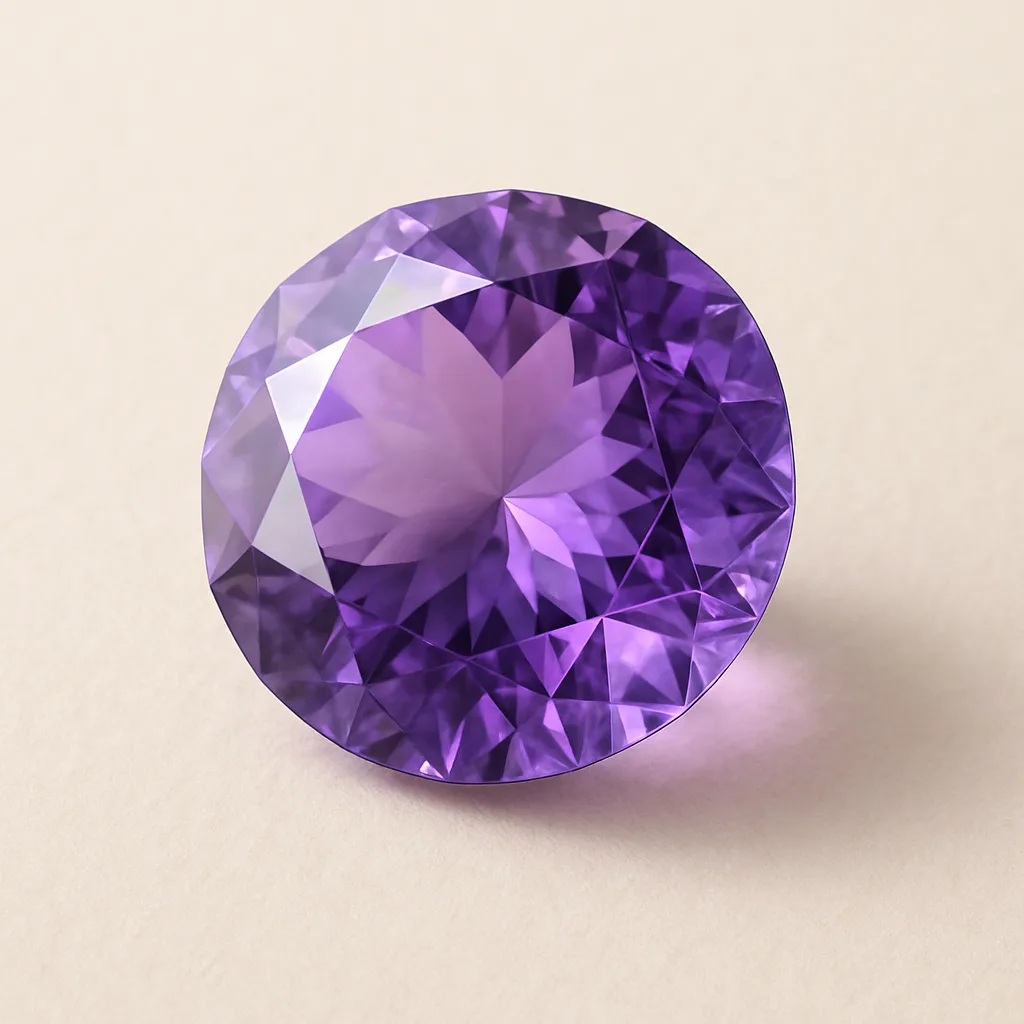
Pale lavender through medium violet-purple to deep reddish-purple and bluish-purple. The classical Mogok 'Burma purple' material sits in the medium-to-deep violet-purple range (hexcode #8B5DAA to #6B3F8B). Kuh-i-Lal Tajikistan material tends toward reddish-purple (hexcode #9C5A8C). Sri Lankan material spans the pale lavender to medium violet range (hexcode #B89BC7 to #8B5DAA).
- egative crystals — diagnostic spinel signature at 10×
- nclusion networks along healed fractures
- nclusions with characteristic radioactive haloes (Mogok Burmese material)
- Apatite octahedral crystals (Mogok material)
- between violet, pink, and blue zones (mixed chromophore patches)
- Synthetic Verneuil material: curved growth striae and round gas bubbles diagnostic of flame-fusion origin
- Refractive index 1.712–1.736 — singly refractive (isotropic cubic )
- Specific gravity 3.58–3.61
- Mohs 8 — excellent durability
- No (isotropic cubic) — diagnostic against purple sapphire which shows distinct violet-to-pink-to-bluish-purple
- Weak-to-medium red LW-UV (Cr³⁺ activation) where chromium dominates the chromophore mix
- Chelsea filter: pink response indicates Cr³⁺ chromophore dominance
- 01Singly refractive (no under crossed polars) versus amethyst's clear — diagnostic separator from amethyst
- 02egative crystals at 10× — diagnostic spinel signature
- 03Specific gravity 3.58–3.61 — separates from amethyst (2.65) decisively, and from purple sapphire (3.99–4.01)
- 04Refractive index 1.712–1.736 — separates from amethyst (1.544–1.553), purple sapphire (1.762–1.770)
- 05No — diagnostic against purple sapphire's distinct trichroic
- 06Mohs 8 — harder than amethyst (Mohs 7), softer than sapphire (Mohs 9)
- Mohs 8 — excellent durability for daily wear
- Ultrasonic cleaning is generally safe for clean unheated material
- Steam cleaning acceptable
- Storage in a soft pouch
Mogok Burmese deep-violet premium material: $500–$5,000 per carat for fine clean 1–3 carat stones. Kuh-i-Lal Tajikistan reddish-purple material: $200–$2,000 per carat. Vietnamese Luc Yen material: $100–$1,500 per carat. Sri Lankan Ratnapura pale-lavender material: $50–$800 per carat. Synthetic Verneuil purple spinel: $1–$15 per carat. Antique-set 'Balas Ruby' purple spinel in European royal-regalia replica jewelry trades at vintage and estate premium prices.
Note: Disclosure as 'natural spinel' is the trade standard; heat treatment for clarity improvement is occasionally encountered and must be disclosed under FTC Jewelry Guides §23.22 and CIBJO Blue Book. Origin determination by GIA, AGL, Lotus Gemology, and SSEF is the standard practice for high-value purple spinel — trace-element fingerprinting (LA-ICP-MS analysis of Ga, Zn, V, Ni, Cr, Fe, Ti ratios) distinguishes Mogok versus Kuh-i-Lal versus Sri Lanka. Synthetic Verneuil purple spinel (L. Paris 1908 process) is distinguishable by curved growth striae, gas-bubble inclusions, and trace-element patterns. The purple-spinel market is smaller than the pink-spinel market — the 2007 Mahenge 'neon pink' commercial breakthrough did not extend equivalently to purple material, and Mogok-origin premium purple spinel commands the high end of the market.
Purple spinel is MgAl₂O₄ in the cubic isometric system, coloured by mixed trace chromophores typically Cr³⁺ (the red component, identical mechanism to ruby) plus V³⁺ (the blue component, identical mechanism to alexandrite and emerald) plus Fe²⁺ (modifying violet tones) — the exact ratios determine the colour position from pale lavender through deep amethyst-violet to reddish-purple. The Cr³⁺ component activates the diagnostic weak-to-medium red LW-UV (stronger in pink-purple spinel, weaker in deep-violet material where Fe²⁺ dominates). The single refraction (isotropic cubic, RI 1.712–1.736, no , no ) is the diagnostic separator from purple sapphire (doubly refractive, distinct ) and from amethyst (doubly refractive trigonal, much lower SG 2.65 and RI 1.544–1.553). The historical 'Balas Ruby' tradition (the Persian Balascia from Badakhshan in the Pamirs) treated red and purple spinel as a continuous variety category, and the Black Prince's Ruby (170 ct octahedral spinel from Kuh-i-Lal in the British Imperial State Crown) shows the deep-red end while many of the medieval European 'amethyst-ruby' regalia stones are actually purple spinel.
Origins
Mogok Stone Tract in northern Myanmar (Mogok, Kyatpyin, Mansin) is the historic premium source for deep-violet purple spinel — the classical 'Burmese purple spinel' reference. Kuh-i-Lal in Khorog, Gorno-Badakhshan, Tajikistan (the historic 'balas ruby' source supplying medieval Central Asia and the Mughal courts), Luc Yen in Yen Bai Province, Vietnam (post-1990 commercial production), Ratnapura in Sri Lanka (the alluvial gem fields, mainly pale lavender material), Ilakaka in southwestern Madagascar (post-1998), and Tanzania (Mahenge ward — though purple is rarer than the famous pink) complete the modern source list. The Mogok deposits have been intermittently disrupted by Myanmar political instability and US sanctions enforcement (2008–2010 and post-2021); current premium purple-spinel supply relies more on Tajik and Vietnamese material.
History
Purple spinel shares the medieval 'Balas Ruby' history with red spinel — the term derives from Old French 'balais' from Persian 'balascia' from the Balascia district = Badakhshan in the Pamirs (modern Tajikistan and Afghanistan), the historic Kuh-i-Lal source. The medieval and Renaissance European royal regalia treats red, pink, and purple spinel under the 'Balas Ruby' or 'Bohemian Ruby' label without separation from corundum ruby. Johan Gottschalk Wallerius's 1747 'Mineralogia' first separated spinel as a distinct species (from corundum) on chemical and crystallographic grounds. Sir David Brewster's 1837 polarization studies established the isotropic-cubic single-refraction signature that mineralogically separates spinel from doubly-refractive corundum — the diagnostic test still used today. Auguste Verneuil's 1902 flame-fusion corundum synthesis and L. Paris's 1908 MgO-modification for synthetic spinel production opened industrial-scale synthetic-purple-spinel production. The 1985 Sri Lankan Embilipitya colour-change spinel discovery (Karl Schmetzer / Henn paper in Gems & Gemology Spring 1985) brought renewed gemological-research attention to spinel including the purple variety. The 2007 Mahenge Tanzania discovery primarily produced pink material but secondary purple spinel was also reported. The 2016 AGTA addition of spinel as the August birthstone (alongside peridot and sardonyx) included all colour varieties of natural spinel.
Lore & symbolism
August birthstone since 2016 (AGTA addition). The 'Balas Ruby' tradition gives purple spinel a deep medieval-royal heritage shared with red and pink spinel. The purple-violet colour carries the spiritual and contemplative symbolism associated with amethyst and purple sapphire in Western tradition — placement on the third-eye and crown chakras in modern metaphysical traditions (Melody 1995, Hall 2003). The deep-violet 'Burmese purple spinel' is considered particularly auspicious in Buddhist tradition where purple-violet is associated with high spiritual attainment.
Tools to confirm this stone
Tools that help confirm Purple Spinel. Tap any item to jump to the matching section on the gem tools page.
- 最終確認日
- 2026年4月28日
- 参 考 文 献
- Gem Encyclopedia/ GIA (Gemological Institute of America)
- 宝石鑑別基準/ 中央宝石研究所 (CGL)
- Mineral & Gem Database/ Mindat.org / Gemdat.org
- 宝石学入門/ 全国宝石学協会
本ページの物性値(屈折率・比重・硬度・結晶系等)は、上記の権威ある一次資料を相互参照して編集しています。最新の鑑別研究の進展により値が更新される場合があります。