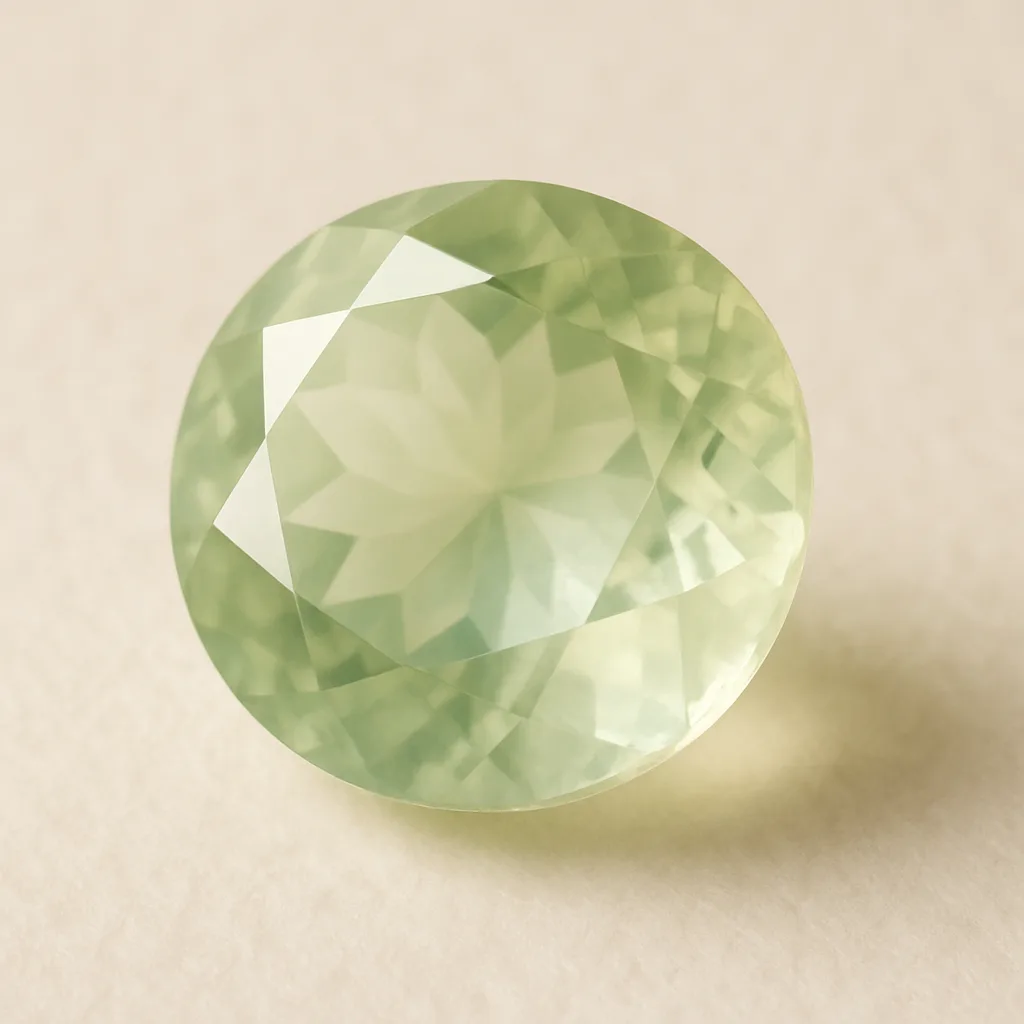
identified this stone yet
Prehnite
| Hardness | 6-6.5 |
| Specific gravity | 2.90 |
| Refractive index | 1.616-1.649 |
| Crystal system | 斜方晶系(球状集合体) |
Pale yellow-green through bright apple green, with rare colorless, blue-green, and pink material. The most prized color is a saturated apple green with high transparency; pale yellow-green material is the commercial standard.
- Fibrous radial structure visible in botryoidal material
- nclusions in transparent crystals
- nclusions of epidote, datolite, or pectolite (related cavity minerals)
- aceted stones
- Doubly refractive, biaxial positive
- Refractive index 1.611–1.669
- 0.020–0.035
- Specific gravity 2.80–2.95
- nclusions
- 01Refractive index 1.611–1.669 — separates prehnite from chrysoprase (1.53–1.54) and aventurine (1.54–1.55)
- 02Specific gravity 2.80–2.95 — heavier than chalcedony group (2.58–2.64) and aventurine (2.65–2.85), lighter than jadeite (3.30–3.38)
- 03Fibrous radial structure visible at 10× in botryoidal material
- 04Botryoidal 'grape jelly' surface morphology in natural rough is diagnostic
- Mohs 6–6.5 — durable for normal jewelry use, but softer than quartz; avoid stone-on-stone storage and impact
- Generally safe to warm soapy water; ultrasonic cleaning is usually safe but avoid for heavily included stones
- Stable to most jeweler's chemicals; avoid hydrofluoric acid (a silicate solvent)
¥1,000–5,000/ct for commercial pale-green or translucent material, up to ¥15,000–30,000/ct for fine bright transparent Malian stones above 5 ct.
Note: No standard treatments are applied — prehnite is sold in its natural state. The chief market discriminator is transparency and color saturation: bright transparent apple-green Malian material above 5 ct commands prices several times above pale, translucent botryoidal material. Cat's-eye prehnite, produced by oriented fibrous inclusions in some Australian and Chinese material, is a small but distinct niche.
Prehnite is a calcium aluminum silicate (Ca₂Al₂Si₃O₁₀(OH)₂, orthorhombic) of the phyllosilicate (sheet silicate) family — the same broad family as the micas, though with different sheet stacking. It occurs as botryoidal (grape-cluster) masses, fibrous globular aggregates, and rare transparent tabular crystals, almost always in cavities and vesicles of basaltic and metamorphic host rocks. Color ranges from colorless through pale yellow-green to bright apple green and rare blue-green. Mohs 6–6.5, SG 2.80–2.95, RI 1.611–1.669. The 'grape jelly' nickname comes from its characteristic botryoidal habit.
Origins
aceted range is now the benchmark.
History
Prehnite holds a unique place in mineralogical history as the first mineral ever named after a person. The Dutch colonial military officer Colonel Hendrik von Prehn (1733–1785), commander of the Dutch East India Company garrison at the Cape of Good Hope from 1768 to 1780, collected specimens of a then-unknown pale-green mineral on Table Mountain in the early 1770s and sent samples to European mineralogists. The German mineralogist Abraham Gottlob Werner — the dominant geological theorist of the late 18th century, founder of the Freiberg Mining Academy — formally described and named the species in 1788, three years after von Prehn's death, in his honor. The naming established the precedent for the hundreds of mineral species since named for their discoverers, patrons, or honorees. For most of the 19th and 20th centuries prehnite remained a mineralogical curiosity; the 1990s opening of the Sandare deposit in Mali transformed it into a viable gem material.
Lore & symbolism
Lacking deep medieval or classical tradition — the species was identified only in the late 18th century — prehnite's symbolic associations are entirely modern. The 1990s New Age literature describes it as 'the stone of unconditional love,' 'the stone of prophecy,' and 'the healer's stone,' and it is widely sold in Western and Japanese power-stone retail under these positionings. The 'grape jelly' nickname is purely descriptive and dates from the 20th-century American mineral-collector vernacular.
Tools to confirm this stone
Tools that help confirm Prehnite. Tap any item to jump to the matching section on the gem tools page.
- 最終確認日
- 2026年4月28日
- 参 考 文 献
- Gem Encyclopedia/ GIA (Gemological Institute of America)
- 宝石鑑別基準/ 中央宝石研究所 (CGL)
- Mineral & Gem Database/ Mindat.org / Gemdat.org
- 宝石学入門/ 全国宝石学協会
本ページの物性値(屈折率・比重・硬度・結晶系等)は、上記の権威ある一次資料を相互参照して編集しています。最新の鑑別研究の進展により値が更新される場合があります。