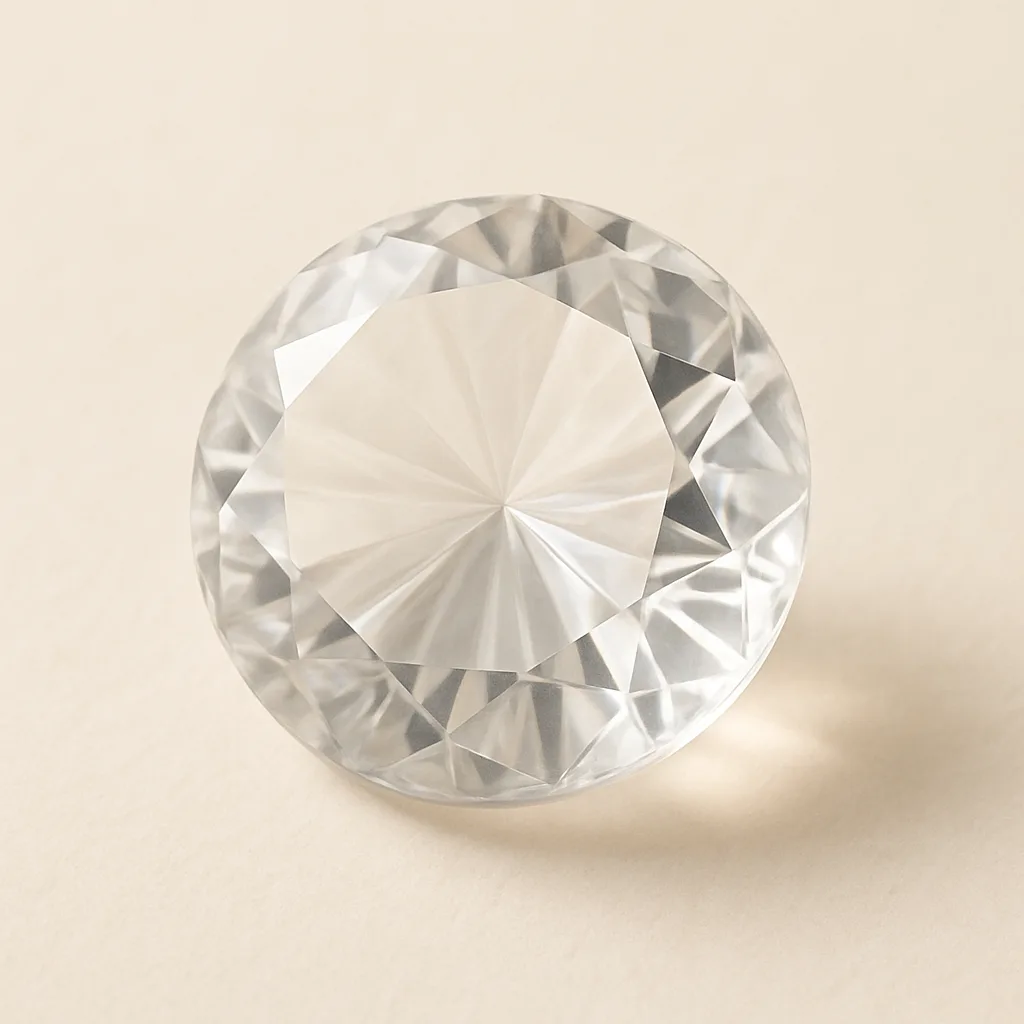
identified this stone yet
Plastic / Acrylic / Lucite
| Hardness | 2-3 |
| Specific gravity | 1.15-1.20 |
| Refractive index | 1.490-1.500 |
Available in any colour from colourless transparent (the standard Plexiglas/Lucite reference) through opaque pastels and saturated jewel tones. Common imitation targets are colourless (diamond imitation), pale blue (aquamarine imitation), pink (morganite imitation), green (emerald or peridot imitation), yellow (citrine imitation), red (ruby imitation), and purple (amethyst imitation). The mass-production Chinese and Indian costume-jewelry market produces all colours at scale; vintage Coro/Trifari/Eisenberg Lucite uses period-specific Pantone-controlled jewel-tone palettes (1950s 'Carmen red,' 'Saxon blue,' 'Spring green') that are now collector references.
- Regular round or elongated gas bubbles distributed through the matrix — diagnostic of cast or moulded polymer at 10× magnification
- Press-die parting lines, gate marks, and surface seams from injection moulding
- Flow lines and shear textures from the polymerization process
- Internal stress patterns visible under crossed polars (despite the amorphous polymer structure, residual casting stress produces visible interference patterns)
- Surface scratches and abrasions from handling — diagnostic against natural gem hardness
- Vintage Lucite costume jewelry: embedded silver-foil layers ('jelly belly' figurals), rhinestones, and pigment particles
- Refractive index 1.49–1.50 — diagnostic on the refractometer (singly refractive, amorphous polymer)
- Specific gravity 1.15–1.20 — extremely low, the diagnostic single-test identifier (floats in concentrated salt brine at SG 1.20)
- Mohs 2–3 — easily scratched by fingernail (Mohs 2.5) and copper coin (Mohs 3.5)
- Singly refractive (amorphous structure) — no on the polariscope
- Acetone-soluble — dissolves cleanly in acetone at 25°C, the diagnostic chemical test
- Hot-needle test — produces characteristic 'sweet' chemical odour of methyl methacrylate monomer; the surface softens and indents at 100°C
- 92% visible-light transmission for optical-grade clear PMMA
- 01Extremely low specific gravity 1.15–1.20 — the diagnostic single-test identifier; PMMA floats in concentrated salt brine at SG 1.20 while every natural gem material sinks (natural gem SG range 2.4–4.5)
- 02Mohs 2–3 — easily scratched by a fingernail; every natural gem material is Mohs 5+
- 03Hot-needle test produces sweet chemical odour of methyl methacrylate monomer and surface softens at 100°C — diagnostic chemical test
- 04Acetone-soluble — a drop of acetone on a hidden surface clouds and dissolves the polish
- 05Refractive index 1.49–1.50 — overlaps with glass (1.5) and opal (1.43–1.46) but combined with the SG 1.18 reading is fully diagnostic
- 06'Warm' thermal feel to the touch — PMMA has low thermal conductivity (0.2 W/m·K) versus quartz (1.4 W/m·K), glass (1.0 W/m·K), and most natural gems (1–10 W/m·K)
- 07Visible press-die seams and gate marks at 10× — diagnostic of moulded plastic origin
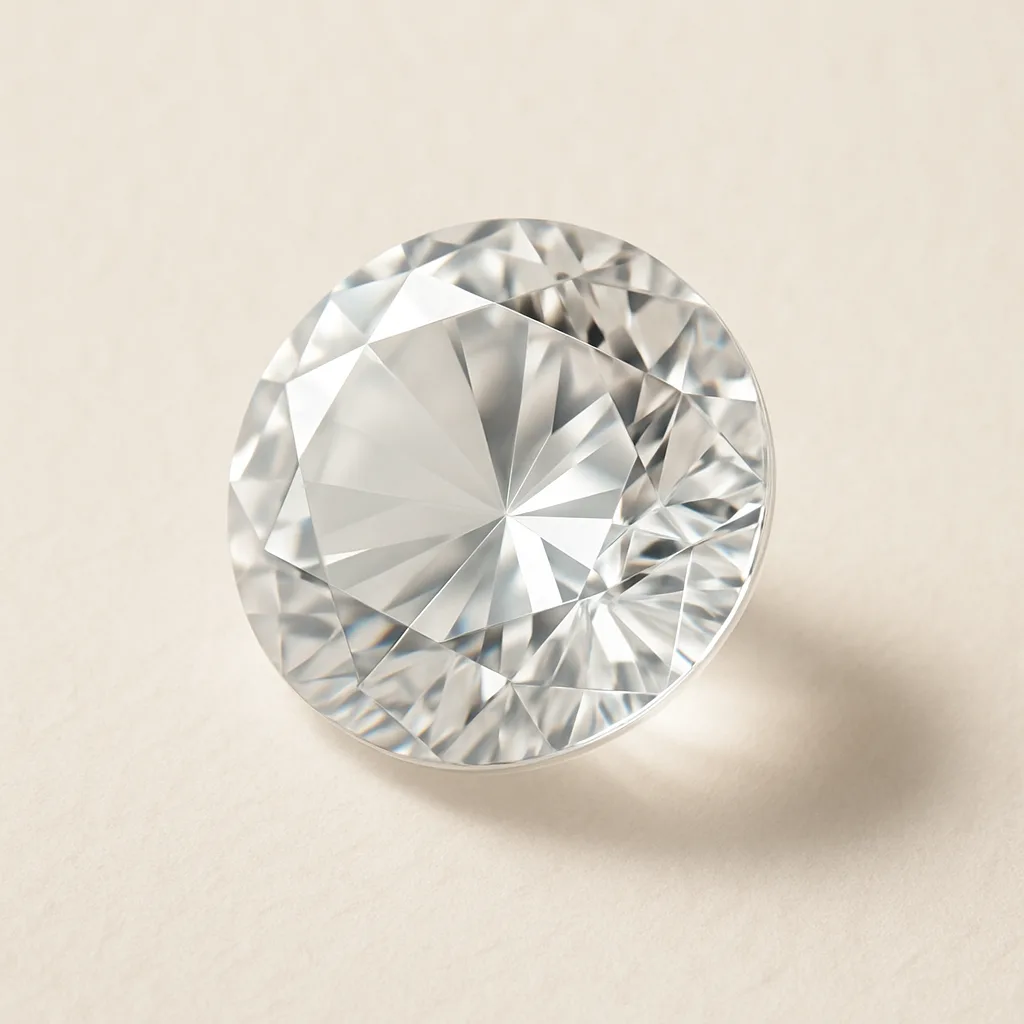
- Mohs 2–3 — extremely soft, easily scratched by virtually any contact
- Solvent-sensitive — acetone, alcohol, paint thinners, nail-polish removers, and most organic solvents dissolve or craze the surface
- Heat-sensitive — softens at 105°C glass-transition temperature, deforms at 160°C, melts at 200°C; avoid sunlight on dark dashboards and any sustained heat above 60°C
- UV-sensitive over decades — gradual yellowing and embrittlement; vintage Lucite costume jewelry shows characteristic 'aged yellow' patina that affects value
- No ultrasonic cleaning, no steam cleaning, no chemical cleaners
- Clean only with a soft dry cloth or barely-damp cloth with mild dish soap and immediate drying
Wholesale mass-production Chinese and Indian acrylic gemstones at $0.05–$1 per piece; finished costume-jewelry pieces at $1–$50 retail; better-quality cast PMMA cabochons and faceted stones at $2–$20 per piece. Vintage signed American costume-jewelry Lucite pieces (1940s–1970s Coro, Trifari, Eisenberg, Weiss, Hobé) at $50–$500 per piece at vintage and estate markets; rare 'jelly belly' Lucite figural pins by Coro, Trifari, or Eisenberg at $500–$5,000 at Sotheby's and Christie's estate-jewelry sales. Industrial bulk PMMA resin for in-house casting at $3–$8 per kg.
Note: Disclosure as 'plastic,' 'acrylic,' 'PMMA,' 'Plexiglas,' 'Perspex,' 'Lucite,' or 'imitation' is mandatory under FTC Jewelry Guides §23.26 and CIBJO Blue Book — selling acrylic as 'crystal,' 'gem,' or natural-stone-name is illegal in the US, EU, UK, and Japan. The 'crystal' terminology is particularly problematic: 'crystal' in legal-trade definition (EU Directive 69/493/EEC, US FTC Crystal Labelling Rule) requires ≥24% lead-oxide content for full-lead crystal glass, ≥10% for half-lead crystal — acrylic plastic contains no lead and cannot be legally labelled 'crystal' in EU markets. The vintage costume-jewelry market values signed pieces (Coro, Trifari, Eisenberg, Weiss, Hobé) at substantial premiums versus unsigned mass-production material — a signed 1950s 'jelly belly' Lucite figural pin can reach $500–$5,000 at major auction while unsigned period pieces trade at $20–$200. The Chinese mass-production output at $0.10–$2 per piece wholesale supplies the global low-tier costume-jewelry market.
Acrylic plastic gem imitations are polymethyl methacrylate (PMMA, polymer formula -[CH₂-C(CH₃)(COOCH₃)]ₙ-) — a thermoplastic synthetic polymer produced by free-radical polymerization of methyl methacrylate (MMA) monomer initiated with benzoyl peroxide at 60–80°C. The bulk density is 1.18 g/cm³ (1.15–1.20 g/cm³ depending on residual monomer and additives), 2–3 (easily scratched by a fingernail at Mohs 2.5), refractive index 1.490–1.500 (singly refractive because of the amorphous polymer structure — no aceted 'jewels' indistinguishable in appearance from glass paste rhinestones at typical viewing distance — the diagnostic separation requires the hardness, density, and acetone-solubility tests.
Origins
Modern industrial production is dominated by China (Guangdong, Zhejiang, and Jiangsu provinces — the world's largest costume-jewelry export economy, centred at Yiwu International Trade Market and Shantou) and India (Mumbai, Jaipur, Delhi). Vintage Lucite costume jewelry was produced at the American mid-Atlantic and New York costume-jewelry workshops (Coro Inc. Providence Rhode Island, founded 1901; Trifari New York founded 1918; Eisenberg & Sons Chicago founded 1914; Weiss New York founded 1942; Hobé Cie New York founded 1887). The polymer itself is produced industrially by Röhm & Haas (now part of Evonik Industries, Darmstadt, Germany), Imperial Chemical Industries (ICI, now Lucite International, Hampshire UK, acquired by Mitsubishi Rayon 2009), DuPont (Wilmington Delaware, the 1937 Lucite trademark), Mitsubishi Chemical (Japan, the world's largest MMA producer since 2008), and Arkema (France).
History
aceted Lucite costume jewelry for the American post-war middle-class market. The 1958–1962 American 'Bakelite revival' incorporated Lucite bracelets and pins. The 1970s Italian-design 'Plexiglas furniture' moment (Studio65, Joe Colombo's 'Universale chair' in Plexiglas, the Phillipe Starck 'Louis Ghost chair' 1999 descendant) brought architectural-scale acrylic into design culture. Chinese mass production of acrylic costume jewelry scaled from c. 1990, reaching the current dominant world-supply position by 2000. The 2000s 'recycled-acrylic' sustainability movement and the 2010s 'plant-based bio-PMMA' (Trinseo Plexiglas Cyrolite, Mitsubishi Chemical PMMA from renewable feedstock) extend the polymer's modern industrial history.
Lore & symbolism
No traditional birthstone designation (synthetic polymer material). The vintage American costume-jewelry market (1940s–1970s Coro, Trifari, Eisenberg, Weiss, Hobé, Schreiner, Schiaparelli, Boucher, Florenza, Castlecliff, Hattie Carnegie, Joseff of Hollywood) has built a dedicated collector culture around Lucite jewelry — signed pieces from the 1950s peak period (especially 'jelly belly' Lucite figural pins with embedded silver foil or rhinestones in colourless cast resin) command serious auction prices in the modern vintage market. The Plexiglas–Perspex–Lucite trio represents one of the great mid-20th-century industrial-design moments and is celebrated in Bauhaus, Cooper Hewitt, and Vitra Design Museum collections. The aircraft-canopy WWII history attaches a deep industrial-heritage narrative to the polymer that the costume-jewelry context preserves.
Tools to confirm this stone
Tools that help confirm Plastic / Acrylic / Lucite. Tap any item to jump to the matching section on the gem tools page.
- 最終確認日
- 2026年4月28日
- 参 考 文 献
- Gem Encyclopedia/ GIA (Gemological Institute of America)
- 宝石鑑別基準/ 中央宝石研究所 (CGL)
- Mineral & Gem Database/ Mindat.org / Gemdat.org
- 宝石学入門/ 全国宝石学協会
本ページの物性値(屈折率・比重・硬度・結晶系等)は、上記の権威ある一次資料を相互参照して編集しています。最新の鑑別研究の進展により値が更新される場合があります。