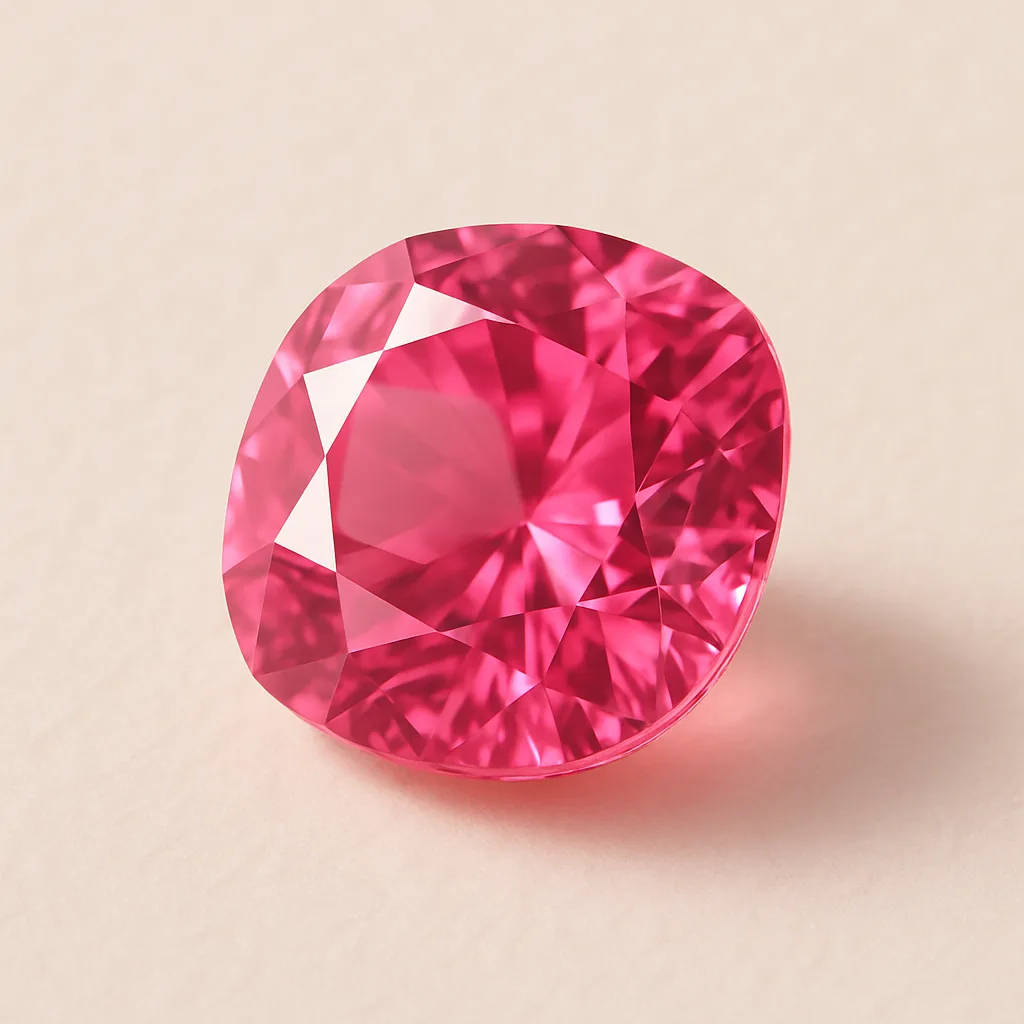
identified this stone yet
Pink Spinel
| Hardness | 8 |
| Specific gravity | 3.60 |
| Refractive index | 1.718 |
| Crystal system | 等軸晶系(立方晶系) |
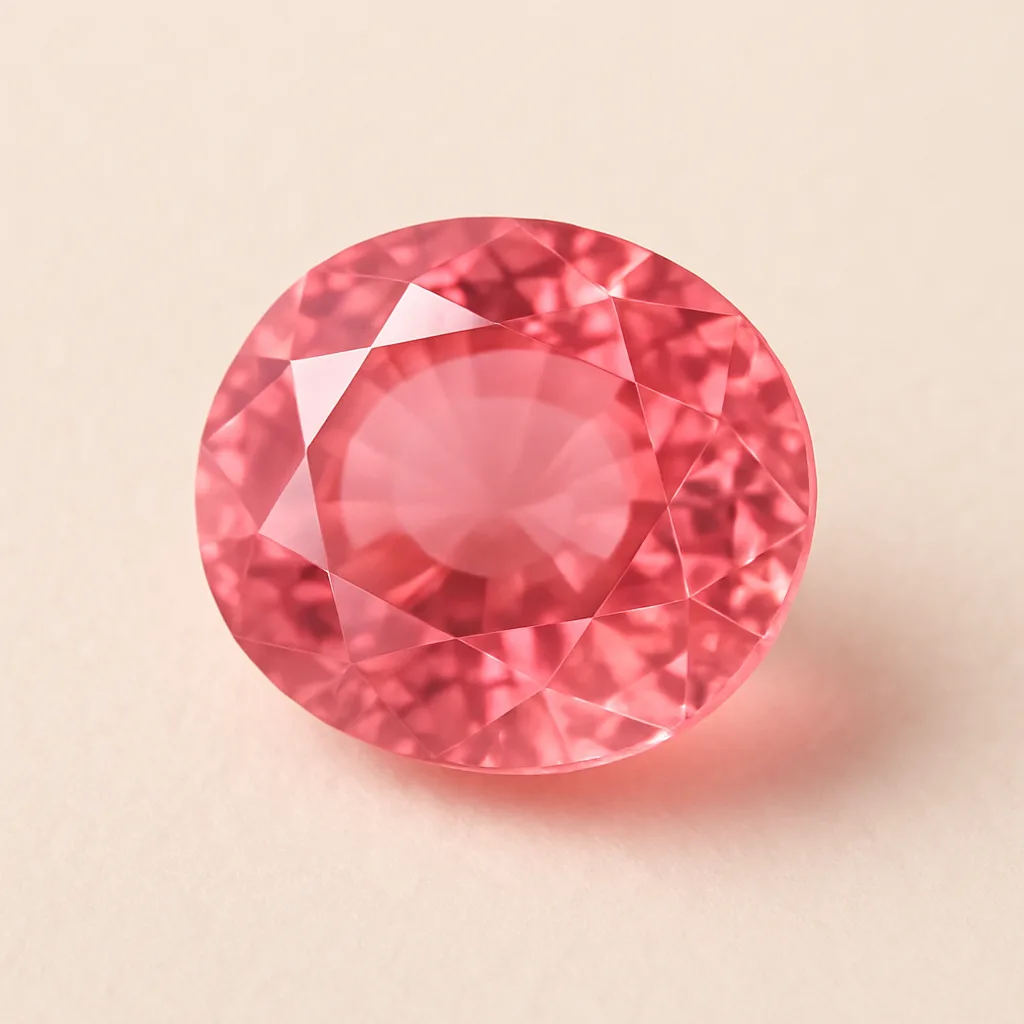
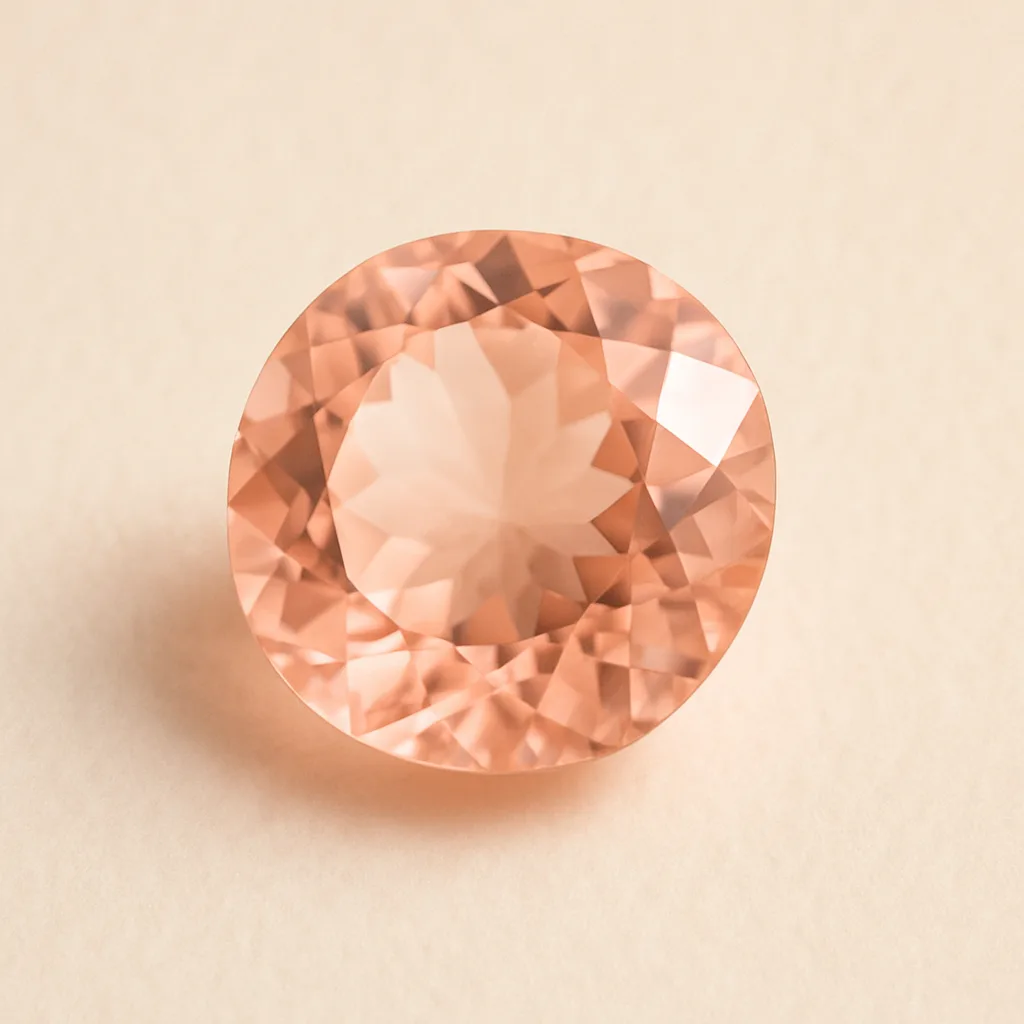
Soft baby-pink to vivid hot-pink and neon-pink, sometimes with slight purple or red modifier. The 2007 Mahenge Tanzania 'neon pink' material with very fine Cr³⁺ saturation and unusually clean clarity is the modern reference (hexcode #F26FA4 to #FF4A8F). Mogok Burmese 'hot pink' and 'Mansin pink' historical material is the classical reference (hexcode #E85C8F to #F58FB8).
- egative crystals — diagnostic spinel signature visible at 10× magnification
- nclusion networks along healed fractures
- nclusions
- Mogok material: characteristic 'snowstorm' clouds of fine octahedral particles
- egative crystals
- Synthetic Verneuil material: curved growth striae and round gas bubbles diagnostic of flame-fusion origin
- Refractive index 1.712–1.736 — singly refractive (isotropic cubic )
- Specific gravity 3.58–3.61 — diagnostic against pink sapphire (3.99–4.01) and morganite beryl (2.71–2.90)
- Mohs 8 — excellent durability for daily wear
- No (isotropic cubic) — diagnostic against pink sapphire which shows weak-to-medium
- Strong red LW-UV — diagnostic Cr³⁺ chromophore signature
- Chelsea filter shows red response — diagnostic of Cr³⁺ chromophore
- 0.020 — moderate, gives noticeable fire in well-cut stones
- 01Singly refractive (no under crossed polars at 30×) versus pink sapphire's clear — diagnostic single-test separator from pink sapphire
- 02egative crystals at 10× magnification — diagnostic spinel signature
- 03Strong red LW-UV — diagnostic Cr³⁺ chromophore versus chromium-free pink stones (morganite, kunzite, pink topaz)
- 04Specific gravity 3.58–3.61 — separates from pink sapphire (3.99–4.01), morganite (2.71–2.90), kunzite (3.16–3.20), pink topaz (3.49–3.57)
- 05Refractive index 1.712–1.736 — separates from morganite (1.567–1.583), pink topaz (1.609–1.643), pink tourmaline (1.616–1.652), kunzite (1.660–1.681)
- 06Chelsea filter red response — diagnostic of Cr³⁺ chromophore
- 07No (isotropic cubic) — diagnostic against pink sapphire's weak-to-medium
- Mohs 8 — excellent durability for daily wear including ring use
- Ultrasonic cleaning is generally safe for clean unheated material
- Steam cleaning acceptable
- nclusions
- Storage in a soft pouch to prevent scratching of softer stones in the same jewelry box
- Heat-treated material (rare for pink spinel) should be cleaned more gently
Mahenge Tanzania 'neon pink' premium material: $1,000–$15,000+ per carat for 1–3 carat fine clean stones with strong Cr³⁺ saturation; $500–$3,000 per carat for commercial-quality Mahenge material. Mogok Burmese 'hot pink' historical material: $500–$5,000 per carat for fine clean 1–3 carat stones. Kuh-i-Lal Tajikistan and Vietnamese Luc Yen material: $200–$2,000 per carat. Sri Lankan Ratnapura and Madagascar Ilakaka material: $100–$1,500 per carat. Synthetic Verneuil pink spinel: $1–$20 per carat. The Black Prince's Ruby (170 ct octahedral spinel) and the Timur Ruby (352 ct cabochon spinel) in the British Royal Collection are non-commercial and effectively priceless as state property of the British monarchy.
Note: Disclosure as 'natural spinel' is the trade standard for unheated material; heat treatment for clarity improvement is occasionally encountered and must be disclosed under FTC Jewelry Guides §23.22 and CIBJO Blue Book. The 2007 Mahenge 'neon pink' material with verified Mahenge origin documentation commands strong premiums versus other pink-spinel sources. Origin determination by GIA, AGL (American Gemological Laboratories), Lotus Gemology, and SSEF Swiss Gemological Institute is the standard practice for high-value pink spinel — trace-element fingerprinting (LA-ICP-MS analysis of Ga, Zn, V, Ni, Cr, Fe, Ti ratios) reliably distinguishes Mahenge versus Mogok versus Kuh-i-Lal versus Sri Lanka. Synthetic Verneuil pink spinel (L. Paris 1908 process) is distinguishable by curved growth striae, gas-bubble inclusions, and trace-element patterns — disclosure as 'synthetic spinel' is mandatory. Glass-imitation 'pink spinel' substitutes (lead-glass paste with Cr³⁺ doping) circulate in the costume-jewelry market and require 'imitation' disclosure.
Pink spinel is MgAl₂O₄ in the cubic isometric system, coloured by trace Cr³⁺ substituting in the octahedral Al³⁺ site at 0.01–0.5 wt% Cr₂O₃. The chromium chromophore mechanism is identical to ruby (where Cr³⁺ substitutes in the Al³⁺ site of corundum α-Al₂O₃) — the same under LW-UV and the same broad-band absorption in the green-yellow that produces the pink-to-red colour. The single refraction (isotropic cubic, RI 1.712–1.736, no , no ) is the diagnostic separator from pink sapphire, which is doubly refractive uniaxial negative with weak-to-medium . The Verneuil flame-fusion synthesis (Auguste Verneuil 1902 French Academy of Sciences) initially produced corundum but in 1908 L. Paris at the Verneuil laboratory modified the technique with magnesium-oxide addition to produce synthetic spinel — the synthetic material has dominated certain colour categories (notably blue and aquamarine-imitation spinels) but pink spinel commercial production remains primarily natural. The 1985 Sri Lankan Embilipitya discovery of colour-change spinel and the 2007 Tanzanian Mahenge 'neon pink' discovery (Werner Spaltenstein, ICA Bangkok and Henn Idar-Oberstein investigation) defined the modern collector market. The 2016 AGTA addition of spinel as the August birthstone (alongside peridot and sardonyx) confirmed the species' modern commercial arrival.
Origins
Mogok Stone Tract in northern Myanmar (the historical 'Burmese ruby' district at Mogok, Kyatpyin, and Mansin — producing the classical 'hot pink' spinel reference since at least the 15th century, though commercial extraction has been disrupted by Myanmar political instability and 2008–2010 US sanctions enforcement) is the historic premium source. Mahenge ward, Ulanga district, Morogoro region, Tanzania — discovered 2007 by Werner Spaltenstein and investigated by Kenneth Scarratt's Henn Idar-Oberstein team (Henn 2008 Gems & Gemology paper) — produces the modern 'neon pink' or 'Mahenge pink' reference with unprecedented Cr³⁺ saturation and unusual clarity. Kuh-i-Lal at Khorog, Gorno-Badakhshan, Tajikistan (the historic 'balas ruby' source supplying medieval Central Asia and the Mughal courts — the Timur Ruby in the British Royal Collection is a 352-carat Kuh-i-Lal spinel, the Black Prince's Ruby a 170-carat octahedral spinel from the same district), Luc Yen district in Yen Bai Province, Vietnam (post-1990 commercial production), Ratnapura district in Sri Lanka (the alluvial gem fields), Ilakaka in southwestern Madagascar (post-1998 alluvial production), and Pamir Mountains region across Tajikistan and Afghanistan complete the source list. The Mahenge production peaked 2007–2012 and has tapered since, supporting collector premium prices for material with reliable Mahenge origin documentation.
History
The history of pink spinel is inseparable from the centuries-long confusion with ruby — both species occur in the same alluvial gem deposits in Burma and Central Asia, both show the chromium red colour, and the distinction was only mineralogically resolved in the 18th–19th century. The Black Prince's Ruby in the British Imperial State Crown (a 170-carat octahedral red spinel from Kuh-i-Lal, Tajikistan) was acquired by Edward of Woodstock 'the Black Prince' in 1367 as a payment from Don Pedro the Cruel of Castile; identified as spinel rather than ruby by James Tennant of the British Museum in 1851. The Timur Ruby (a 352-carat polished spinel from Kuh-i-Lal, inscribed with the names of Mughal emperors Akbar, Jahangir, and Shah Jahan, ceded to Queen Victoria in 1851 after the British East India Company seizure from the Sikh treasury at Lahore) — also confirmed as spinel rather than ruby in modern gemological re-examination. The medieval and Renaissance European royal regalia treats 'ruby' and 'balas ruby' (the Persian/Old French term for spinel from the Balascia district = Badakhshan) as separate categories without understanding the underlying mineralogical difference; modern scholarship recognizes that the majority of the great 'rubies' in pre-19th-century crown jewels are actually spinels. Auguste Verneuil's 1902 flame-fusion synthesis of corundum at the French Academy of Sciences laid the groundwork; L. Paris at the Verneuil laboratory modified the technique in 1908 with magnesium-oxide addition to produce synthetic spinel, opening industrial production of synthetic-spinel imitations from c. 1910 onward. The Karl Schmetzer 1985 paper on the Sri Lankan colour-change spinel discovery (Embilipitya, Henn/Schmetzer in Gems & Gemology Spring 1985) defined the modern spinel-research era. The 2007 Mahenge Tanzania discovery (Werner Spaltenstein 2007 ICA Bangkok announcement; Henn 2008 Gems & Gemology investigation paper) launched the modern 'pink spinel' premium market — the unprecedented 'neon pink' Cr³⁺-saturated material from this single Tanzanian district commands prices comparable to fine pink sapphire and pink tourmaline. The 2016 American Gem Trade Association (AGTA) decision to add spinel as the August birthstone (alongside peridot and sardonyx) confirmed the species' commercial arrival.
Lore & symbolism
August birthstone since 2016 (AGTA addition, alongside peridot and sardonyx). The 'Balas Ruby' tradition (medieval Persian, Mughal, Ottoman, and European royal regalia) treats spinel as a high-prestige stone equivalent to ruby. The Black Prince's Ruby and the Timur Ruby in the British Royal Collection are the iconic spinels of Western royal heritage. The chromium-pink colour carries the modern lore of compassion, love, and physical vitality in metaphysical traditions (Melody 1995, Hall 2003) — placement on the heart chakra, parallel to ruby's emotional-vitality associations. The 2007 Mahenge Tanzania story (Werner Spaltenstein's discovery during a routine gem-buying trip; the subsequent ICA Bangkok / Henn Idar-Oberstein investigation; the global premium market that emerged) is part of the modern gem-discovery folklore.
Tools to confirm this stone
Tools that help confirm Pink Spinel. Tap any item to jump to the matching section on the gem tools page.
- 最終確認日
- 2026年4月28日
- 参 考 文 献
- Gem Encyclopedia/ GIA (Gemological Institute of America)
- 宝石鑑別基準/ 中央宝石研究所 (CGL)
- Mineral & Gem Database/ Mindat.org / Gemdat.org
- 宝石学入門/ 全国宝石学協会
本ページの物性値(屈折率・比重・硬度・結晶系等)は、上記の権威ある一次資料を相互参照して編集しています。最新の鑑別研究の進展により値が更新される場合があります。