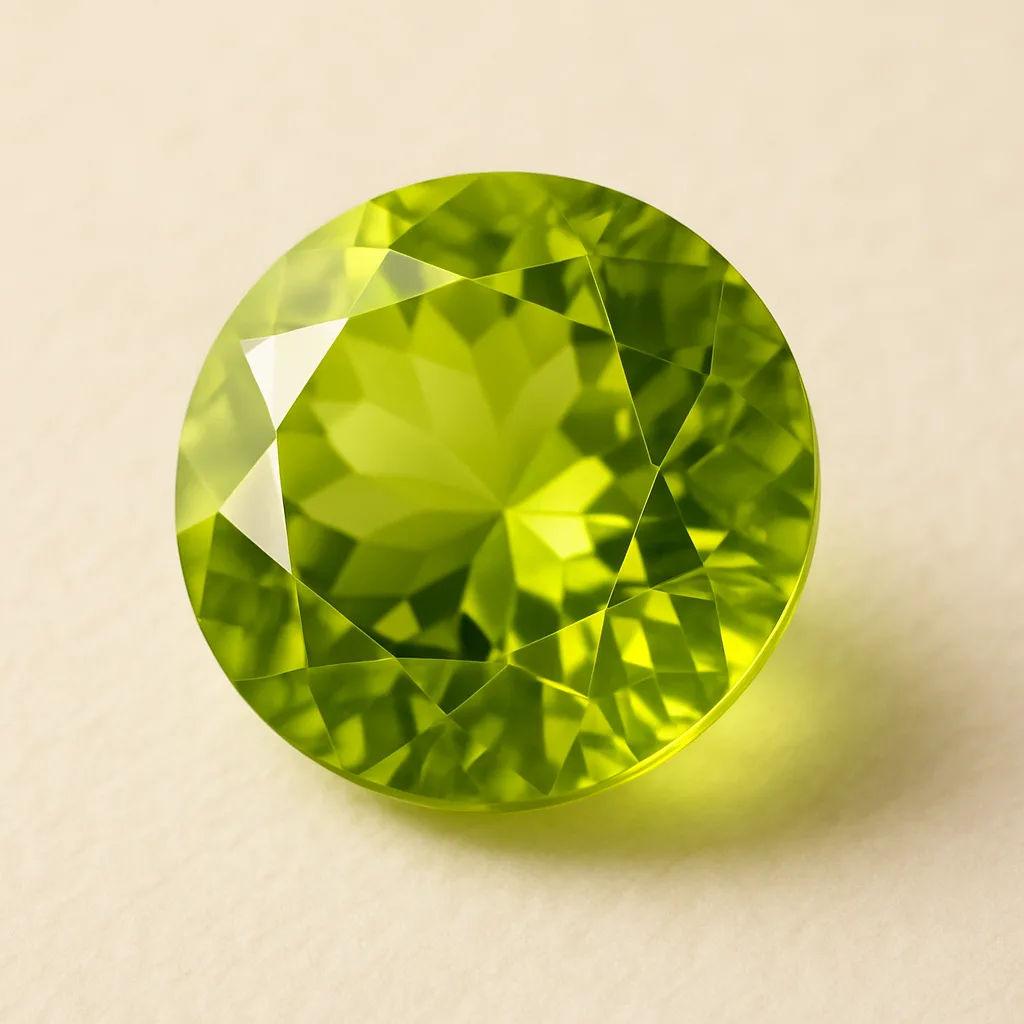
identified this stone yet
Peridot
| Hardness | 6.5-7 |
| Specific gravity | 3.34 |
| Refractive index | 1.654-1.690 |
| Crystal system | 斜方晶系 |
Yellowish green to slightly brownish green. The most prized tone is pure spring green ('grass green') without yellow undertones — characteristic of Burmese and Pakistani material. Iron content limits how dark peridot can become.
- nclusions surrounding a tiny crystal, diagnostic
- nclusions
- nclusions
- Healing fractures
- Doubly refractive, biaxial positive
- Strong (0.036) — visible at 10× and often to the unaided eye
- Weak dichroism: yellowish green and green
- 01Obvious acets visible at 10× — the strongest single identifier
- 02nclusions strongly support natural origin
- 03RI 1.654–1.690 and SG 3.27–3.48 are diagnostic
- 04No under either UV
- Avoid ultrasonic and steam — sudden thermal shock can damage
- Avoid acid contact (citrus, perspiration over time)
- Clean with warm soapy water
From $30/ct for commercial Arizona material up to $1,000/ct for fine Burmese or Pakistani spring-green stones over 5 ct.
Note: Untreated — peridot is one of the few major colored stones that is essentially never treated. Larger sizes (>5 ct) in pure spring green command increasing premiums. Burmese and Kashmir Pakistani material is the trade benchmark.
Peridot is forsterite-rich olivine ((Mg,Fe)₂SiO₄). Unlike most gems, color is intrinsic — every peridot is green because iron is part of the basic formula. Mohs 6.5–7 with no but distinct fracture. Notable for its very strong — acets is visible to the naked eye in larger stones.
Origins
Egypt's Zabargad Island produced peridot for over 3,500 years and was the historic source for European royal jewels. Myanmar (Mogok) and Pakistan (Suppat Valley, Kashmir) produce top-color modern material. Arizona (San Carlos Apache Reservation) is the largest current source by volume. Pallasite meteorites occasionally contain gem-quality peridot, sold as 'extraterrestrial peridot.'
History
Ancient Egyptians mined peridot on Zabargad Island in the Red Sea from at least 1500 BCE and called it the 'gem of the sun.' Many 'emeralds' in medieval European church treasuries — including some in the Shrine of the Three Kings in Cologne Cathedral — turned out to be peridot.
Lore & symbolism
August's birthstone, symbolizing strength and protection. Said to dispel night fears when set in gold. The 16th wedding anniversary stone.
Tools to confirm this stone
Tools that help confirm Peridot. Tap any item to jump to the matching section on the gem tools page.
- 最終確認日
- 2026年4月28日
- 参 考 文 献
- Gem Encyclopedia/ GIA (Gemological Institute of America)
- 宝石鑑別基準/ 中央宝石研究所 (CGL)
- Mineral & Gem Database/ Mindat.org / Gemdat.org
- 宝石学入門/ 全国宝石学協会
本ページの物性値(屈折率・比重・硬度・結晶系等)は、上記の権威ある一次資料を相互参照して編集しています。最新の鑑別研究の進展により値が更新される場合があります。