identified this stone yet
Synthetic Opal
| Hardness | 5-6 |
| Specific gravity | 1.97-2.20 |
| Refractive index | 1.37-1.50 |
| Crystal system | 非晶質(人工含水シリカまたは樹脂複合) |
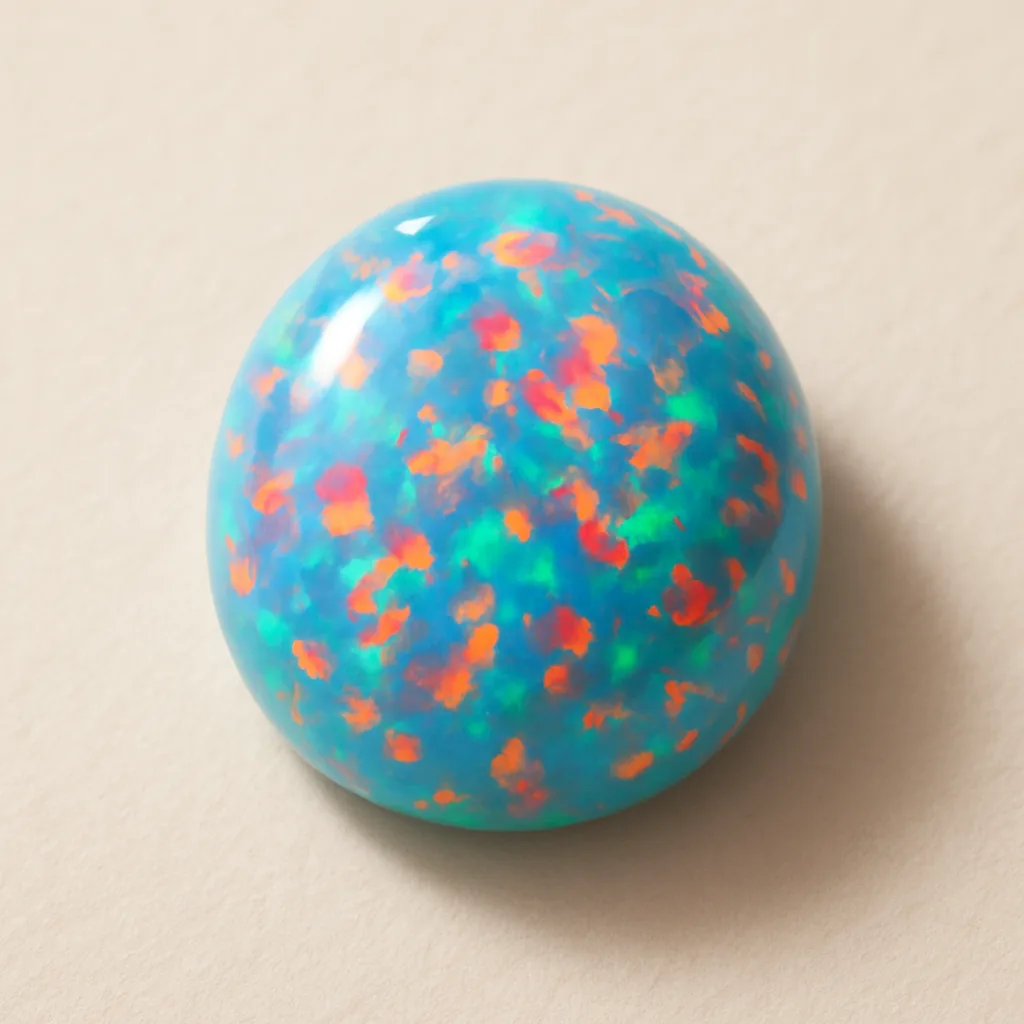
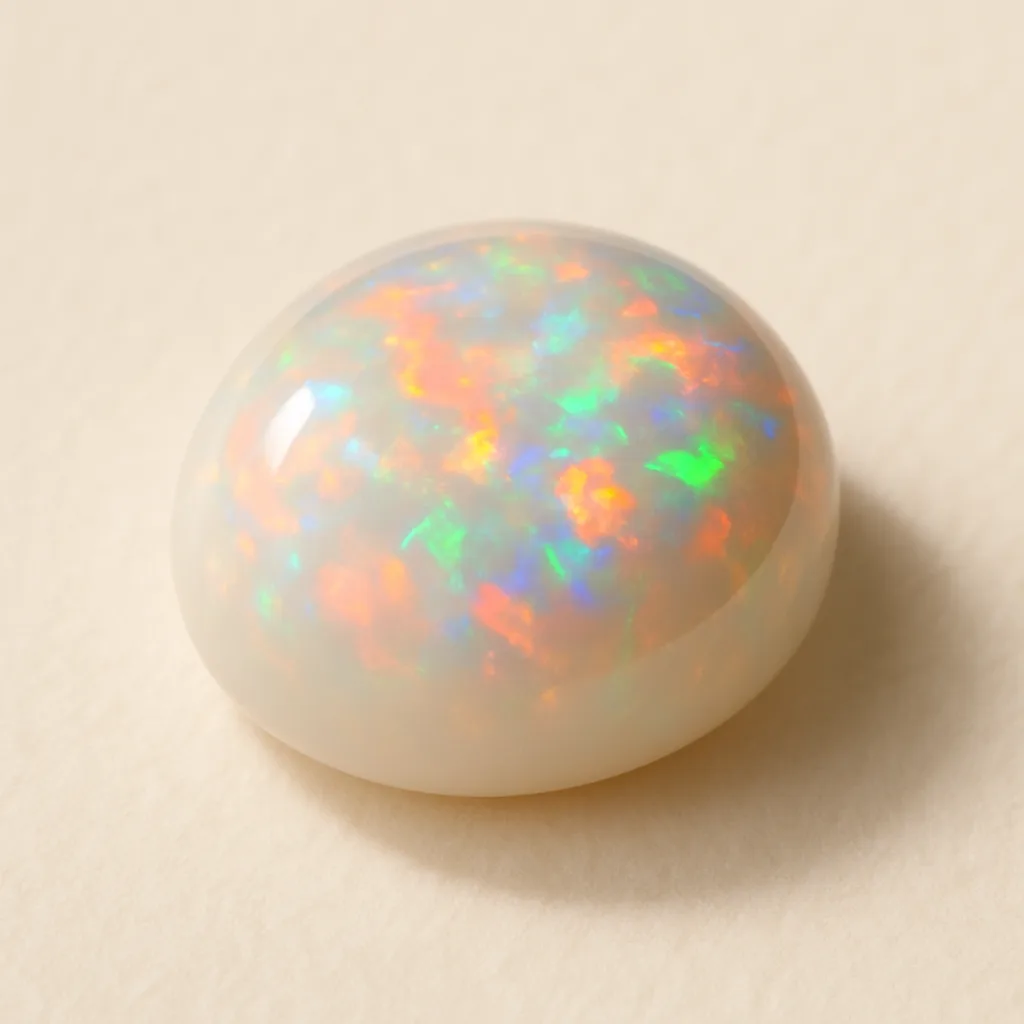
Engineered body colors — white, black, transparent, and warm — with vivid uniform play-of-color across the full spectrum. Reds and oranges are easier to produce in synthetic than in natural opal, making 'lab-created black opal' with red flashes very common.
- 'Chicken wire' polygonal pattern in the play-of-color zones — diagnostic of Gilson and Kyocera synthetic opal under 30× magnification
- Columnar growth structure visible from the side
- Uniformly sized and spaced color blocks
- Polymer 'plastic opal' may show air bubbles and resinous patches
- Amorphous, singly refractive (same as natural opal)
- Strong vitreous luster on Gilson/Kyocera material; resinous on polymer-impregnated stones
- Play-of-color uniform and engineered rather than organically variable
- Lower SG and Mohs on polymer-impregnated material is a quick separator
- 01Chicken wire or snakeskin pattern under 30× — single most diagnostic feature
- 02Regular, uniform color blocks vs. organic patches in natural opal
- 03Stronger and more uniform UV than typical natural opal
- 04Polymer-impregnated material is lighter and softer than true synthetic
- Mohs 5–6 for true synthetic — same care as natural opal
- Polymer-impregnated material (Mohs 4–5) is heat- and solvent-sensitive and should not be exposed to acetone or jewelry-cleaning solutions
- Avoid ultrasonic cleaning across all types
- Wipe with soft cloth and warm soapy water only
Roughly $5–$30/ct for polymer-impregnated 'plastic opal' cabochons, $30–$150/ct for true synthetic Gilson-style or Crescent Vert material with strong play-of-color, and $200–$500/ct for large or specialty synthetic opals (synthetic boulder opal, synthetic harlequin). A fraction of natural opal pricing.
Note: Disclosure is critical. Gemologically, synthetic opal is detected by examining the play-of-color regions under 30×: regular polygonal 'chicken wire' or 'snakeskin' patterns indicate synthetic origin, while natural opal shows irregular, organic color patches. The polymer-impregnated 'plastic opal' is lighter (SG 1.6–1.9 vs 2.0–2.2 for true synthetic) and softer (Mohs 4–5), and is sometimes mislabeled as synthetic in low-end markets.
Synthetic opal is amorphous hydrated silica (SiO₂·nH₂O) produced by sedimenting submicron silica spheres into a regular three-dimensional lattice, then consolidating the structure with a binder. The result reproduces the diffraction physics of natural opal and is gemologically classified as a true synthetic — not an imitation. Pierre Gilson developed the first commercial process in the late 1960s; full-scale Gilson Created Opal production began in 1972. Kyocera launched the Crescent Vert synthetic opal in Japan in the early 1980s. A polymer-impregnated variant ('plastic opal,' often labeled Ducol or similar) is sold at lower price points and is technically an opal imitation, not a synthetic.
Origins
France: Pierre Gilson's original laboratory near Paris produced Gilson Created Opal from 1972 until the late 1990s, when manufacturing licenses moved to Asia. Japan: Kyocera's Crescent Vert process operates from facilities in Kagoshima and Shiga prefectures and remains the dominant high-end synthetic opal source. China: several factories produce both classic-style synthetic opal and polymer-impregnated 'plastic opal' for fashion jewelry.
History
Pierre Gilson, already known for synthetic emerald, turbo-charged opal synthesis research in 1964 and announced commercial Gilson Created Opal in 1972, complete with a published synthesis description that triggered a decade of gemological identification papers. Kyocera's Crescent Vert was introduced commercially in 1984, building on the Inamori Group's synthetic gem research. The Gilson and Kyocera processes both produce a characteristic 'chicken wire' pattern in column cross-section — the diagnostic feature still used in GIA labs to separate synthetic from natural opal.
Lore & symbolism
The October birthstone — synthetic opal carries the same nominal lore as natural opal, but modern jewelry writing positions it as a stone of innovation and possibility. Synthetic opal is also widely used in modern Buddhist juzu prayer beads in Japan, where Kyocera's reputation for stable quality is valued. The 14th wedding anniversary gem.
Tools to confirm this stone
Tools that help confirm Synthetic Opal. Tap any item to jump to the matching section on the gem tools page.
- 最終確認日
- 2026年4月28日
- 参 考 文 献
- Gem Encyclopedia/ GIA (Gemological Institute of America)
- 宝石鑑別基準/ 中央宝石研究所 (CGL)
- Mineral & Gem Database/ Mindat.org / Gemdat.org
- 宝石学入門/ 全国宝石学協会
本ページの物性値(屈折率・比重・硬度・結晶系等)は、上記の権威ある一次資料を相互参照して編集しています。最新の鑑別研究の進展により値が更新される場合があります。