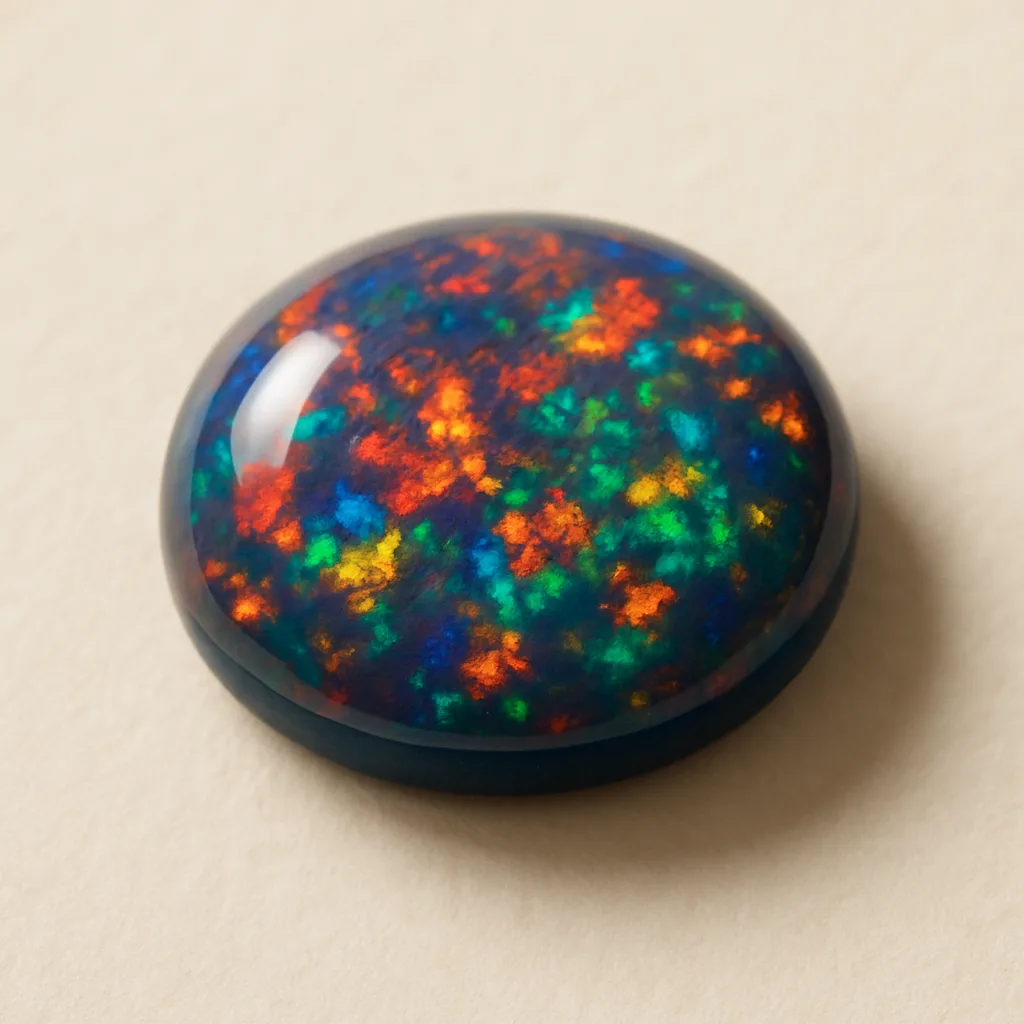
identified this stone yet
Assembled Opal (Doublet/Triplet)
| Hardness | 5.5-6 |
| Specific gravity | 2.00-2.50 |
| Refractive index | 1.37-1.50 |
| Crystal system | 非晶質(天然オパール薄片+台座) |
The opal slice provides the play-of-color (full spectrum, body color black-to-crystal); the backing provides the visual ground (typically black, sometimes brown or gray); the optional cap is transparent and colorless. Cap-induced magnification can make a triplet's play-of-color appear larger and more saturated than the underlying opal slice alone would suggest.
- Cement layer at the opal-backing interface — visible as a planar reflective line in side view, the diagnostic feature
- Second cement layer at the opal-cap interface in triplets — produces two visible planar lines
- Occasional air bubbles trapped in the cement layer (especially in older shellac-set doublets)
- Edge view of the laminate sandwich, visible if the side seam is not concealed by a bezel
- Layered composite — bulk optical properties are weighted averages and not directly diagnostic
- Opal slice: RI 1.43–1.47, singly refractive
- Quartz cap (in triplets): RI 1.54–1.55, doubly refractive — produces detectable visible at 10× on edges of the cap
- Glass cap (in cheaper triplets): RI 1.50–1.65, singly refractive
- Total internal reflection at the cement layers visible in transmitted light
- 01Side-view examination at 10× shows planar cement-layer interface(s) — one for doublets, two for triplets — the single most reliable diagnostic
- 02Edge of the stone shows the laminate sandwich unless concealed by bezel — many older settings deliberately bezeled the side to hide the assembly
- 03Backing material differs visibly from the opal layer in transmitted light (black potch, basalt, or glass shows as distinct dark layer)
- 04nclusions (if glass)
- 05Water-soak test: doublets sometimes show water ingress at the cement seam over hours (cementing failure); triplets are typically sealed
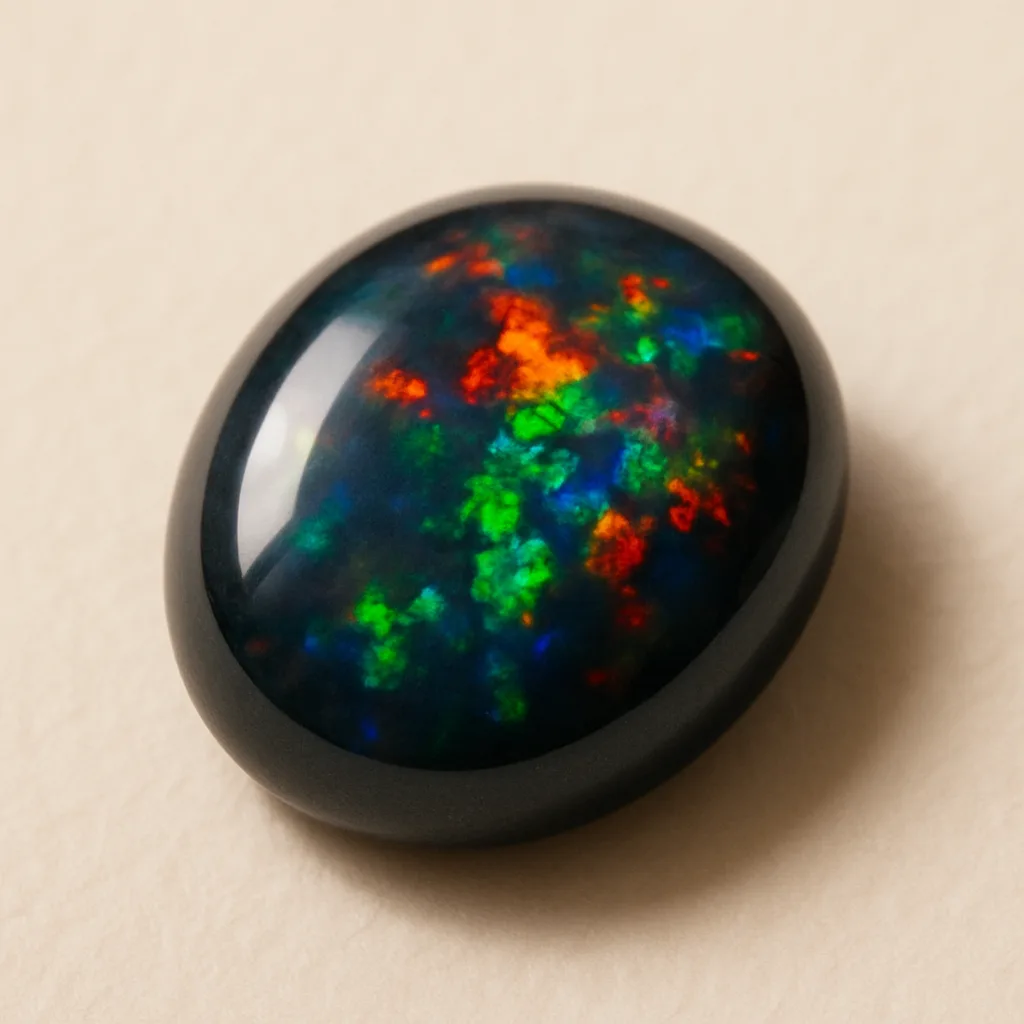
- The opal layer is Mohs 5.5–6.5 — protected by the cap in triplets, exposed in doublets
- Never ultrasonic, steam, or thermal cleaning — the cement layer is the principal failure point in both doublets and triplets
- Avoid prolonged water immersion — older shellac-set doublets in particular can delaminate; modern epoxy assemblies are more durable but not immune
- Avoid solvents (acetone, alcohol, jewelry cleaning fluids) — many cements are soluble in these
- Store flat and dry; humidity cycling can stress the laminate seam over decades
- Clean only with a soft cloth, optionally barely damp with plain water — never soak
Commercial doublets $10–150 per stone; quality Australian Lightning Ridge or Coober Pedy doublets with strong black-base play-of-color $200–800 per stone; triplets in equivalent quality ranges typically priced 30–50% lower than equivalent doublets because the cap reduces perceived authenticity.
Note: Disclosure as 'assembled,' 'doublet,' or 'triplet' is required at every level of trade under CIBJO, AGTA, and FTC standards. The dominant retail issue is undisclosed sale as 'solid opal' or 'natural black opal,' which substantially defrauds purchasers — assembled opal typically trades at 1/10 to 1/5 the per-carat price of equivalent solid opal. Triplets are more durable than doublets because the protective cap shields the opal layer from abrasion and moisture, but triplets are also more visually recognizable as composites (the cap edge is visible) and so command lower premiums than well-made doublets that have been cleverly bezeled to hide the side seam. The Japanese market has historically been one of the largest consumers of well-made Australian doublets, with persistent enforcement attention from the Japan Jewelry Association on undisclosed assembled material.
An opal doublet consists of a thin slice (typically 0.5–2 mm) of precious opal cemented to a dark backing — usually common potch (opaline silica without play-of-color), black basalt, obsidian, vulcanite, or black glass — that intensifies the play-of-color by providing a contrast ground. An opal triplet adds a third layer: a clear protective dome of rock crystal quartz, glass, or (in cheaper modern production) plastic on top of the opal slice, which protects the soft opal layer from wear and amplifies the play-of-color through magnification. Mohs (effective) ~5.5–6.5 for the opal portion, with the cap (if present) contributing additional surface hardness — rock crystal cap raises the effective surface hardness to Mohs 7, glass cap to about 5–6. SG and RI are weighted averages of the constituent layers and are not diagnostic of solid opal. The assembled structure is detectable by viewing the stone from the side under 10× magnification or in transmitted light: the cement layer or layers appear as planar interfaces (the 'watershed line' in lapidary jargon).
Origins
Doublet and triplet manufacture is concentrated in the Australian opal-cutting centers — Lightning Ridge (New South Wales) for black-opal-slice doublets, Coober Pedy (South Australia) for crystal and white opal slices, and Mintabie (also South Australia). Most Australian rough that is too thin or too irregular for solid cutting is now assembled rather than discarded, and several Australian-based workshops have produced doublets and triplets at industrial scale since the 1950s. Hong Kong and Thai workshops produce a substantial share of the lower-end assembled-opal market, often using imported Ethiopian or Mexican opal slices on basalt or glass backings. Ethiopian Welo opal (post-2008) has expanded the available material base for assembled work because Welo material is naturally hydrophane (water-absorbing) and can be more easily worked into thin slices than Australian opal.
History
Assembled opal technique appears in the Australian opal-cutting literature from approximately 1908 onward, with the first documented Australian doublet workshops (in Sydney and at Lightning Ridge) producing pendant-grade composites for the European jewelry trade from the 1910s. The technique scaled commercially after World War II, when post-1945 Australian opal production at Coober Pedy yielded enormous quantities of thin-seam crystal opal that was uneconomical to cut as solids. The triplet variant — adding a protective rock-crystal or glass cap — was developed in the 1950s, partly in response to the durability complaints that had limited doublet acceptance in ring jewelry. Disclosure standards were progressively formalized through the 1960s and 1970s by the Federal Trade Commission in the United States and by CIBJO in Europe; the AGTA classification 'assembled stone' is the current standard term. Notable historical fraud cases (the 1970s Australian 'doublet ring' export scandal, in which Lightning Ridge doublets were systematically marketed as solid black opal to Japanese buyers) led to tightened disclosure requirements and to mandatory side-view inspection protocols in the Japanese gem-import trade.
Lore & symbolism
Assembled opal as a commercial category has no traditional lore — it is a 20th-century manufacturing innovation rather than an inherited gem material. The cultural associations of the opal slice within the assembly are inherited from the parent opal varieties (black, crystal, white, or fire). Some contemporary opal-trade marketing presents doublets and triplets as 'composite art jewelry' or 'engineered opal,' framings that have grown in acceptability as the broader market has become more comfortable with disclosed treatments and constructions.
Tools to confirm this stone
Tools that help confirm Assembled Opal (Doublet/Triplet). Tap any item to jump to the matching section on the gem tools page.
- 最終確認日
- 2026年4月28日
- 参 考 文 献
- Gem Encyclopedia/ GIA (Gemological Institute of America)
- 宝石鑑別基準/ 中央宝石研究所 (CGL)
- Mineral & Gem Database/ Mindat.org / Gemdat.org
- 宝石学入門/ 全国宝石学協会
本ページの物性値(屈折率・比重・硬度・結晶系等)は、上記の権威ある一次資料を相互参照して編集しています。最新の鑑別研究の進展により値が更新される場合があります。