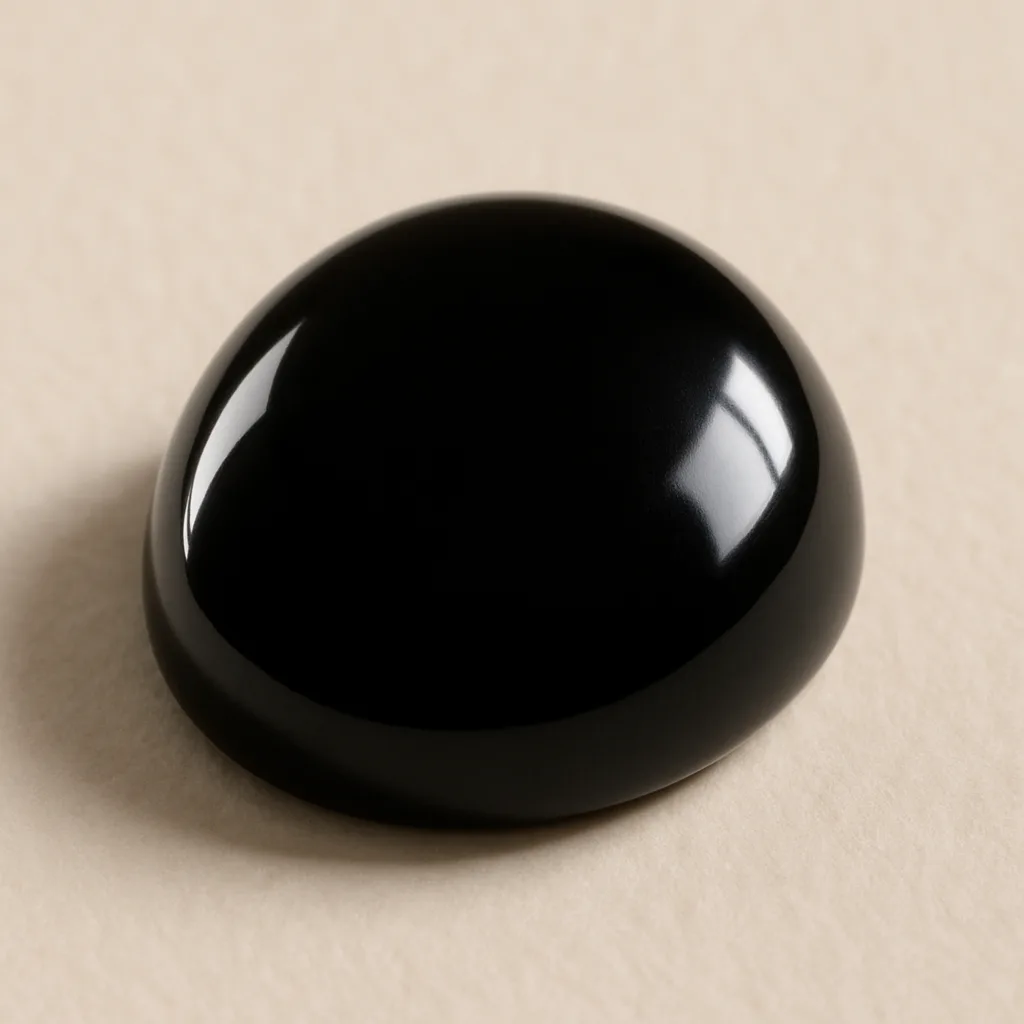
identified this stone yet
Onyx
| Hardness | 7 |
| Specific gravity | 2.60-2.65 |
| Refractive index | 1.535-1.539 |
| Crystal system | 六方晶系(三方晶系・微晶質クォーツ) |
Naturally: alternating black and white parallel bands; sardonyx adds red-brown layers. As dyed: uniform deep black ('black onyx,' the dominant commercial form), occasionally green or blue dye variants. Banding always runs in straight parallel lines, not curves.
- Parallel straight banding — the structural signature, distinguishing onyx from concentrically banded agate
- Color zoning visible at layer boundaries under 10×
- Occasional quartz druse along seams in matrix material
- Microcrystalline quartz texture visible in immersion
- Singly refractive (cryptocrystalline aggregate)
- Refractive index 1.53–1.54
- Specific gravity 2.58–2.64
- Vitreous to waxy luster on polished surfaces
- Translucent on thin edges, opaque in mass
- 01Mohs 7 — significantly harder than jet (2.5–4) and obsidian (5–5.5), comparable to other quartz family stones
- 02Specific gravity 2.58–2.64 — heavier than jet (1.3–1.35), lighter than hematite (5.1–5.3) and onyx-mimicking spinels
- 03Straight parallel banding (often visible only at edges of dyed material) distinguishes natural sardonyx from manufactured black glass
- 04Vitreous-to-waxy luster characteristic of chalcedony; hot-pin streak test is non-destructive (no scorch as with jet)
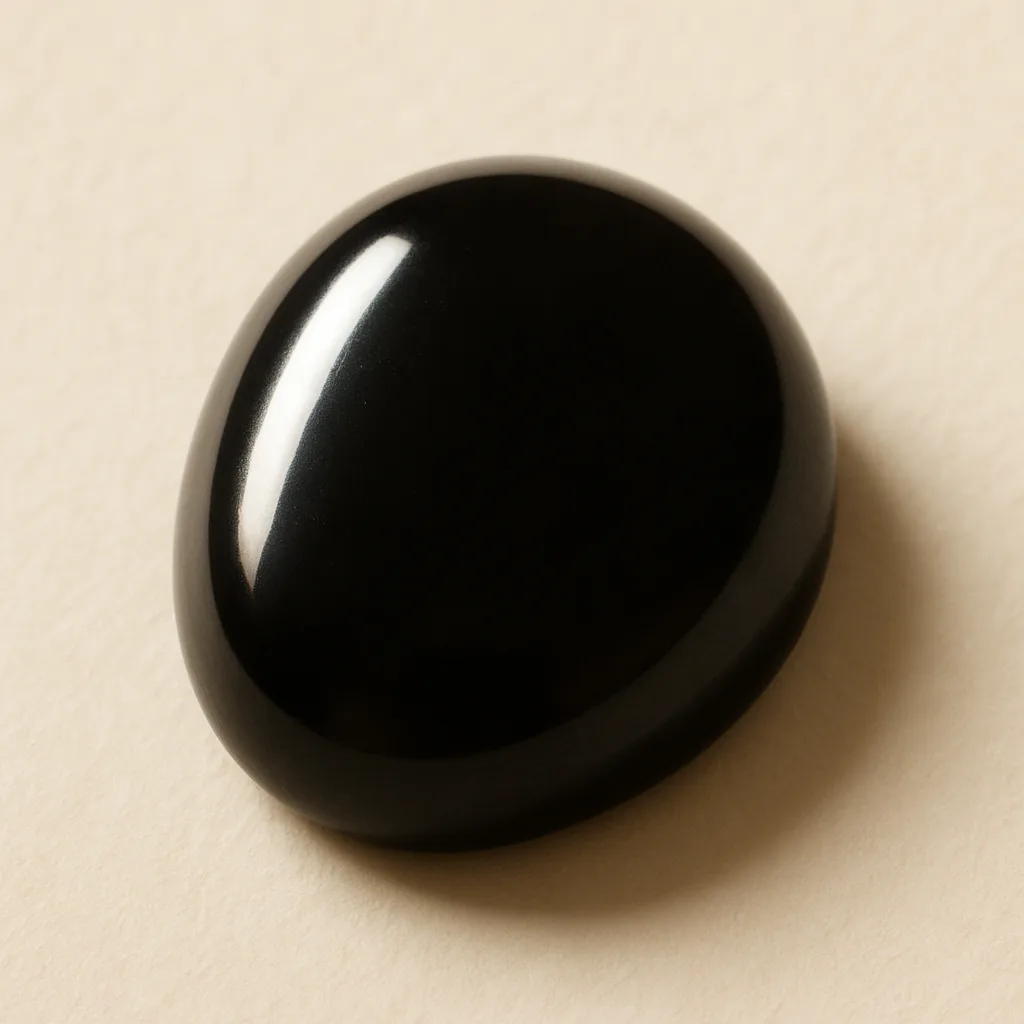
- Mohs 7 — durable for daily wear in rings, pendants, and earrings
- Generally safe to warm soapy water; ultrasonic and steam cleaning are safe for natural and dyed material alike (the dye is permanent)
- Avoid prolonged contact with strong acids and bases — the dye is stable but the chalcedony matrix can dull
- Stable to normal sunlight; no fade concerns
Modern dyed black onyx cabochons and beads $2–30 per piece; high-quality black onyx in Art Deco platinum settings $200–2,000 depending on workmanship; antique sardonyx cameos from $100 (19th-c. Italian revival) to many millions (verified Roman imperial work).
Note: Disclosure of the sugar-acid dye treatment is universal in the trade but rarely communicated at the retail level — consumers generally assume 'black onyx' is naturally black, which it almost never is. The treatment is permanent and stable; CIBJO and AGTA accept it without need for special disclosure. The chief market concerns are: (1) misidentification of dyed black chalcedony as 'black agate' or 'black jade' for higher prices; (2) cheap glass and resin imitations passed off as onyx in fashion jewelry; (3) historical sardonyx cameos, where attribution and dating drive enormous price differences (a verified Roman imperial cameo can reach seven figures at major auctions, while a 19th-century Italian revival sardonyx cameo of the same subject may sell for $500–5,000).
Onyx is a banded chalcedony — cryptocrystalline quartz (SiO₂) — distinguished from agate by its straight parallel banding rather than the concentric, curved, or fortification patterns of true agate. Mohs 7, SG 2.58–2.64, RI 1.53–1.54, singly refractive in the aggregate. Strict gemological usage reserves 'onyx' for chalcedony with black-and-white banding; sardonyx adds red-brown to the layering; carnelian-onyx adds orange-red. The single-color 'black onyx' that dominates contemporary jewelry is the product of a centuries-old dye process: grey chalcedony is soaked in concentrated sugar solution for several weeks, then immersed in concentrated sulfuric acid, which carbonizes the absorbed sugar in situ and produces a dense, permanent black throughout the porous structure. This process originated in Idar-Oberstein, Germany, in the 1820s and remains the universal commercial method.
Origins
Brazil's Minas Gerais — particularly the Rio Grande do Sul agate belt around Salto do Jacuí — is the dominant world source of the gray chalcedony rough used for both natural banded onyx and the Idar-Oberstein dyeing process; this trade route has been continuous since the 1830s when German agate-cutters established direct buying operations in Brazil. India's Deccan Traps (Maharashtra, particularly the Khambhat / Cambay region) produced the natural sardonyx that supplied the Roman imperial cameo workshops via the Erythraean Sea trade. Uruguay (Artigas Department) shares the same volcanic agate belt as southern Brazil. Mexico, Madagascar, and the United States (Oregon, Wyoming) contribute additional material. Idar-Oberstein, Germany, is not a source of rough but is the historical processing center where most commercial black onyx is dyed and cut.
History
Onyx has a longer documented use in glyptic art than almost any other gem. Sumerian and Babylonian cylinder seals (c. 3000 BCE) used sardonyx and banded chalcedony, taking advantage of the contrasting layers to produce relief carvings with built-in color contrast. The Roman imperial cameo tradition reached its peak in the early 1st century CE with the Gemma Augustea (c. 9–12 CE, Kunsthistorisches Museum Vienna), a two-layer onyx cameo 19 × 23 cm depicting the apotheosis of Augustus, and the Great Cameo of France (Grand Camée de France, c. 23 CE, Bibliothèque nationale de France), a five-layer sardonyx 31 × 26 cm depicting the Julio-Claudian dynasty — both carved from single Indian-origin sardonyx blocks of extraordinary size. The Renaissance saw renewed interest in cameo cutting at Italian courts (Pope Paul II's onyx collection, 15th century). The Idar-Oberstein sugar-and-acid dyeing process, developed by Carl Wild and others in the 1820s, transformed onyx from a banded specialty into the uniform black mourning stone that defined Victorian funerary jewelry alongside jet. The Art Deco period (1920s–1930s) used black onyx prominently in geometric platinum settings, often paired with diamonds or pearls — a stylistic vocabulary that has been repeatedly revived through the modern era.
Lore & symbolism
Greek onyx (ónux, 'fingernail/claw') was named for its layered translucence resembling the human nail bed. Roman tradition associated onyx with martial discipline and with the rigor of imperial Roman virtue; the apotropaic function of sardonyx amulets is recorded in Pliny. Medieval European lapidary texts (Marbode of Rennes, Liber Lapidum c. 1090) attributed onyx with the property of causing nightmares and quarrels — an unusually negative reputation that limited its medieval popularity. Victorian mourning culture (1860s–1890s) rehabilitated black onyx as the appropriate stone of second-stage mourning, worn after the initial all-jet phase. Contemporary New Age literature positions onyx as a stone of grounding, protection, and 'absorbing negative energy' — modern marketing claims without classical foundation.
Tools to confirm this stone
Tools that help confirm Onyx. Tap any item to jump to the matching section on the gem tools page.
- Last reviewed
- April 28, 2026
- Bibliography
- Gem Encyclopedia / GIA (Gemological Institute of America)
- Gem Identification Standards / Central Gem Laboratory (CGL), Tokyo
- Mineral & Gem Database / Mindat.org / Gemdat.org
- Introduction to Gemology / Gemmological Association of All Japan (GAAJ)
The gemological data on this page (refractive index, specific gravity, hardness, crystal system, etc.) is cross-checked against the authoritative primary sources listed above. Values may be revised as gemological research advances.