identified this stone yet
Obsidian
| Hardness | 5-5.5 |
| Specific gravity | 2.35-2.60 |
| Refractive index | 1.48-1.51 |
| Crystal system | 非晶質(天然ガラス) |
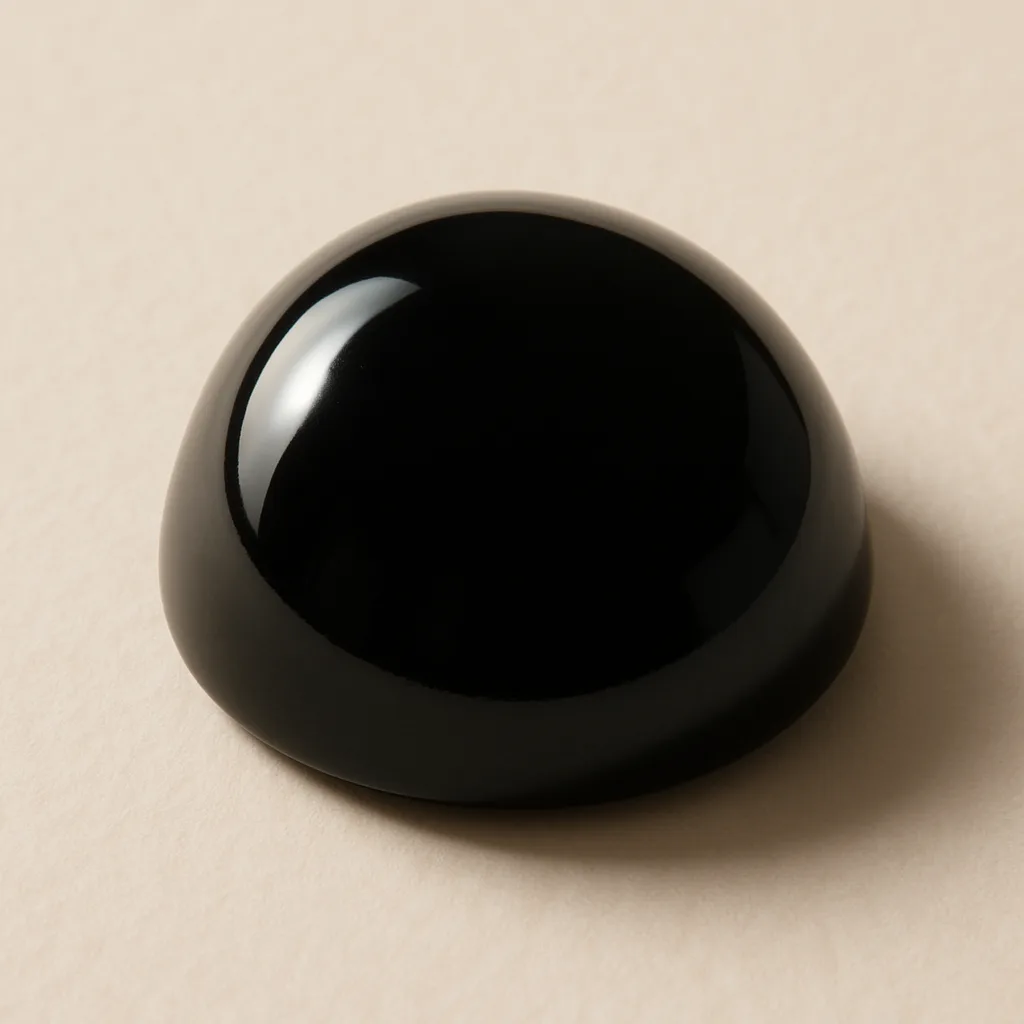
Predominantly black or very dark green-brown in transmitted light; sheen varieties show silver, gold, or rainbow iridescence from oriented films. Snowflake obsidian shows white-gray cristobalite spherulites on a black ground.
- Cristobalite spherulites — small radial white-gray crystal clusters — produce snowflake obsidian
- Oriented gas-bubble layers produce sheen and rainbow varieties
- Magnetite, hematite, and biotite microcrystals in mahogany and rainbow varieties
- Perlitic crackling (concentric onion-skin fractures) from hydration of the glass surface — produces Apache Tears spherules
- Singly refractive (isotropic — amorphous glass)
- Refractive index 1.48–1.51
- Specific gravity 2.3–2.6
- Conchoidal fracture — produces edges measuring 3 nanometers across, sharper than surgical steel
- Translucent to opaque; very thin sections transmit dark green or brown
- 01Singly refractive — no and no dichroism — separates obsidian from any crystalline black gem
- 02Refractive index 1.48–1.51 — lower than nearly all crystalline gems and characteristic of glass
- 03Specific gravity 2.3–2.6 — lighter than most opaque crystalline competitors (onyx 2.58–2.64, jadeite 3.30–3.38, hematite 5.1–5.3)
- 04Conchoidal fracture with sharp, glossy fracture surfaces is diagnostic and visible to the unaided eye
- 05Mohs 5–5.5 — scratches with a steel file but not with a copper coin
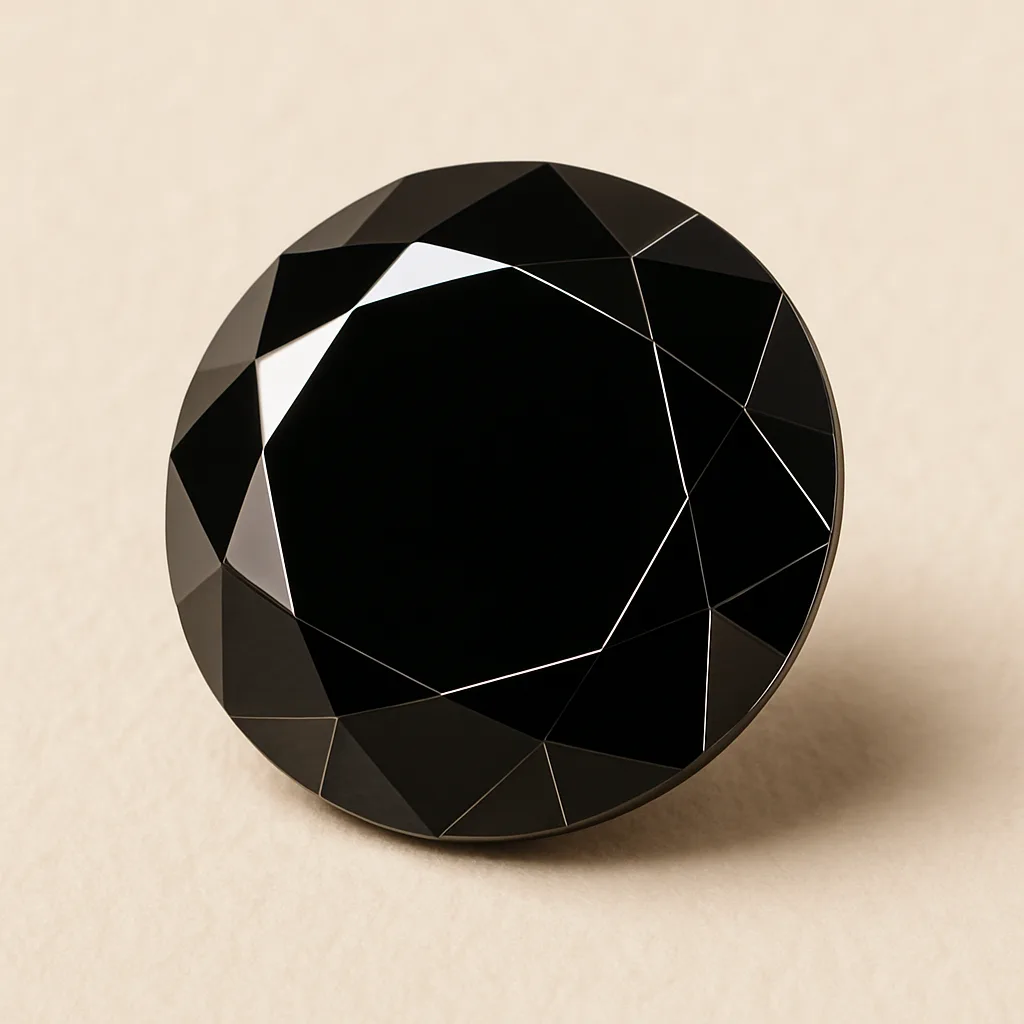
- Mohs 5–5.5 — relatively soft; suitable for pendants, beads, and carvings rather than daily-wear ring stones
- aceted obsidian carefully
- Generally safe to warm soapy water; avoid ultrasonic (microfractures propagate) and steam (thermal shock)
- Stable to most chemicals; avoid hydrofluoric acid (a silica solvent)
Tumbled or polished obsidian beads $2–15 per piece; sheen and rainbow obsidian cabochons $20–150 each; high-grade carved sculptures (especially Mexican workshop work in Sierra de las Navajas material) range from $50 to several thousand dollars.
Note: Obsidian is sold untreated in the jewelry trade. Imitations are uncommon — it is itself cheap enough that imitation is not economically motivated — but tumbled glass marbles and slag glass are occasionally misrepresented as obsidian in low-end markets. The main retail disclosure issue is the conflation of natural sheen varieties with manufactured imitations such as 'goldstone' (aventurine glass with copper crystals) and 'blue goldstone' (cobalt-containing glass), which share the iridescent appearance but are entirely artificial. Apache Tears spherules are typically sold rough rather than cut.
Obsidian is amorphous silica (SiO₂) glass of rhyolitic composition, with 70–75% silica and 1–4% water. Mohs 5–5.5, SG 2.3–2.6, RI 1.48–1.51, singly refractive (isotropic, as with all glasses). Conchoidal fracture is its defining mechanical property — knapped obsidian edges measure 3 nanometers across, sharper than any human-manufactured surgical blade, and the modern fields of microscalpel obsidian surgery (Errett Callahan, Bruce Buck c. 1975) and Paleolithic flintknapping experimental archaeology trade on this property. Varieties: black obsidian (the standard); snowflake obsidian (cristobalite spherulite phenocrysts on a black ground); rainbow/sheen obsidian (iridescence from oriented films); Apache Tears (small rhyolitic spherules naturally weathered out of perlitic host); mahogany obsidian (a separate stone in the gem trade); and golden/silver sheen obsidian.
Origins
Italy's Lipari (Aeolian Islands) was the primary source supplying obsidian to Neolithic Mediterranean cultures via maritime trade routes from c. 7000 BCE — Lipari obsidian has been chemically traced in tools across Malta, Sicily, mainland Italy, and southern France. Turkey's Çiftlik and Acıgöl in Cappadocia supplied Çatalhöyük (c. 7500 BCE), the oldest known urban settlement. Japan's Shirataki, Hokkaido, has been worked since c. 25,000 BCE — among the world's longest continuously exploited obsidian sources — and supplied Jōmon-period blade industries across Honshu and Hokkaido. Mexico's Sierra de las Navajas (Hidalgo) and Otumba supplied Teotihuacan and Aztec Tenochtitlan with the bottle-green obsidian preferred for prestige goods. Modern lapidary sources: Glass Buttes Oregon (rainbow and sheen varieties), Apache Tears spherules from Arizona's Superior and adjacent Sonoran localities, Hekla and Hrafntinnusker Iceland, and the Armenian highlands.
History
Obsidian is the foundational tool stone of Paleolithic and Neolithic human technology, predating agriculture, pottery, and metallurgy. The Çatalhöyük obsidian trade c. 7500 BCE is the oldest documented long-distance commodity exchange. Aztec sacrificial blades (tecpatl, often dedicated to Tezcatlipoca, 'Smoking Mirror') and ritual mirrors used Sierra de las Navajas obsidian; one such mirror, originally Aztec, came into the hands of Elizabethan astrologer Dr. John Dee in 1582, who used it as a scrying glass and recorded angelic conversations through it — the mirror is now in the British Museum (catalogue Am1966,10.1). Pliny's Naturalis Historia describes obsidian as 'lapis obsianus,' attributing its discovery to a Roman explorer named Obsius in Ethiopia. The Hokkaido Shirataki obsidian was foundational to Ainu and pre-Ainu tool industries. Modern obsidian surgery — using knapped obsidian microblades for delicate procedures including ophthalmic and microvascular work — was pioneered by Errett Callahan and Don Crabtree in experimental archaeology contexts and adopted clinically by Bruce Buck and others from 1975 onward; obsidian blades remain in limited use for high-precision surgical applications.
Lore & symbolism
Aztec tradition identified obsidian with Tezcatlipoca, 'Smoking Mirror,' the god of night, sorcery, and divination — Tezcatlipoca's iconography includes an obsidian mirror in place of one foot. Mesoamerican shamans used polished obsidian disks for scrying. The Apache Tears name comes from a 19th-century Pinal Apache narrative recorded in southern Arizona: after an 1870 cavalry skirmish at Big Picacho left a band of Apache warriors trapped on a cliff who chose to leap rather than surrender, the women of the band wept onto the ground, and their tears were said to have fallen as the small rhyolitic obsidian spherules now scattered across the desert below. The narrative is folkloric, but the rocks are real and the name has stuck. Modern New Age and crystal-healing literature recycles Mesoamerican shamanic associations into 'protection,' 'truth-telling,' and 'shadow work' marketing categories.
Tools to confirm this stone
Tools that help confirm Obsidian. Tap any item to jump to the matching section on the gem tools page.
- 最終確認日
- 2026年4月28日
- 参 考 文 献
- Gem Encyclopedia/ GIA (Gemological Institute of America)
- 宝石鑑別基準/ 中央宝石研究所 (CGL)
- Mineral & Gem Database/ Mindat.org / Gemdat.org
- 宝石学入門/ 全国宝石学協会
本ページの物性値(屈折率・比重・硬度・結晶系等)は、上記の権威ある一次資料を相互参照して編集しています。最新の鑑別研究の進展により値が更新される場合があります。