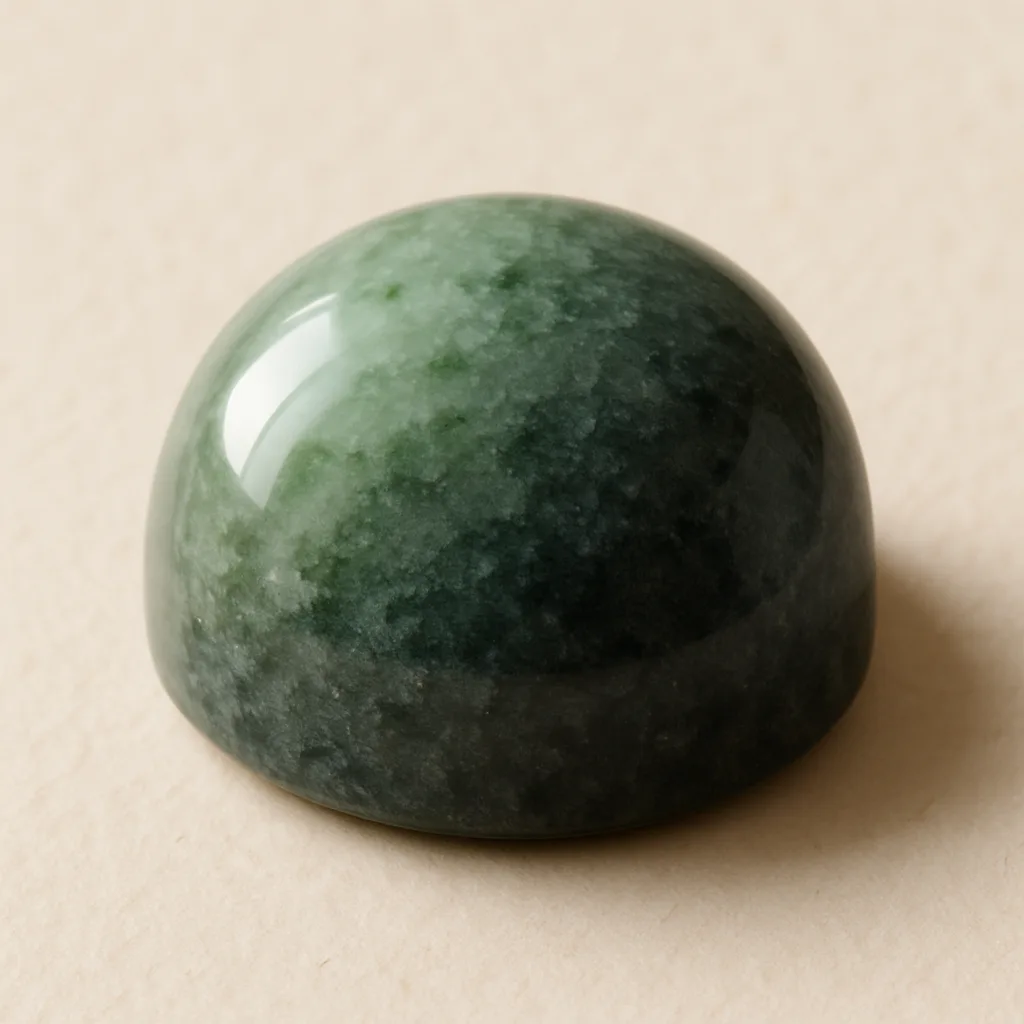
identified this stone yet
Nephrite
| Hardness | 6-6.5 |
| Specific gravity | 2.95 |
| Refractive index | 1.60-1.63 |
| Crystal system | 単斜晶系(繊維状集合体) |
Creamy white ('mutton-fat'), spinach green, gray-green, yellow, brown, and black, depending on the iron-to-magnesium ratio.
- Fine, felted fibrous texture under 10× — finer than jadeite's granoblastic structure
- Black magnetite or chromite spots and veins
- Iron-oxide brown staining along natural fractures
- Aggregate behavior — a single refractometer reading near 1.61–1.63
- Exceptional toughness — among the highest of all gem materials
- Specific gravity 2.90–3.03 — distinctly lower than jadeite
- 6–6.5
- 01Weak bluish-white LW — strongly suggests nephrite over jadeite
- 02Specific gravity ~2.95 — lighter in hand than jadeite
- 03Finer, more felted fiber structure than jadeite's coarser granoblastic texture
- 04Slightly softer (Mohs 6 vs 6.5–7) but equally tough
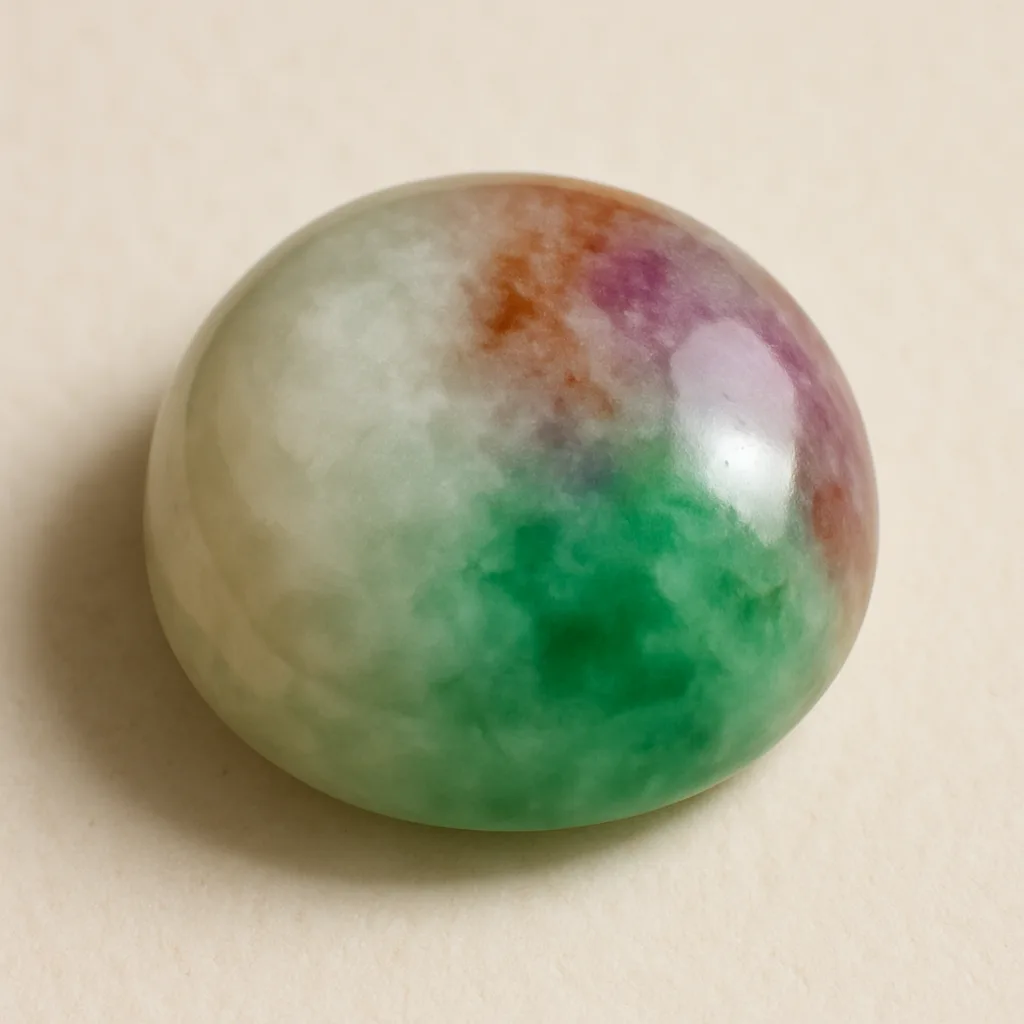
- Mohs 6–6.5 but exceptionally tough — Neolithic axe heads survive intact after 5,000 years
- Sensitive to acids
- Carved antiquities deserve special care — protect from impact and avoid ultrasonic cleaning
A few US dollars per gram for commercial green Canadian or Russian material to several thousand dollars per gram for top-quality Hetian mutton-fat white nephrite.
Note: Top-grade Hetian 'mutton-fat' nephrite from Xinjiang is the most valuable nephrite on the market and can rival mid-grade jadeite by weight. Russian, Canadian, and New Zealand material is more affordable and widely used for carved pieces. Dyed serpentine, bowenite, and aventurine quartz are commonly sold as 'jade' in tourist markets.
Nephrite is a fine-grained, felted aggregate of tremolite-actinolite amphibole — Ca₂(Mg,Fe)₅Si₈O₂₂(OH)₂. The fibers interlock so tightly that nephrite is one of the toughest natural materials known, surviving impacts that would shatter steel of equivalent thickness. Color depends on the iron-to-magnesium ratio: pure magnesian tremolite gives the cream-white 'mutton-fat jade' prized in Hetian, while actinolite-rich material runs through every shade of green to near-black. The French mineralogist Alexis Damour first distinguished nephrite from jadeite in 1863 — until then, all 'jade' in European collections was a single confused category.
Origins
Hotan in Xinjiang, China — the Hetian jade fields — has been the imperial Chinese source for at least 6,000 years and supplies the legendary 'mutton-fat' white nephrite. The Lake Baikal region of Russia (Buryatia), British Columbia in Canada, the South Island of New Zealand, Taiwan's Hualien County, Wyoming and Alaska in the United States, and the New South Wales–South Australia border in Australia round out the modern producers. New Zealand pounamu, sacred to Māori carvers, comes from the rivers of the Westland and Otago regions.
History
Worked continuously in China since the Neolithic, nephrite is the material of the Hongshan and Liangzhu jade cultures (c. 4500–2300 BCE) and of every Han, Tang, and Song dynasty 'jade' carving. Confucius cataloged jade's Five Virtues — benevolence, wisdom, righteousness, propriety, and sincerity — making it the gentleman's stone. In New Zealand, pounamu was traded along Māori routes for centuries and remains protected by treaty as the property of Ngāi Tahu iwi. The 1863 publication by Damour separating nephrite from jadeite finally untangled what had been a single confused category in European mineralogy.
Lore & symbolism
Recognized in some traditions as a May birthstone (within the broader 'jade' category) and as the 12th-anniversary stone. In Confucian thought, nephrite embodies the moral cultivation of the gentleman. In Māori culture, pounamu carries mana (spiritual power) and is passed down as an heirloom, never sold lightly; the hei-tiki pendant is its most sacred form.
Tools to confirm this stone
Tools that help confirm Nephrite. Tap any item to jump to the matching section on the gem tools page.
- Last reviewed
- April 28, 2026
- Bibliography
- Gem Encyclopedia / GIA (Gemological Institute of America)
- Gem Identification Standards / Central Gem Laboratory (CGL), Tokyo
- Mineral & Gem Database / Mindat.org / Gemdat.org
- Introduction to Gemology / Gemmological Association of All Japan (GAAJ)
The gemological data on this page (refractive index, specific gravity, hardness, crystal system, etc.) is cross-checked against the authoritative primary sources listed above. Values may be revised as gemological research advances.