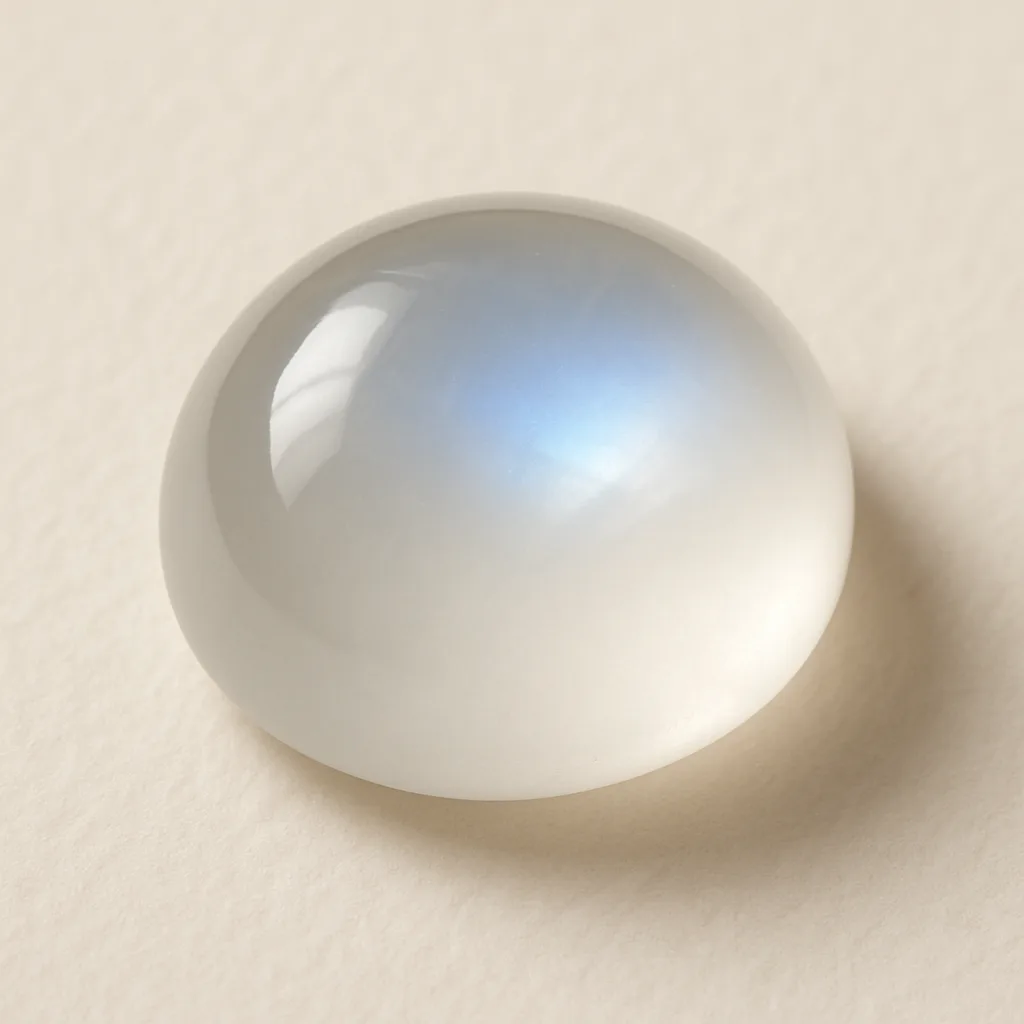
identified this stone yet
White Moonstone
| Hardness | 6-6.5 |
| Specific gravity | 2.55-2.63 |
| Refractive index | 1.518-1.526 |
| Crystal system | 単斜晶系 |
Body color from pure colorless and milky white to soft champagne. The adularescent sheen ranges from cool blue (most prized) through silvery white to a slight golden cast.
- nclusions — short parallel cracks resembling centipede legs, diagnostic for moonstone
- Two-direction planes at ~90°
- Albite layering visible under high magnification
- nclusions
- Doubly refractive (biaxial negative)
- Adularescence — a billowing blue or white sheen caused by light scattering
- Two directions of good
- Vitreous to pearly luster
- 01abochons
- 02RI 1.518–1.526 and SG 2.55–2.61 separate moonstone from labradorite (slightly higher) and chalcedony (singly refractive)
- 03Adularescence moves smoothly across the dome — rotate slowly under a single light to confirm
- Mohs 6 with two-direction — protective settings only
- Never ultrasonic or steam — can propagate
- Warm soapy water and a soft brush; avoid sudden temperature changes
Roughly $5–$30/ct for commercial Indian cabochons, $50–$150/ct for clean Sri Lankan blue-sheen stones, and $300–$1,000+/ct for top Meetiyagoda 'blue moonstone' over 5 ct. Sheen strength matters far more than body clarity.
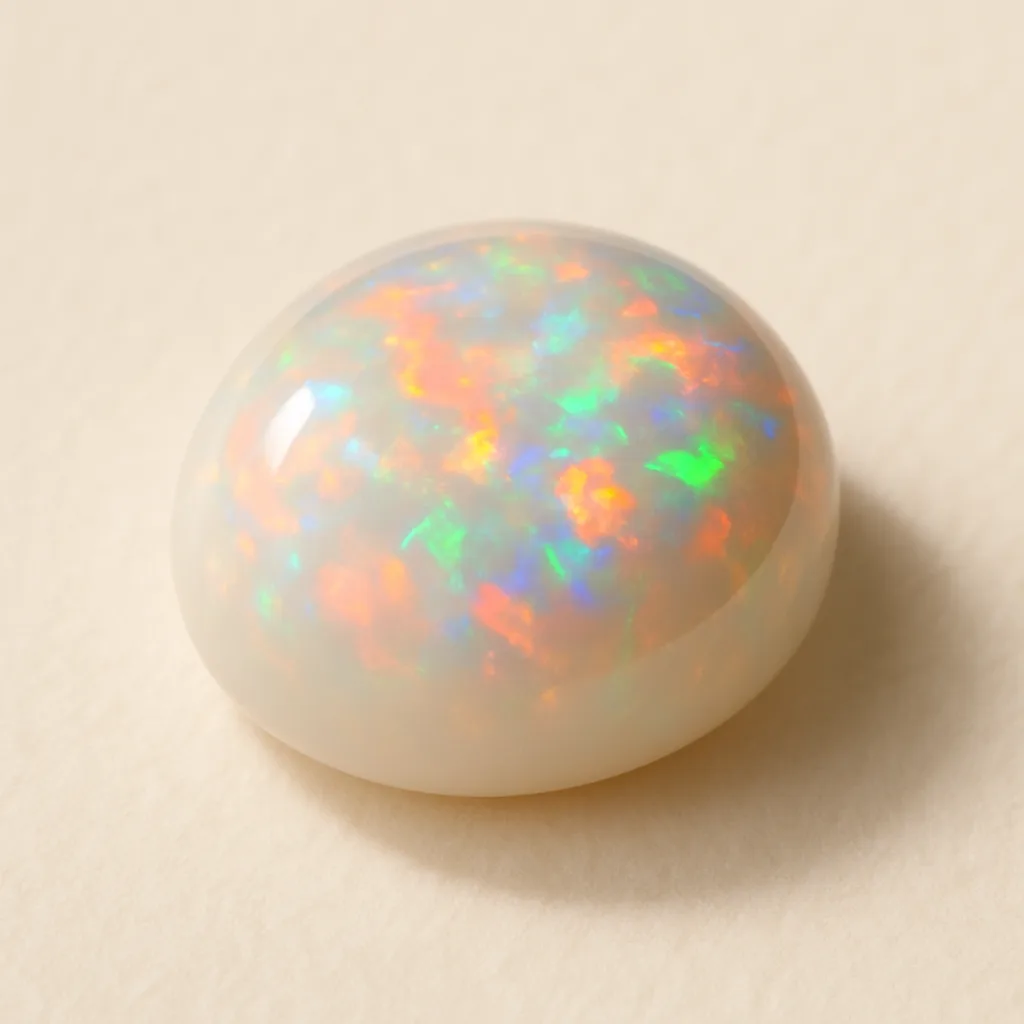
Note: Moonstone is essentially untreated — surface coatings to enhance sheen are rare and detectable. Synthetic moonstone does not exist commercially. The principal market issue is identification: 'rainbow moonstone' sold today is usually labradorite (not orthoclase) and should be disclosed as such, though the trade name persists. Top-grade Sri Lankan stones with strong blue sheen command large premiums over Indian commercial material.
Moonstone is a member of the orthoclase-albite feldspar series (KAlSi₃O₈ – NaAlSi₃O₈). Its signature optical effect, adularescence, arises from microscopic intergrowths of orthoclase and albite at a scale that scatters short-wavelength light, producing a soft blue or white sheen that 'floats' across the stone as it is rotated. Major sources include Sri Lanka (the classical 'Ceylon moonstone'), India, Myanmar, Madagascar, Tanzania, and the United States (Virginia, North Carolina).
Origins
abochons with strong blue adularescence on a colorless-to-translucent base. India's Kerala and Andhra Pradesh deposits produce vast amounts of commercial material, generally with whiter sheen and slightly silkier body. Myanmar produces both white and rainbow (labradorescent) moonstones. Madagascan rough is increasingly important and supplies large clean stones. Virginia's Amelia Court House produces small amounts of fine collector material.
History
Moonstone has been carved and polished since classical antiquity — Romans believed the gem was formed from solidified moonbeams, and Pliny the Elder described its sheen as shifting with the lunar cycle. Hindu mythology treats moonstone as a sacred stone of the moon god Chandra, and it remains an important religious gem in India. The Art Nouveau movement (1890–1910) revived moonstone in flowing nature-inspired designs by René Lalique, Louis Comfort Tiffany, and Georges Fouquet.
Lore & symbolism
June's traditional and modern birthstone alongside pearl and alexandrite, and the gem for the 13th wedding anniversary. Long associated with intuition, feminine energy, and lunar cycles; given as a travelers' charm in Indian tradition.
Tools to confirm this stone
Tools that help confirm White Moonstone. Tap any item to jump to the matching section on the gem tools page.
- 最終確認日
- 2026年4月28日
- 参 考 文 献
- Gem Encyclopedia/ GIA (Gemological Institute of America)
- 宝石鑑別基準/ 中央宝石研究所 (CGL)
- Mineral & Gem Database/ Mindat.org / Gemdat.org
- 宝石学入門/ 全国宝石学協会
本ページの物性値(屈折率・比重・硬度・結晶系等)は、上記の権威ある一次資料を相互参照して編集しています。最新の鑑別研究の進展により値が更新される場合があります。