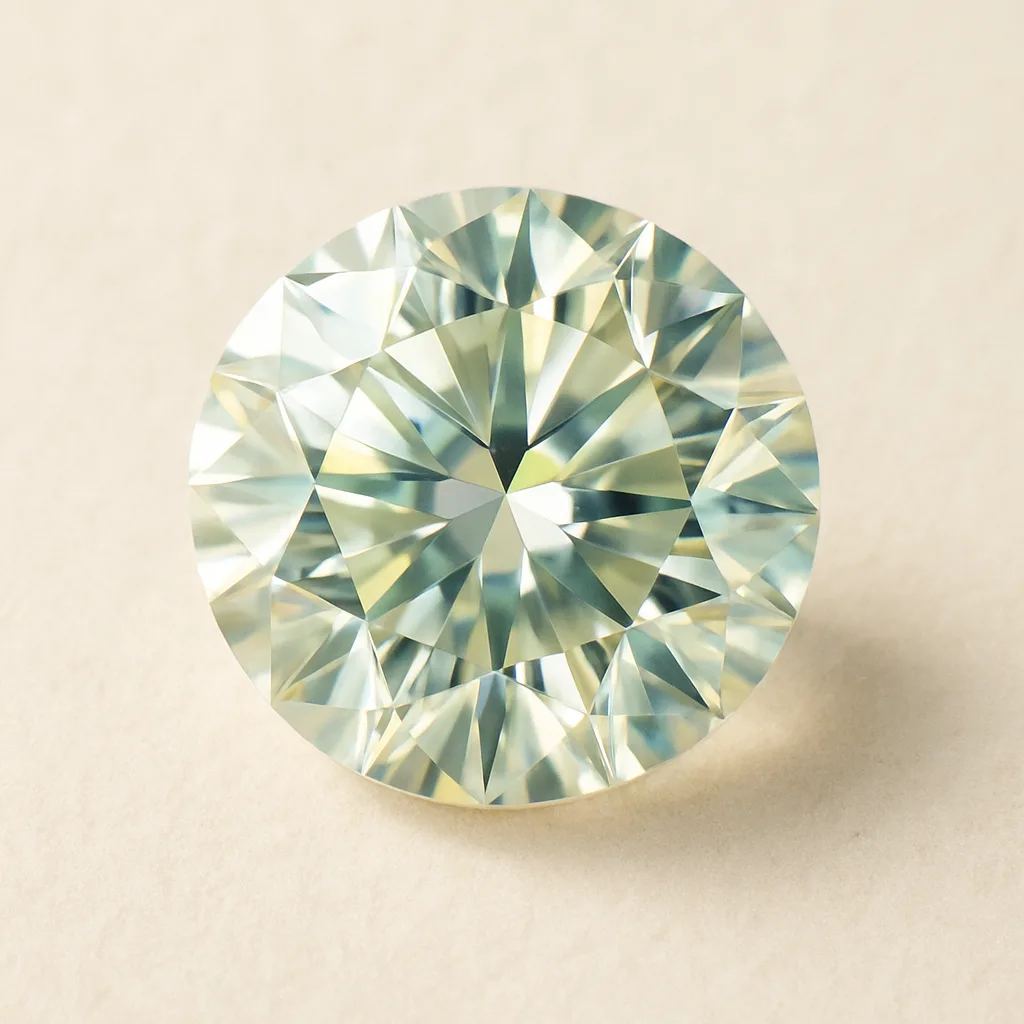
identified this stone yet
Moissanite
| Hardness | 9.25 |
| Specific gravity | 3.20-3.22 |
| Refractive index | 2.648-2.691 |
| Crystal system | 六方晶系 |
Modern Forever One and equivalent Chinese-origin material is essentially colorless, comparable to D-E-F diamond grading. Earlier 'Forever Brilliant' material (2012–2015) was near-colorless H-J equivalent with a faint yellow-green undertone diagnostic of older Charles & Colvard production. Pre-2012 first-generation Charles & Colvard moissanite carried more pronounced yellow or greenish casts. Color-treated variants in fancy yellow, green, blue, and pink are commercially available but represent a small fraction of sales relative to the colorless mainstream.
- nclusions (residual sublimation-growth artifacts) — when present, diagnostic of synthetic SiC origin
- Negligible: most commercial material is internally clean to 10× inspection
- Faint 'whitish' clouding from polytype-boundary scattering in lower-grade material
- Hexagonal (uniaxial positive) — strong acet visible at 10× through the table, the textbook diamond-distinguishing field test
- Refractive index 2.65–2.69 — exceeds diamond's 2.42
- 0.104 — more than double diamond's 0.044, producing characteristic 'too-much-fire' rainbow color flash
- Specific gravity 3.21–3.22 — lighter than diamond (3.52) and dramatically lighter than CZ (5.6–6.0)
- Mohs 9.25 — second only to diamond
- 01acet visible at 10× through the table — the single most reliable diamond-vs-moissanite field test, taught in every gemological certificate program
- 02Combined thermal/electrical conductivity testers (Presidium SDS, Yehuda) read moissanite distinctly — single-probe heat testers fail on moissanite
- 03Specific gravity 3.21–3.22 is lighter than diamond (3.52) — hand-heft test gives noticeable difference at 1.5 ct and above
- 04Excessive colored fire ( 0.104 vs diamond 0.044) — visible 'rainbow effect' under standard lighting that diamond does not show
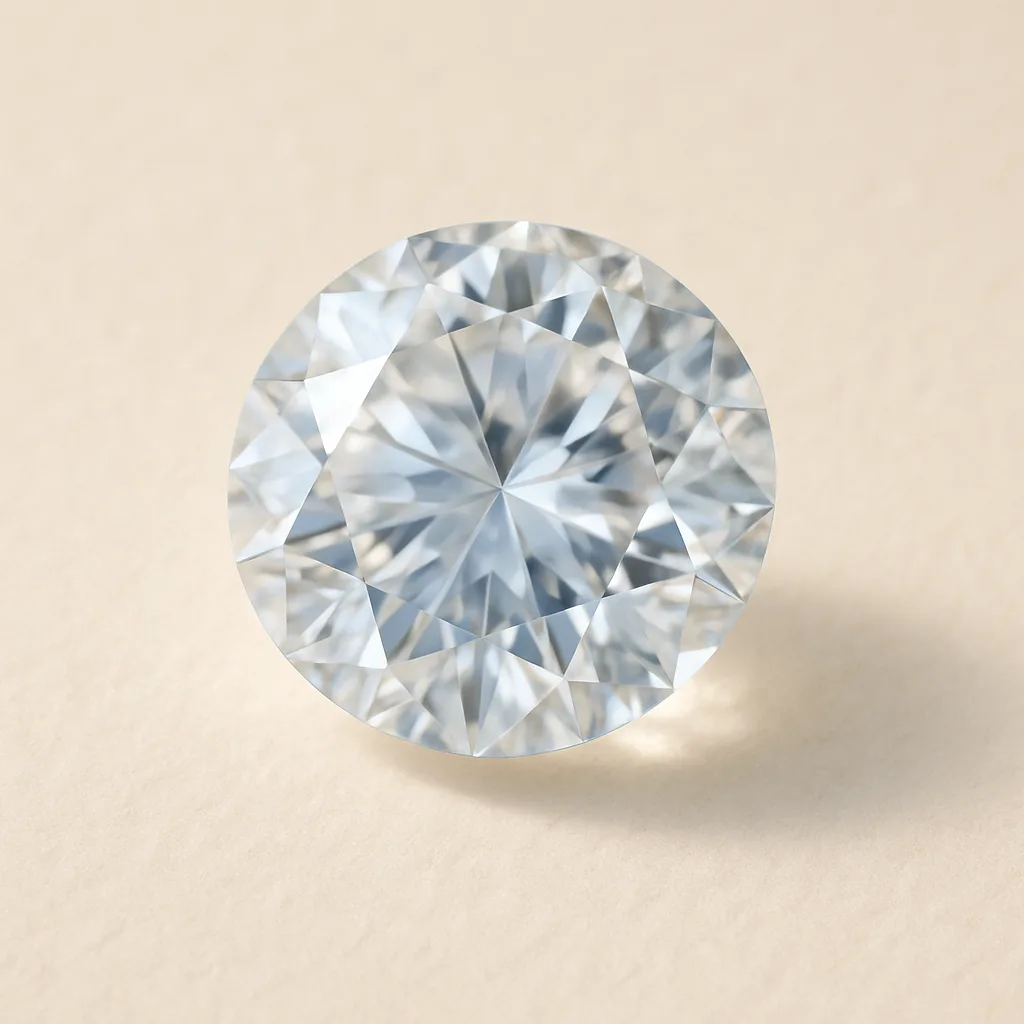
- Mohs 9.25 — extremely durable, suitable for daily wear including engagement-ring use
- Ultrasonic and steam cleaning are safe
- Thermally and chemically stable to standard household conditions
- Heat tolerant beyond diamond's 700 °C atmospheric oxidation threshold — moissanite withstands jeweller's torch repair work safely
Colorless 'D-E-F' moissanite from 2025 Chinese production trades at $30–$200 per carat at the wholesale level for 0.5–2.0 ct sizes; Charles & Colvard 'Forever One' pieces with origin certification command 50–100% premium. Pre-2015 Charles & Colvard inventory and vintage 'Forever Brilliant' pieces have entered a faint vintage market. Finished moissanite engagement ring jewelry typically retails at 5–15% of equivalent-size mined-diamond pricing.
Note: Disclosure as 'moissanite,' 'silicon carbide,' 'lab-grown,' or 'synthetic' is mandatory under FTC Jewelry Guides and CIBJO Blue Book. Charles & Colvard's 'Forever One' branding and 'Made by Charles & Colvard' inscriptions on stones above 1 ct are a quality-assurance and provenance signal that Chinese-origin material lacks. The thermal-conductivity testing problem (moissanite reads as diamond on legacy single-probe heat testers) was a major retail concern in the late 1990s and led to development of combined thermal/electrical conductivity testers (Presidium SDS, Yehuda) that read moissanite distinctly from diamond. Skilled gemologists separate moissanite from diamond by 10× back-facet doubling inspection alone; lab-grade discrimination uses Raman or FTIR spectroscopy. Patent-expiration arbitrage means that 2015-and-later production from China is essentially indistinguishable in optical and physical properties from contemporary Charles & Colvard material at a fraction of the price.
aceting in classical brilliant-cut geometry. Mohs 9.25, SG 3.21–3.22, RI 2.65–2.69 (uniaxial positive, acet is visible at 10× through the table, the principal visual diagnostic against diamond), 0.104, thermal conductivity 320–490 W/m·K (close to diamond's 600+, defeating cheap heat-probe testers). The original natural moissanite identified by Henri Moissan in 1893 is essentially absent from the gem trade; commercial supply is universally synthetic. Charles & Colvard introduced 'Forever Brilliant' (near-colorless H-J range) in 2012 and 'Forever One' (colorless D-E-F equivalent) in 2015, immediately preceding the patent expiration that opened the market to Chinese producers.
Origins
Charles & Colvard Ltd. (Morrisville, North Carolina) was the original commercial producer from 1995 through patent expiration in 2015, sourcing crystal from Cree Inc. (also Morrisville, the leading industrial SiC producer for power electronics). Patent expiration in 2015 opened the market to Chinese producers concentrated in Jiamusi (Heilongjiang), Henan, and Wuzhou (Guangxi), which now supply the bulk of world gemstone moissanite. Russian (Stary Oskol Electrometallurgical Combine) and Indian (Surat cutting houses with imported Chinese rough) production complements the supply chain. The original natural Canyon Diablo meteorite source (Coconino County, Arizona) yielded only microscopic crystals embedded in the iron-meteorite matrix and is a museum-collection specimen rather than a commercial source — the natural moissanite trade is essentially nonexistent.
History
aceting. The 1980s and 1990s development of SiC for high-power, high-temperature semiconductors at Cree Research (later Cree Inc.) of Morrisville, North Carolina, finally produced single-crystal SiC of gem-suitable size and quality. Charles & Colvard's 1995 commercial debut leveraged Cree's growth technology under exclusive license; the company filed key patents on the gemstone-specific cutting and finishing methods in the late 1990s. Charles & Colvard maintained a near-monopoly on the gemstone moissanite market through 2015, when the foundational Cree growth-process patents expired and Chinese producers entered the market at dramatically lower price points. By 2020, gemstone-quality colorless moissanite traded at one-fifth to one-tenth of pre-expiration prices — the same competitive trajectory that earlier disrupted the Verneuil-grown synthetic ruby and sapphire markets in the early twentieth century. The 2015–2020 commercial debut of high-quality CVD lab-grown diamond at sub-$1,000/ct levels created a new competitive pressure: where moissanite previously occupied an unambiguous price/performance niche between CZ and diamond, lab-grown diamond now overlaps the upper portion of moissanite's price range, complicating retail positioning.
Lore & symbolism
Not assigned to any traditional birthstone list (synthetic, no historical precedent). Modern crystal-writing positions moissanite as a stone of starlight, cosmic origin (acknowledging the meteoritic discovery), and the union of science and beauty — the 'born from the stars' marketing language that Charles & Colvard themselves promoted heavily during the 1995–2010 introduction period. The Henri Moissan / Nobel Prize / Canyon Diablo meteorite narrative gives moissanite an unusually well-developed origin story for a synthetic gemstone, and that story is heavily leveraged in contemporary engagement-ring marketing as a 'meaningful' alternative to mined diamond.
Tools to confirm this stone
Tools that help confirm Moissanite. Tap any item to jump to the matching section on the gem tools page.
- 最終確認日
- 2026年4月28日
- 参 考 文 献
- Gem Encyclopedia/ GIA (Gemological Institute of America)
- 宝石鑑別基準/ 中央宝石研究所 (CGL)
- Mineral & Gem Database/ Mindat.org / Gemdat.org
- 宝石学入門/ 全国宝石学協会
本ページの物性値(屈折率・比重・硬度・結晶系等)は、上記の権威ある一次資料を相互参照して編集しています。最新の鑑別研究の進展により値が更新される場合があります。