identified this stone yet
Mexican Opal
| Hardness | 5.5-6 |
| Specific gravity | 1.98-2.20 |
| Refractive index | 1.370-1.470 |
| Crystal system | 非晶質 |
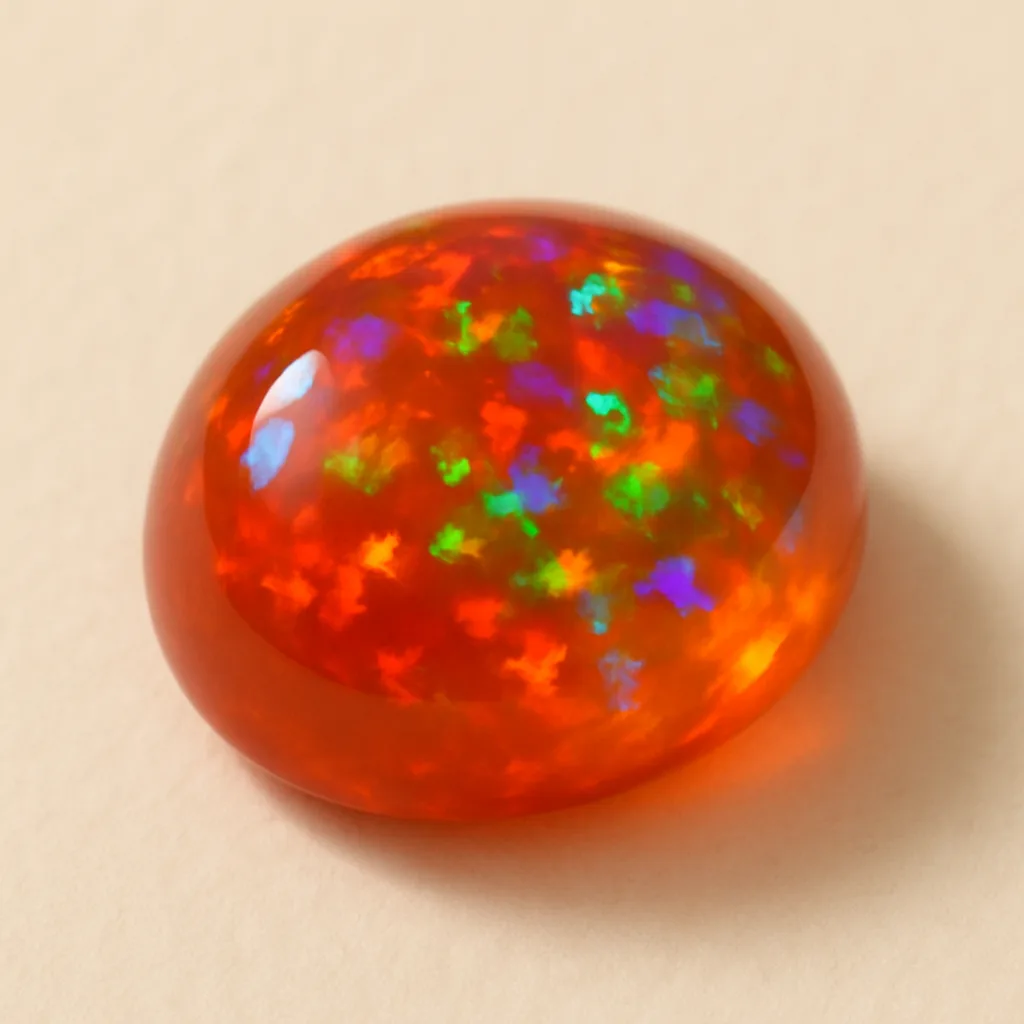
Warm orange, cherry red, golden yellow, water-clear, and (rarely) deep brown 'contraluz' material. Body transparency ranges from glassy clear ('jelly') through milky translucent. Play-of-color, when present, runs the full spectrum but tends toward greens, oranges, and reds.
- Gas bubbles and 'flow' patterns from the volcanic host
- Iron oxide micro-particles distributing the body color
- Aligned silica spheres in precious material (visible only under SEM)
- Rhyolite matrix on rough specimens; incipient crazing in dehydrated stones
- Amorphous, singly refractive
- Strong vitreous-to-resinous luster
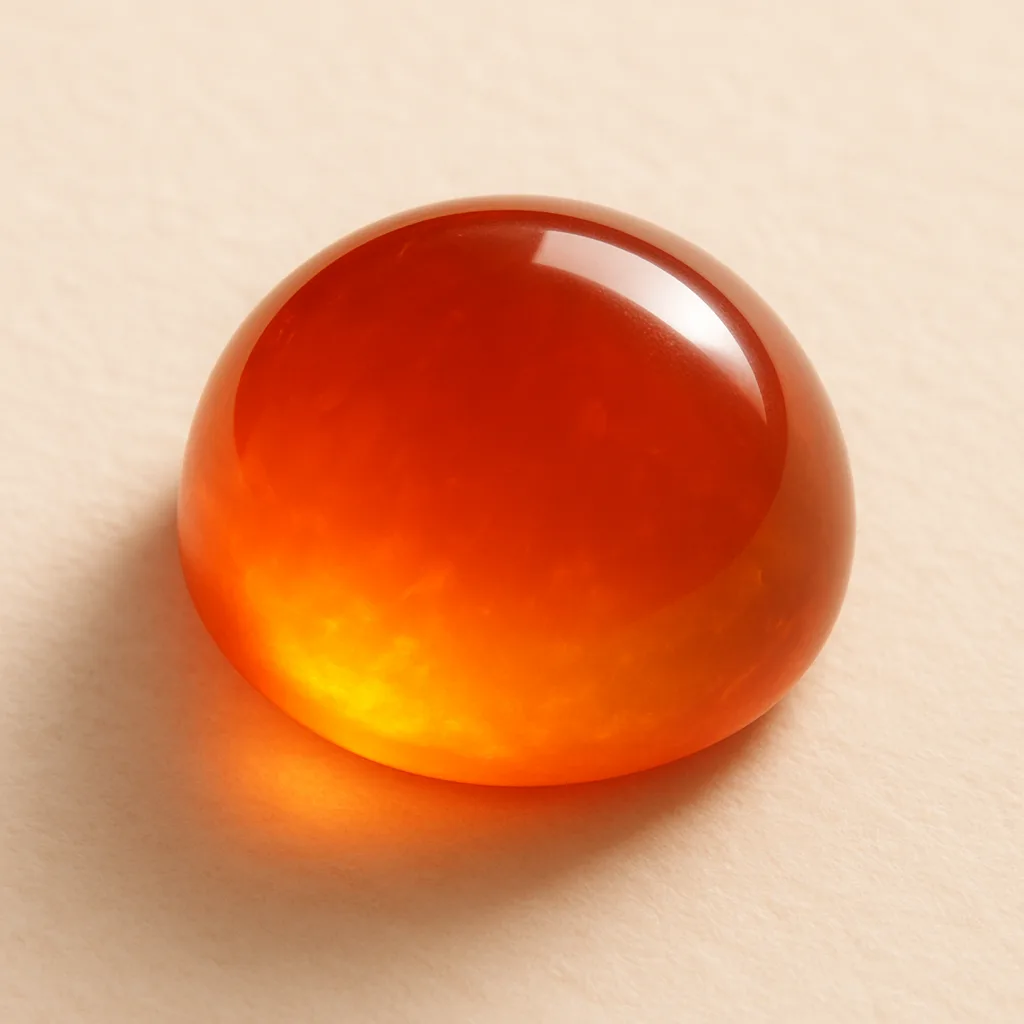
- Transparent body — the hallmark of Mexican fire opal
- Contraluz effect — play-of-color visible only with backlighting — appears in select Querétaro material
- 01Warm transparent body color is the strongest single indicator
- 02RI 1.37–1.47 and SG 1.97–2.20 confirm opal
- 03Crazing or surface fractures — common in older Mexican stones, especially after climate changes
- 04Mexican volcanic matrix (rhyolite) on rough pieces
- Mohs 5.5–6.5 — softer than most gems; protective settings advised
- Store in stable humidity — humidity shifts can trigger crazing in Mexican fire opal
- Never use ultrasonic or steam cleaners
- Wipe with a soft damp cloth; avoid solvents and prolonged water contact
Roughly $20–$100/ct for commercial Mexican fire opal, $300–$1,500/ct for fine transparent cherry-red faceted stones above 1 ct, and $5,000–$15,000+/ct for the rare precious fire opal showing both fiery body and broad play-of-color. Contraluz — opal that shows play-of-color only when backlit — commands a separate premium among collectors.
Note: Mexican opal is rarely treated, but sugar-and-acid darkening exists for fire opal and should be disclosed. The principal stability concern is crazing — the dry climate of central Mexico produces stones that can craze if moved to very different humidity, so storage in stable humidity is essential. Look for matrix-attached cabochons from La Esperanza for premium pieces, and ask sellers whether stones have been kept hydrated since extraction.
Mexican opal is hydrated silica (SiO₂·nH₂O) formed in cavities and seams within volcanic rhyolite. The volcanic host gives Mexican opal its characteristic transparent-to-translucent body and warm color suite — orange, red, golden, and clear ('water opal') — distinct from the sedimentary-hosted Australian opals with their classic milky and dark bodies. Mexico has been the principal source of warm-bodied opal for over 500 years and declared it the national stone in the 20th century.
Origins
Querétaro state is the historical heart of Mexican opal mining, with the Magdalena district (especially the La Esperanza, La Trinidad, and La Carbonera mines) producing the finest precious fire opal. Jalisco's Cerro Viejo, Huitzo, and Mesa Larga fields supply additional material. San Luis Potosí and Guerrero are minor sources. The rhyolitic host rock is a 30-million-year-old volcanic deposit; opal fills cavities left by gas bubbles and devitrification cracks.
History
Pre-Columbian Mesoamerican cultures, including the Aztec, called fire opal 'quetzalitzlipyollitli' — the stone of the bird of paradise — and dedicated it to the sun. Hernán Cortés sent Mexican opals back to Spain in the 1520s, but commercial mining only began in 1835 when Don José María Siurob rediscovered the Magdalena deposit at Hacienda Esperanza. The 1870s and 1880s saw Mexican opal flood European art-nouveau jewelry. Australian opal eventually overtook Mexico in volume, but Querétaro's reputation for the finest jelly and contraluz material endures.
Lore & symbolism
The October birthstone, symbolizing passion, independence, and pride. Mexican folk tradition holds that fire opal carries the warmth of the sun god Tonatiuh and protects the wearer against fear. The 14th wedding anniversary gem.
Tools to confirm this stone
Tools that help confirm Mexican Opal. Tap any item to jump to the matching section on the gem tools page.
- 最終確認日
- 2026年4月28日
- 参 考 文 献
- Gem Encyclopedia/ GIA (Gemological Institute of America)
- 宝石鑑別基準/ 中央宝石研究所 (CGL)
- Mineral & Gem Database/ Mindat.org / Gemdat.org
- 宝石学入門/ 全国宝石学協会
本ページの物性値(屈折率・比重・硬度・結晶系等)は、上記の権威ある一次資料を相互参照して編集しています。最新の鑑別研究の進展により値が更新される場合があります。