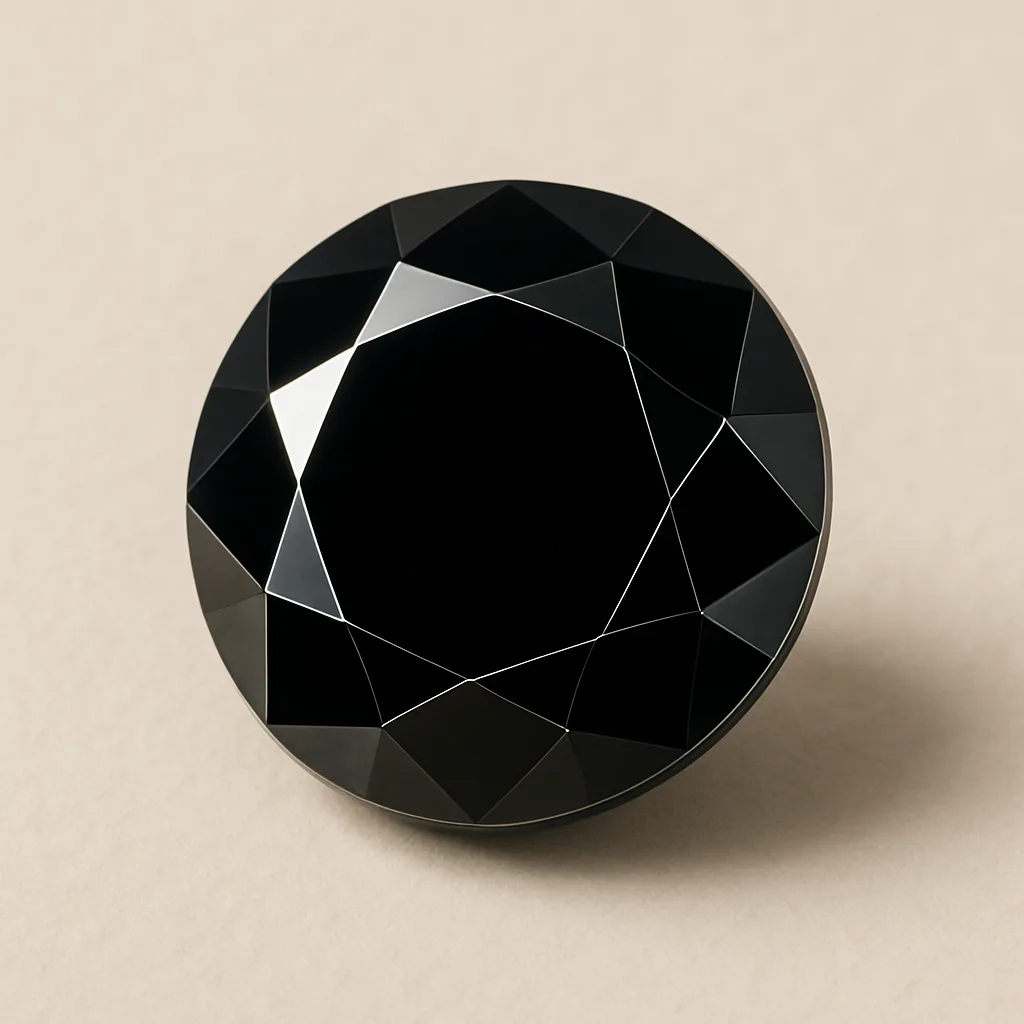
identified this stone yet
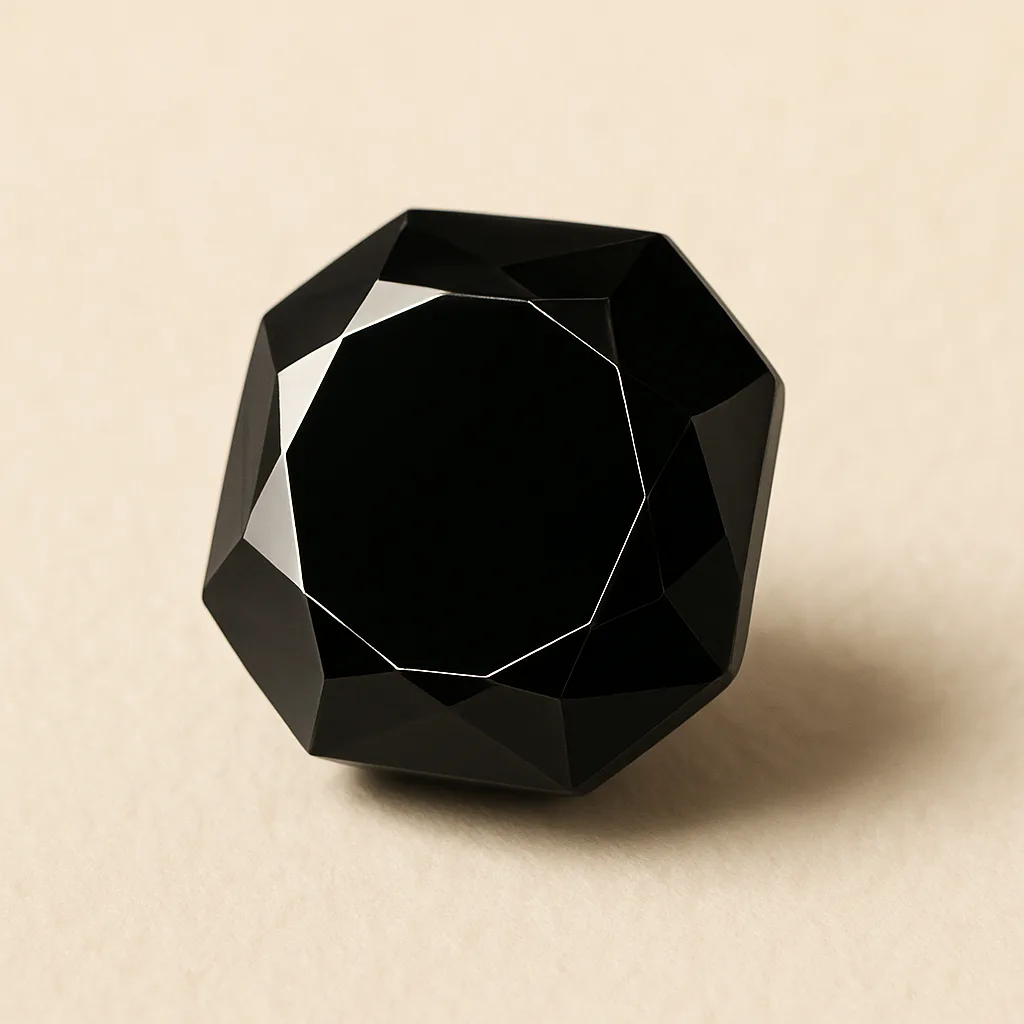
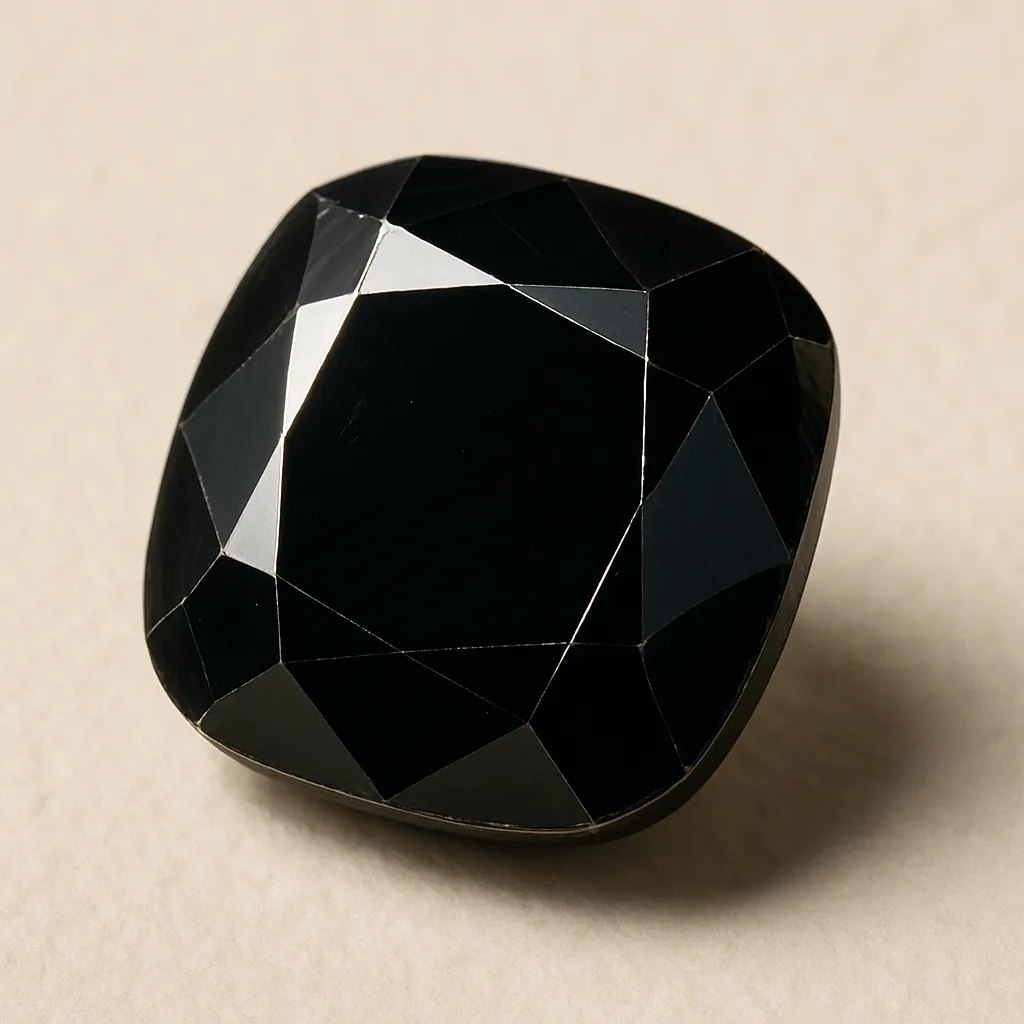
Melanite Garnet
| Hardness | 6.5-7 |
| Specific gravity | 3.80-3.90 |
| Refractive index | 1.870-1.890 |
| Crystal system | 等軸晶系 |
Jet black with strong rainbow ('fire'), occasionally ink-blue-black in transmitted light.
- Granular garnet-aggregate texture in poorer material
- Healed fractures along crystal interfaces
- nclusions in some Magnet Cove specimens (the locality is named for the mineral's magnetic component)
- Singly refractive (cubic system) — no
- 0.057 — exceeds diamond (0.044) and sphene (0.051)
- No (cubic system)
- 01Diamond-rivaling rainbow fire from a black body — the diagnostic feature
- 02Singly refractive — separates melanite from black tourmaline (doubly refractive with prism striations)
- 03SG 3.85 — heavier than black spinel (SG 3.60) and black tourmaline (SG 3.10)
- 04Mohs 6.5–7
- Mohs 6.5–7 — durable enough for daily wear
- Ultrasonic cleaning is normally safe
- Cutting and polishing should preserve crown ratios — fire depends critically on the cut
A few thousand yen per carat up to several tens of thousands of yen per carat for large stones with strong, sharply resolved rainbow dispersion.
Note: Italian, French, Swiss, and Russian Alpine material is the historic standard; Mali's Sandaré district has become an important modern source. Most melanite reaches the market through specialist garnet dealers rather than mainstream jewelry channels.
Melanite is the titanium-bearing variant of andradite garnet, Ca₃Fe₂(SiO₄)₃, with titanium substituting for ferric iron and shifting the color from green (in demantoid) all the way to opaque jet black. The name comes from Greek melas, 'black.' What makes melanite remarkable optically is its : at 0.057 it exceeds diamond (0.044) and even sphene (0.051), and a well-cut stone throws rainbow flashes visible against the otherwise jet-black body. Victorian jewelers paired it with jet, French jet (black glass), and schorl in the elaborate mourning-jewelry suites worn during the prescribed nine months of formal mourning.
Origins
The classical Alpine localities — Val d'Ala in Piedmont, Italy and the Zermatt valley in Switzerland — produced the material that defined the species in 19th-century mineralogy. The Magnet Cove complex in Hot Spring County, Arkansas, and the Sanford mine in St. Lawrence County, New York, supply most American collector specimens. Mali's Sandaré pegmatite district and the Russian Urals also produce gem-grade melanite. Mexican localities supply darker, more 'pitch-black' material.
History
Werner identified melanite in the late 18th century as a distinct variety; the Italian Val d'Ala material was the type-locality reference for most of the 19th century. Victorian-era jewelers (1837–1901), responding to the elaborate mourning protocols established after Prince Albert's death in 1861, used melanite — along with jet, schorl, French jet, and onyx — in formal mourning suites that prescribed specific stones for each of the nine months of full mourning. The stone faded with the Edwardian rejection of mourning fashion but has been revived in the 21st century by gothic and alternative-jewelry designers who prize its diamond-exceeding fire.
Lore & symbolism
January birthstone (within the broader garnet family) and the gift for the 2nd wedding anniversary. Long associated with protection, fortitude, and the disciplined endurance of grief — the 'guardian against shadow' of medieval European lapidary tradition.
Tools to confirm this stone
Tools that help confirm Melanite Garnet. Tap any item to jump to the matching section on the gem tools page.
- Last reviewed
- April 28, 2026
- Bibliography
- Gem Encyclopedia / GIA (Gemological Institute of America)
- Gem Identification Standards / Central Gem Laboratory (CGL), Tokyo
- Mineral & Gem Database / Mindat.org / Gemdat.org
- Introduction to Gemology / Gemmological Association of All Japan (GAAJ)
The gemological data on this page (refractive index, specific gravity, hardness, crystal system, etc.) is cross-checked against the authoritative primary sources listed above. Values may be revised as gemological research advances.