identified this stone yet
Matrix Opal
| Hardness | 5.5-6.5 |
| Specific gravity | 2.00-2.20 |
| Refractive index | 1.450 |
| Crystal system | 非晶質(アモルファス) |
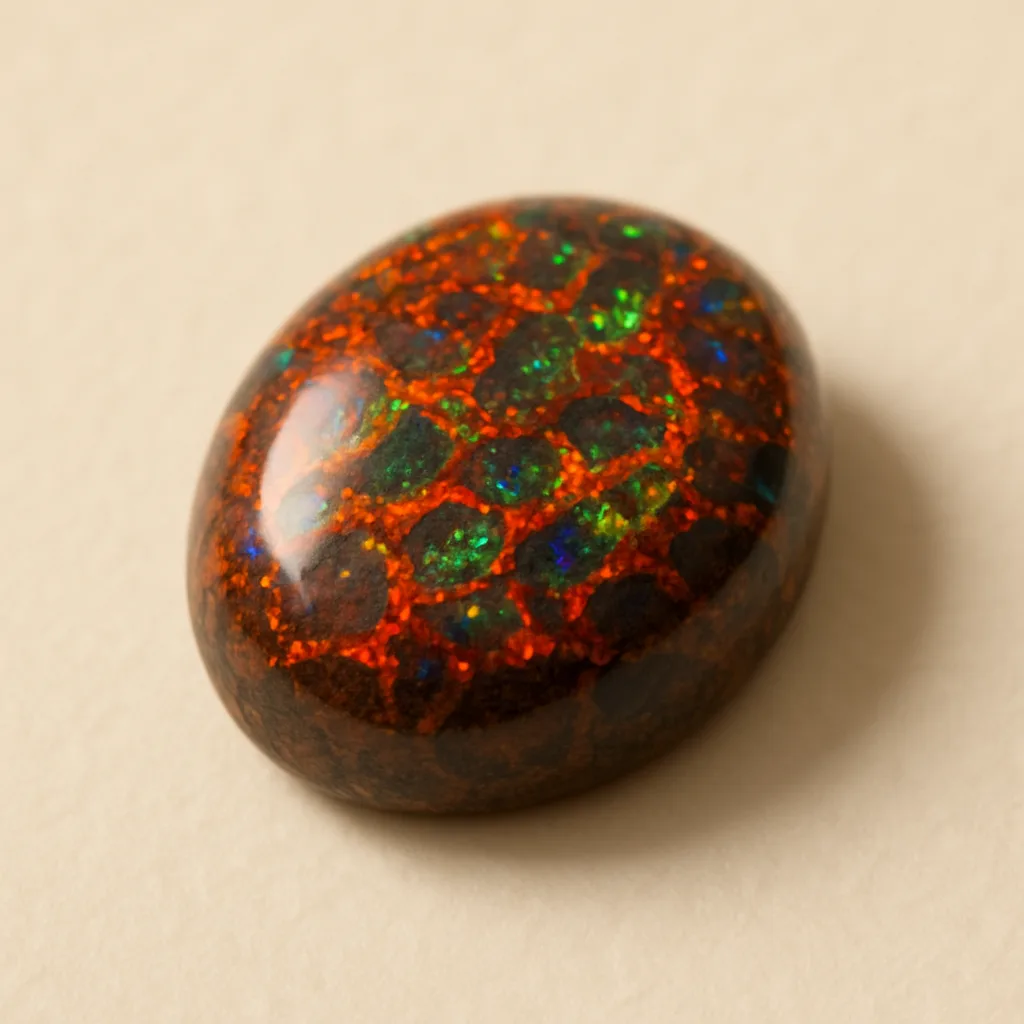
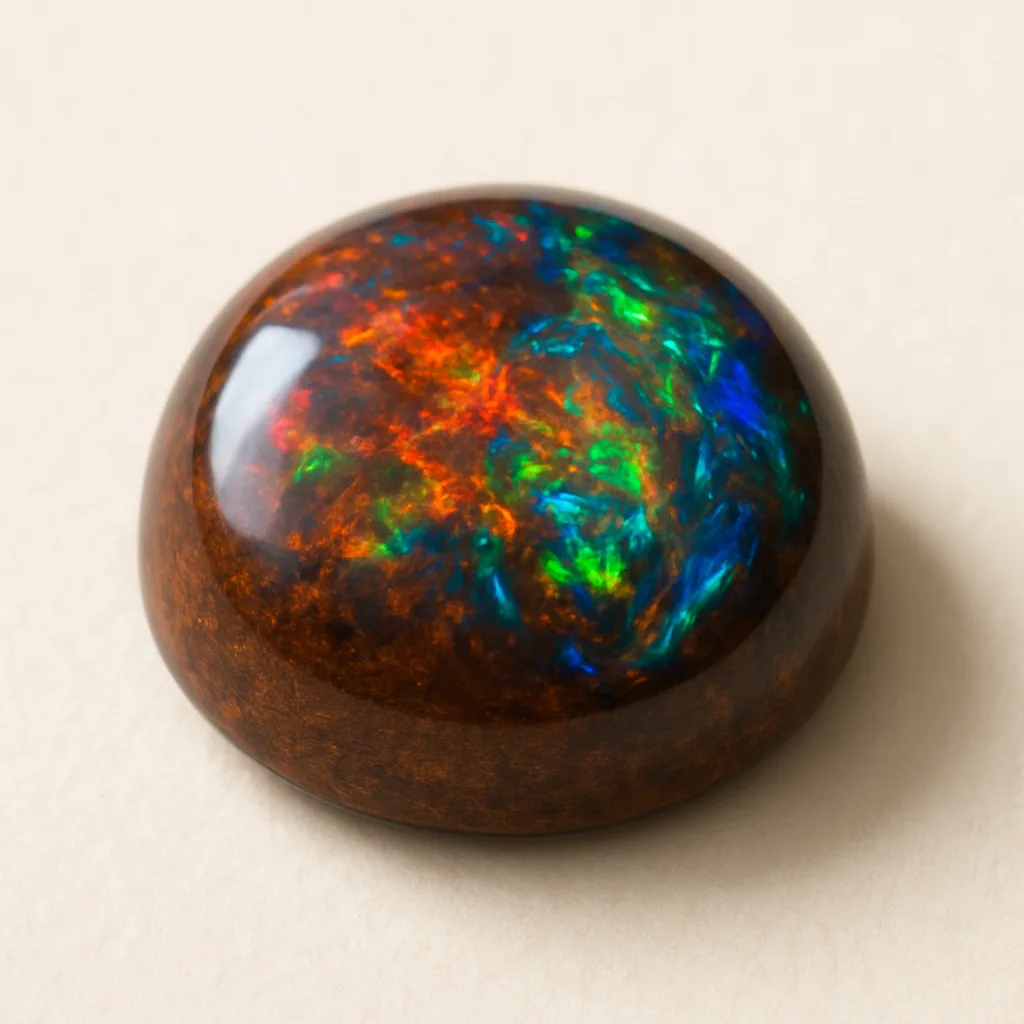
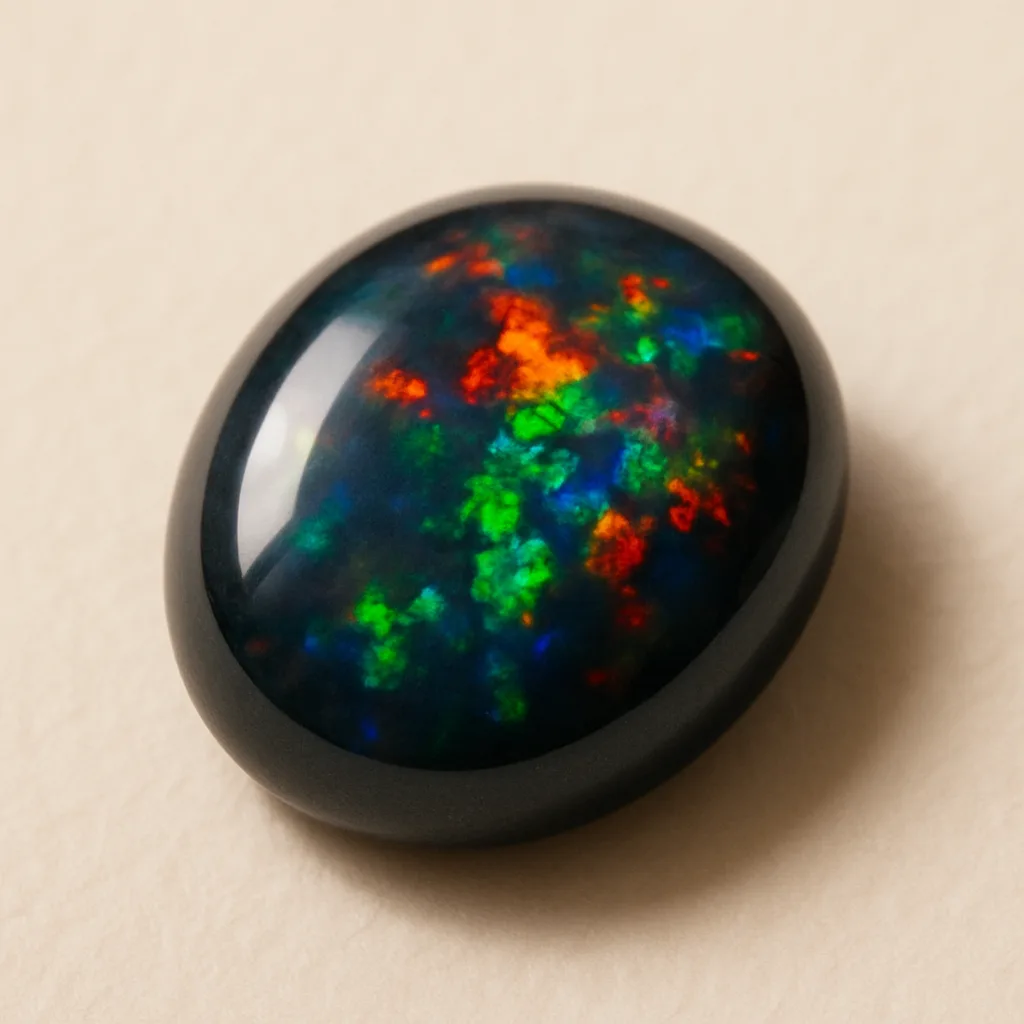
Body color black, brown, gray, or cream depending on host rock; play-of-color ranges across the full opal spectrum (red, orange, green, blue, violet) but is most striking on darker treated or naturally dark matrix. Andamooka treated matrix shows fine pinpoint or 'pinfire' play; Queensland ironstone matrix produces larger 'broad flash' patterns.
- Host rock grain structure (quartzite grains in Andamooka, ironstone laminae in Yowah-Koroit) visible at the surface and in cross-section
- Pinpoint distribution of opal-filled pore space — the structural definition of the variety
- nclusions in ironstone host
- Banding or layering in Yowah-nut concretions
- Singly refractive (amorphous opal in amorphous-to-microcrystalline host)
- Refractive index 1.43–1.47 for the opal portion
- Specific gravity 2.0–2.5 (highly variable with host composition and porosity)
- Play-of-color from diffraction by ordered 150–400 nm silica microspheres in the opal portion
- Subvitreous to dull luster on the host portions, vitreous on opal-rich areas
- 01Pinpoint or sparse play-of-color distributed through a visible host-rock matrix — the visual definition
- 02Specific gravity 2.0–2.5 — variable but generally lower than solid black opal (2.10) because of host porosity
- 03Surface examination at 10× shows host-rock grain structure between opal-filled regions
- 04Sugar-and-acid treatment in Andamooka material shows characteristic uniform deep black saturation of the porous host (untreated Andamooka host is cream to pale gray)
- 05Yowah-Koroit ironstone matrix shows characteristic red-brown iron-rich host rock that responds to a magnet (weak) and stains a streak plate brown
- Mohs 5.5–6.5 (opal portion) — soft and brittle; suitable for pendants and protected ring settings, with careful daily handling
- Sensitive to thermal shock and to dehydration (opal is hydrated silica with ~3–10% water content) — avoid prolonged dry heat, hot car interiors, and rapid temperature changes
- Never ultrasonic or steam — vibration and heat both pose serious risk; clean only with a soft cloth and warm soapy water
- Sugar-treated Andamooka material is permanent in normal wear but should not be exposed to strong solvents or to extended UV (sun bleaching of host treatment occasionally reported in poorly treated material)
- Stable to most household chemicals; avoid hydrofluoric acid (a silica solvent)
Andamooka treated matrix opal $20–200/ct for commercial material, up to $400–800/ct for fine treated stones with bright play-of-color on saturated black ground. Yowah and Koroit ironstone matrix $50–500/ct for typical material, exceptional 'pineapple' or 'broad flash' pieces from these fields reaching $1,000–3,000/ct.
Note: The sugar-and-acid treatment of Andamooka matrix opal must be disclosed at the retail level (CIBJO and AGTA standards). The treatment is permanent and stable. Queensland ironstone matrix opal from Yowah and Koroit is sold untreated. The principal market concerns are (1) misrepresentation of treated Andamooka matrix as 'natural black opal' (a substantial price differential), (2) the long-running competition between solid-opal purists and matrix-opal advocates over relative status in the Australian opal market, and (3) variable quality control on Andamooka treatment, where some operators have used inconsistent acid concentrations producing matrix material that fades or discolors over time.
is a composite material: amorphous hydrated silica (SiO₂·nH₂O) opal infiltrating the intergranular pore space of a sedimentary or volcanic host rock. Mohs 5.5–6.5 (matrix-dependent — the opal portion alone is 5.5–6.5, the host rock contributes), SG 2.0–2.5 (lower than pure opal at 2.10 because of porosity, can vary widely with host), RI 1.43–1.47 (the opal portion). The play-of-color comes from diffraction by ordered silica microspheres in the opal portion, identical in mechanism to solid precious opal; the host rock provides the dark or contrasting ground that intensifies the visual effect. Two principal commercial varieties: (1) Andamooka — a porous white-to-cream quartzitic host saturated with white precious opal, traditionally sugar-and-acid treated (sugar absorption followed by sulfuric acid carbonization, the same chemistry used for black-onyx dyeing) to blacken the host and produce a 'black matrix' product that has been a defining Andamooka output since the 1950s; (2) Queensland ironstone from Yowah and Koroit, where natural brown-to-black ironstone hosts dispersed opal pinpoints producing untreated 'Yowah nuts' and 'Koroit boulder matrix.'
Origins
Andamooka, in northern South Australia, was discovered as an opal field in 1930 and rapidly became the world's principal source; the sugar-and-acid treatment process for blackening the porous quartzitic host was developed locally by miners and lapidaries (most prominently John Altmann and Allan Gross) in the early 1950s and has been the standard finish for Andamooka matrix material ever since. The 1954 'Andamooka Queen' — a 203-carat opal presented to Queen Elizabeth II by the South Australian government during her Commonwealth tour — was a particularly fine solid opal from the field; the field's daily output, however, is overwhelmingly matrix material. Queensland's Yowah field (south of Quilpie, in the southwest of the state) produces the famous 'Yowah nuts' — small ironstone concretions with concentric opal layers and centers — and the Koroit field nearby yields ironstone boulder-matrix with dispersed pinpoint play-of-color. Honduras (Erandique, in the western highlands) produces a basalt-hosted atrix opal.
History
as a recognized lapidary category dates from the 1950s development of the Andamooka sugar-and-acid treatment, which transformed otherwise unmarketable porous opal-bearing host rock into a viable jewelry product. Earlier 19th-century Australian opal mining (Coober Pedy from 1915, Lightning Ridge from 1873) had focused on solid black, crystal, and white opal; the porous-host material was discarded as 'matrix' in the original derogatory sense of 'enclosing rock.' The Andamooka treatment process reversed that valuation. Queensland's Yowah field, in operation since the 1880s, produced its distinctive ironstone-concretion 'Yowah nuts' continuously through the late 19th and 20th centuries; the Koroit boulder-matrix field, opened around 1897, has supplied untreated matrix material to the Australian and Japanese gem trades for over a century. Disclosure standards for Andamooka treatment were formalized by the International Gem Society and the Australian Opal Industry Code in the 1980s — the treatment must be disclosed at the retail level as 'sugar treated' or 'treated.'
Lore & symbolism
Australian Aboriginal traditional narratives across central and northern Australia identify opal as ancestral 'rainbow serpent' material, with the Andamooka, Coober Pedy, and Lightning Ridge fields all carrying Songline associations in Arabana, Antakirinja, and Yuwaalaraay cultural traditions respectively. specifically, as a 20th-century commercial category, has no traditional folkloric layer of its own. Contemporary New Age literature recycles general opal associations — emotional intuition, creative expression, and 'amplification' — into matrix-opal positioning without distinguishing it from other opal varieties.
Tools to confirm this stone
Tools that help confirm Matrix Opal. Tap any item to jump to the matching section on the gem tools page.
- 最終確認日
- 2026年4月28日
- 参 考 文 献
- Gem Encyclopedia/ GIA (Gemological Institute of America)
- 宝石鑑別基準/ 中央宝石研究所 (CGL)
- Mineral & Gem Database/ Mindat.org / Gemdat.org
- 宝石学入門/ 全国宝石学協会
本ページの物性値(屈折率・比重・硬度・結晶系等)は、上記の権威ある一次資料を相互参照して編集しています。最新の鑑別研究の進展により値が更新される場合があります。