identified this stone yet
Malachite
| Hardness | 3.5-4 |
| Specific gravity | 3.95 |
| Refractive index | 1.655-1.909 |
| Crystal system | 単斜晶系(球状集合体) |
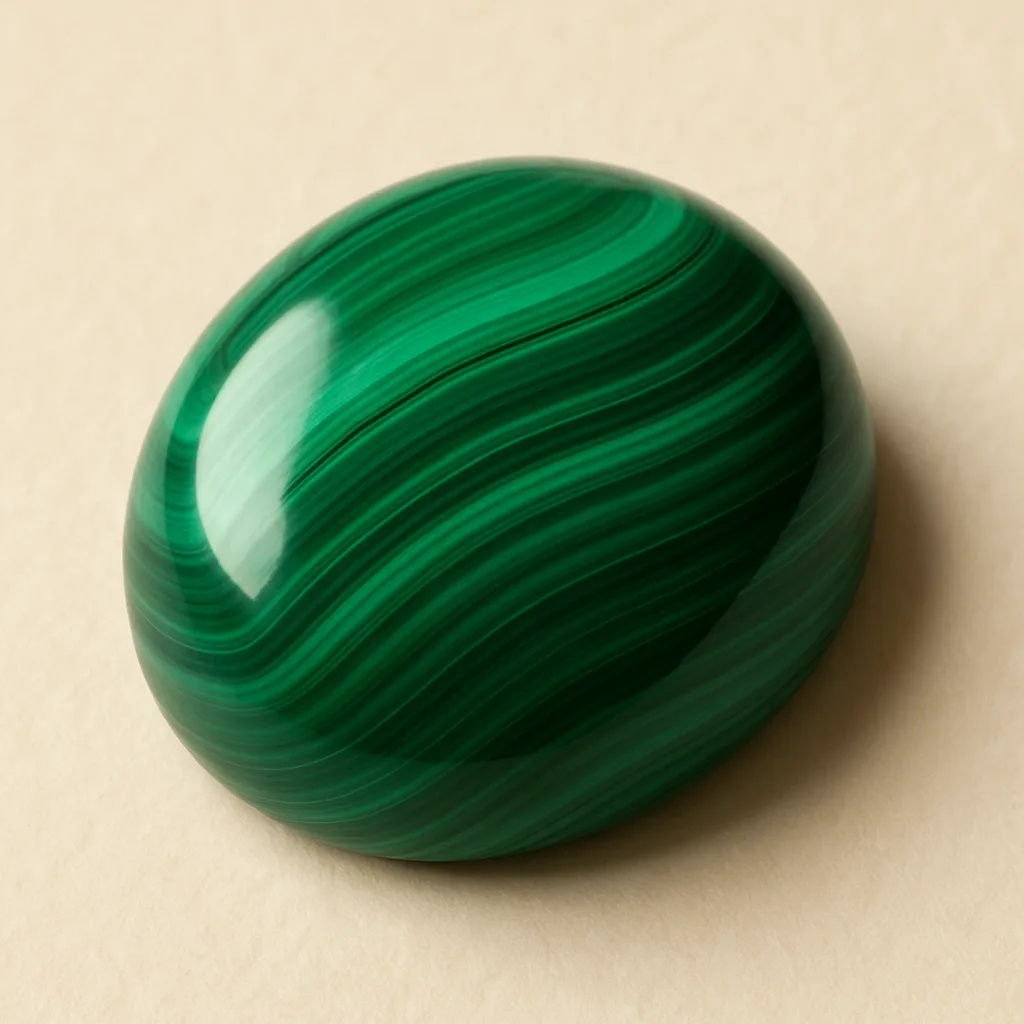
Light apple-green through deep emerald-green and near-black, banded concentrically. Copper is the sole chromophore.
- Curved concentric bands — the defining feature, formed by sectioning botryoidal masses
- Cross-sections of stacked spherulitic aggregates ('bull's-eye' patterns)
- Azurite or chrysocolla intergrowths in mixed-mineral specimens (sold as 'azurmalachite' or 'eilat stone')
- Opaque
- Silky to waxy luster on polished surface
- Refractive index 1.655–1.909 (high within the aggregate)
- Specific gravity 3.6–4.0
- 01Curved concentric green banding — diagnostic and impossible to fake convincingly
- 02Unnaturally regular straight banding is a sign of imitation or reconstituted material
- 03Mohs 3.5–4 — very soft; scratched easily by a steel blade
- 04Reacts and effervesces visibly when touched with hydrochloric acid (destructive — do not perform routinely)
- Mohs 3.5–4 — soft and easily scratched; protect carefully and store separately
- Sensitive to acids, perspiration, and household cleaners — never wash with soap and water for any length of time
- Polishing dust is mildly toxic (copper-bearing) — workshops must use respiratory protection
A few thousand yen for typical polished slabs and beads up to several tens of thousands of yen for large carved pieces with strong, well-resolved banding.
Note: Almost all commercial malachite today comes from the Congo and is sold as polished slabs, cabochons, eggs, spheres, and small carvings. Bead-strung jewelry should be examined for resin filling, which is common with the softer, more porous material. Synthetic malachite produced by hydrothermal growth in Russia is technically excellent and laboratory-distinguishable but rare in normal commerce.
Malachite is a hydrated copper carbonate, Cu₂CO₃(OH)₂, formed by the weathering of copper sulfide ores. Its botryoidal (grape-like) habit produces the famous concentric ring patterns when the rounded masses are sliced and polished. Color, derived entirely from copper, varies only in intensity — there is no chromophore range as in other gem species — so the visual interest comes from the banding alternation rather than from hue. The 'eye' patterns earned the stone its Japanese name 孔雀石 ('peacock stone') and the Russian medieval epithet 'eye of the earth.'
Origins
The Katanga (Shaba) Province of the Democratic Republic of Congo, especially the Kolwezi and Likasi areas, is the world's dominant source today and supplies most large polished slabs and carving stock. The classic historical source was the Nizhny Tagil region of Russia's central Urals, which produced the enormous masses used for the Malachite Room of the Winter Palace and the columns of St. Isaac's Cathedral in St. Petersburg. Other sources include Tsumeb in Namibia (with razor-sharp velvet-green crystals prized by collectors), Bisbee and Morenci in Arizona, Mexico, France's Chessy mines (the type locality for 'chessylite' — the older European name), and Australia's Burra and Cobar mines.
History
Ground malachite was the green pigment of Egyptian tomb paintings from the Old Kingdom onward and supplied the green band of Cleopatra's eye makeup. Greeks and Romans wore it as an apotropaic amulet for children. The undisputed peak of malachite as an architectural material came under Nicholas I of Russia in the 1830s: vast quantities of Nizhny Tagil malachite were sliced into veneer and applied to the columns and pilasters of the Winter Palace's Malachite Room (Maliakitovaya Gostinaya), still on display at the State Hermitage Museum. The Demidov family, which owned the Ural mines, exhibited a malachite-clad temple at the 1851 Great Exhibition in London.
Lore & symbolism
Sometimes listed as a secondary May birthstone. Long known as a 'mother's stone' and a 'pilgrim's stone' for traveler protection; medieval European tradition credited it with detecting impending danger by 'breaking' when worn near threat. In the metaphysical market it is associated with transformation, prosperity, and the heart chakra.
Tools to confirm this stone
Tools that help confirm Malachite. Tap any item to jump to the matching section on the gem tools page.
- 最終確認日
- 2026年4月28日
- 参 考 文 献
- Gem Encyclopedia/ GIA (Gemological Institute of America)
- 宝石鑑別基準/ 中央宝石研究所 (CGL)
- Mineral & Gem Database/ Mindat.org / Gemdat.org
- 宝石学入門/ 全国宝石学協会
本ページの物性値(屈折率・比重・硬度・結晶系等)は、上記の権威ある一次資料を相互参照して編集しています。最新の鑑別研究の進展により値が更新される場合があります。