identified this stone yet
Mahogany Obsidian
| Hardness | 5-5.5 |
| Specific gravity | 2.35-2.60 |
| Refractive index | 1.45-1.55 |
| Crystal system | 非晶質(天然ガラス) |
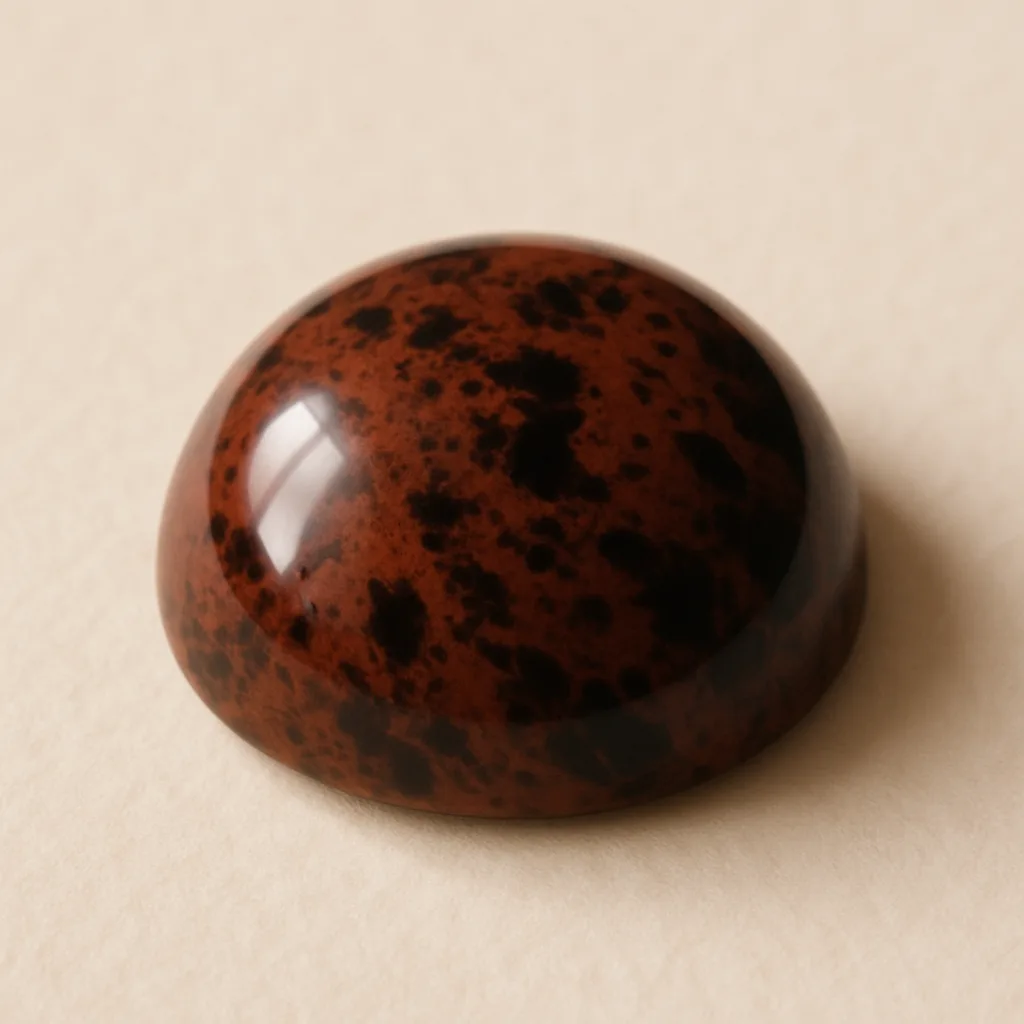
Reddish-brown to mahogany-brown banded with jet-black; the contrast is produced by hematite-rich versus hematite-depleted flow zones in the original volcanic glass. Highest-quality material from Jalisco shows sharp, well-defined banding with high color contrast; lower-grade material shows mottled, indistinct mixing. Some specimens also incorporate snowflake-like cristobalite spherulites, transitional toward 'snowflake obsidian.'
- Hematite-rich banding producing the diagnostic mahogany-and-black flow patterns
- Gas bubbles ranging from microscopic (giving the glass its faint bluish sheen in some specimens) to macroscopic (visible to the naked eye in low-grade material)
- Cristobalite spherulites (sometimes transitional toward 'snowflake obsidian')
- Flow lineations recording the original eruptive shear conditions
- Amorphous (no crystal structure) — singly refractive at all orientations
- Refractive index 1.480–1.510 — comparable to ordinary soda-lime glass
- Vitreous luster
- Conchoidal fracture (the diagnostic glass / tektite signature)
- 01Conchoidal fracture surfaces are the immediate field diagnostic — distinguishes obsidian from any crystalline lookalike
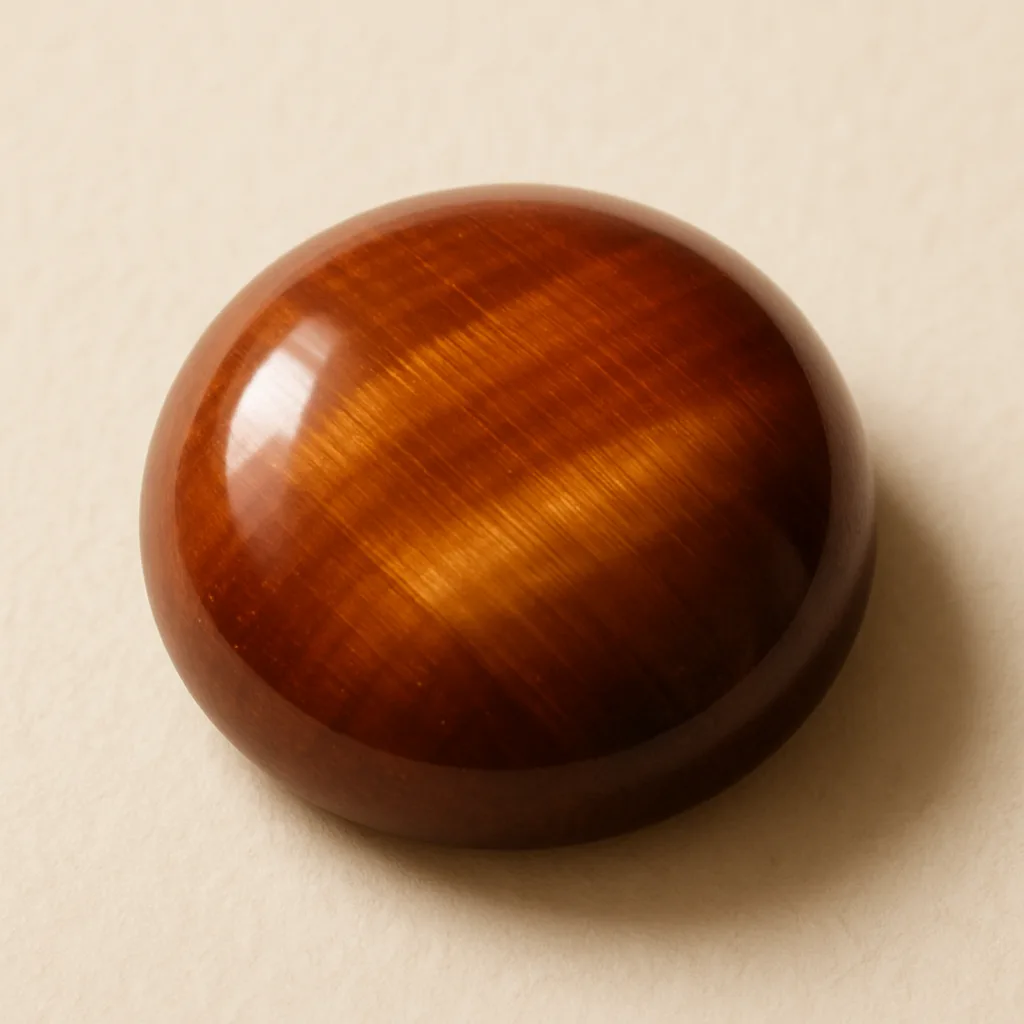
- 02Vitreous (glass) luster, never silky or chatoyant
- 03Mahogany-and-black banding pattern follows flow lineations rather than mineral
- 04Singly refractive in polariscope (no ) — same as soda-lime glass and tektites
- Mohs 5–5.5 — soft for jewelry use; scratches readily and chips along conchoidal fracture lines
- Avoid impact and rough wear
- Ultrasonic cleaning generally not recommended due to chip-prone edges
- Stable to standard cleaning chemicals
Cabochons trade at $5–$50 per piece for typical commercial quality; high-banded specimens with sharp Jalisco patterning run $20–$200 each. Carved decorative pieces (eggs, spheres, animal figures) trade at $20–$300 depending on size and craftsmanship. Authentically Aztec or pre-Columbian obsidian artefacts (certified provenance through legitimate auction houses such as Christie's or Sotheby's Antiquities sales) command four-to-six figure prices — but the antiquities market is heavily regulated under the 1970 UNESCO Convention and Mexican federal cultural-property law.
Note: Commercial supply is dominated by Mexican and Oregonian rough sold to American and Chinese cabochon and bead workshops. No treatments are routinely applied — natural color suffices. Beware of 'dyed mahogany obsidian' marketed in budget New Age channels, occasionally produced from clear or black obsidian dyed with iron-oxide stains. The Mesoamerican archaeological provenance gives the material a strong narrative-marketing position not matched by competing volcanic glasses.
nclusions and oxidation banding produce alternating reddish-brown and black flow patterns. Amorphous (no crystal structure), single refractive in polariscope, Mohs 5–5.5, SG 2.30–2.55, RI 1.480–1.510. The hematite banding records gas-flow and shear conditions during the original eruptive cooling — typically late-stage rhyolitic obsidian flows where iron-bearing volatiles oxidized along flow lineations. Conchoidal fracture (the fundamentally diagnostic feature of glass and tektites alike) produces the classic curved 'shell' fracture surfaces that distinguish obsidian from any crystalline lookalike. Hokkaido Shirataki, Lipari (Italy), Glass Buttes (Oregon), and Acatlán (Mexico) are the type localities for studying obsidian flow chemistry; the Mexican volcanic belt supplies the commercial mahogany-banded material.
Origins
Mexico (Jalisco state — particularly the Tequila Volcano region and surrounding Sierra Madre Occidental rhyolite flows; Sierra de Pachuca in Hidalgo state) is the dominant commercial source of mahogany-banded obsidian. The Sierra de Pachuca complex is the same source that supplied the green-gold sheen obsidian used by Aztec craftsmen for ceremonial blades (tecpatl) and the famous scrying mirrors (tezcatl) — INAA (Instrumental Neutron Activation Analysis) provenance work by Michael Glascock at the University of Missouri Research Reactor since the 1980s has mapped Mesoamerican obsidian trade networks back to specific source flows. United States Oregon (Glass Buttes, Burns) and California (Glass Mountain) yield mahogany material as well. Armenian (Gutanasar volcano) and Guatemalan (El Chayal, San Martín Jilotepeque) sources are documented archaeologically but have minor commercial presence. The Hokkaido Shirataki obsidian source supplied 25,000 BCE Jōmon-period long-distance trade across northern Japan, comparably ancient to Çatalhöyük.
History
Obsidian's human history is among the oldest in the lithic record. The Çatalhöyük Anatolian obsidian trade documented by James Mellaart's 1960s excavations established 7500 BCE as a baseline for long-distance commodity exchange. Pliny the Elder in Naturalis Historia (77 CE) named the genus 'lapis obsianus' after the Roman explorer Obsius, who according to Pliny brought the first specimens to Rome from Ethiopia. Aztec obsidian craftsmanship reached its apex in the fifteenth and sixteenth centuries: the prismatic blade (tecpatl) used in sacrificial ritual, the Tezcatlipoca scrying mirror (tezcatl, 'Smoking Mirror' — the same deity-name), and the macuahuitl wooden sword set with obsidian edges. The 1521 Spanish conquest documented these in detail (Bernardino de Sahagún's Florentine Codex) before the obsidian craft tradition collapsed. The Hokkaido Shirataki source supplied Jōmon-period long-distance trade from 25,000 BCE. Modern revival began in the 1870s with the Apache Tears narrative from Pinal Apache flight at Big Picacho, Arizona, and accelerated with the New Age movement of the 1980s and 1990s. Errett Callahan and Bruce Buck demonstrated in 1975 that knapped obsidian edges measured 3 nm in cross-section — sharper than any steel scalpel — and obsidian surgical scalpels saw limited modern use in the 1980s for soft-tissue work where edge fineness mattered more than durability.
Lore & symbolism
Not assigned to any traditional birthstone list. Modern crystal-writing positions mahogany obsidian as a stone of grounding, root-chakra strength, decisive action, and protection against psychic vampirism — Western neopagan adaptations of the Mexican curandero tradition that retains some genuine continuity with pre-Hispanic obsidian use. The Apache Tears narrative (1870 Pinal Apache flight at Big Picacho, Arizona) attaches to all dark obsidian forms and gives the material a documented place in nineteenth-century Western American folklore. The Tezcatlipoca 'Smoking Mirror' association from Mexica state religion gives obsidian an unbroken sacred-stone status from 1500 BCE Olmec scrying use through to modern Mexican folk-Catholicism.
Tools to confirm this stone
Tools that help confirm Mahogany Obsidian. Tap any item to jump to the matching section on the gem tools page.
- 最終確認日
- 2026年4月28日
- 参 考 文 献
- Gem Encyclopedia/ GIA (Gemological Institute of America)
- 宝石鑑別基準/ 中央宝石研究所 (CGL)
- Mineral & Gem Database/ Mindat.org / Gemdat.org
- 宝石学入門/ 全国宝石学協会
本ページの物性値(屈折率・比重・硬度・結晶系等)は、上記の権威ある一次資料を相互参照して編集しています。最新の鑑別研究の進展により値が更新される場合があります。