identified this stone yet
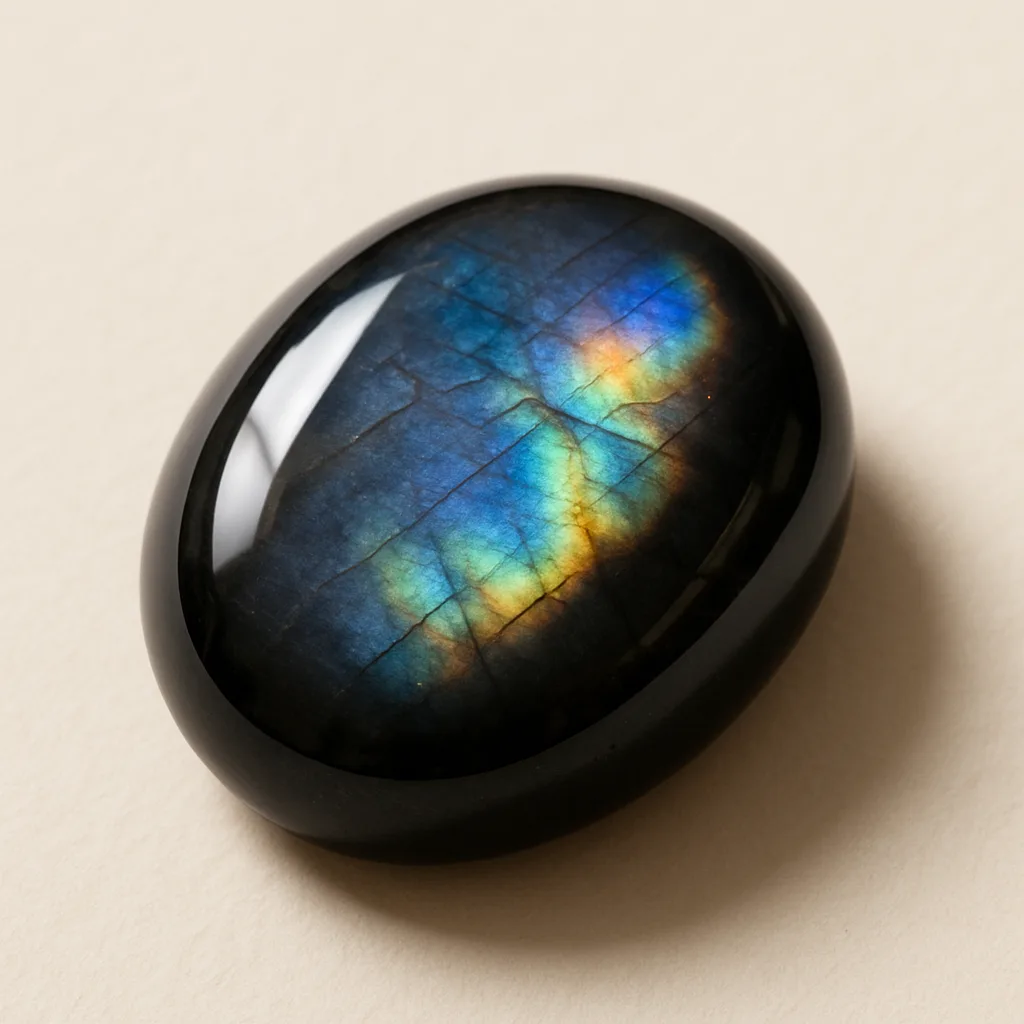
Labradorite
| Hardness | 6-6.5 |
| Specific gravity | 2.68-2.72 |
| Refractive index | 1.560-1.573 |
| Crystal system | 三斜晶系 |
Base color from very dark gray to medium gray, occasionally pale or near-translucent. Labradorescent flashes span blue (most common), green, gold, orange, violet, and rarely red — Finnish spectrolite shows the broadest spectrum.
- Twinning lamellae visible as fine straight lines parallel to the direction
- Two directions of good at ~86°
- Magnetite or ilmenite needles in some Finnish material
- nclusions
- Doubly refractive (biaxial positive or negative depending on composition)
- — structural color from lamellar interference
- Two directions of good at nearly right angles
- 01 appears in broad sheet-like flashes that change abruptly with viewing angle — different from opal's broken play-of-color or moonstone's continuous sheen
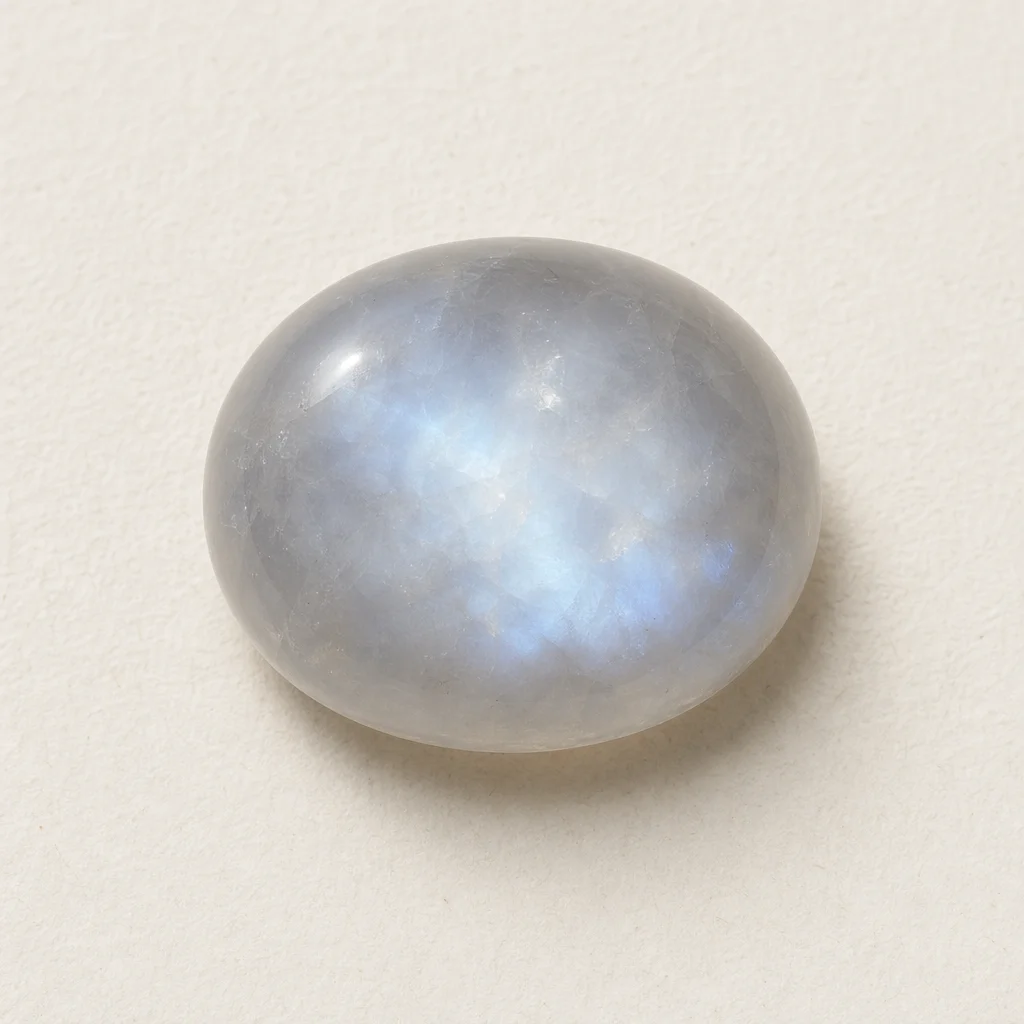
- 02RI 1.559–1.573 and SG 2.65–2.75 separate labradorite from moonstone (slightly lower) and the rarer oligoclase
- 03Twinning lamellae are visible under 10× as fine parallel lines
- Mohs 6–6.5 with two-direction — protective settings preferred
- Avoid ultrasonic and steam — may propagate
- Warm soapy water and a soft brush; avoid harsh chemicals
Roughly $3–$20/ct for commercial Madagascan blue-flash cabochons, $30–$80/ct for clean translucent rainbow material, and $100–$500/ct for fine Finnish spectrolite with strong multicolor flash. Faceted labradorite (less common) commands modest premiums over cabochon.
Note: Untreated and unsynthesized — labradorite is sold as-mined. The main market caution is the trade name 'rainbow moonstone,' which refers to translucent labradorite (not orthoclase moonstone) and should be disclosed. Spectrolite from Finland commands a substantial premium when origin is certified. Coated assembled stones are rare but possible.
Labradorite is a calcium-rich plagioclase feldspar in the andesine-labradorite series ((Ca,Na)(Al,Si)₄O₈, ~50–70% anorthite). Its arises from light interfering with very thin alternating lamellae of calcium-rich and sodium-rich plagioclase — a structural color effect known as the Bøggild intergrowth, named for the Danish mineralogist Ove Balthasar Bøggild. Discovered on Paul Island, Labrador in 1770 by Moravian missionaries, today's gem sources include Madagascar, Finland (spectrolite), Ukraine, Mexico, and Russia.
Origins
Madagascar's central and southern regions now dominate commercial production, supplying large clean rough with strong blue at attractive prices. Finland's Ylämaa deposit produces 'spectrolite' — the trade name reserved for material showing the full visible-light spectrum in a single flash. Ukraine and Russia's Kola Peninsula yield darker, larger ornamental blocks. The original Paul Island deposit in Canada is now historic but produced classic dark-base material with broad blue flash.
History
Inuit oral tradition explained as the Northern Lights trapped inside Labrador stones; the gem was first 'discovered' by Moravian missionaries on Paul Island in 1770 and rapidly entered European mineral cabinets. Finnish spectrolite was identified during World War II by mineralogist Aarne Laitakari and named in 1944. The modern boom in Madagascan production began in the 1990s and made labradorite affordable enough for fashion jewelry worldwide.
Lore & symbolism
Modern crystal lore treats labradorite as a stone of transformation and protection of the aura; it has no traditional birthstone status. Inuit folklore connects it to the aurora borealis.
Tools to confirm this stone
Tools that help confirm Labradorite. Tap any item to jump to the matching section on the gem tools page.
- 最終確認日
- 2026年4月28日
- 参 考 文 献
- Gem Encyclopedia/ GIA (Gemological Institute of America)
- 宝石鑑別基準/ 中央宝石研究所 (CGL)
- Mineral & Gem Database/ Mindat.org / Gemdat.org
- 宝石学入門/ 全国宝石学協会
本ページの物性値(屈折率・比重・硬度・結晶系等)は、上記の権威ある一次資料を相互参照して編集しています。最新の鑑別研究の進展により値が更新される場合があります。