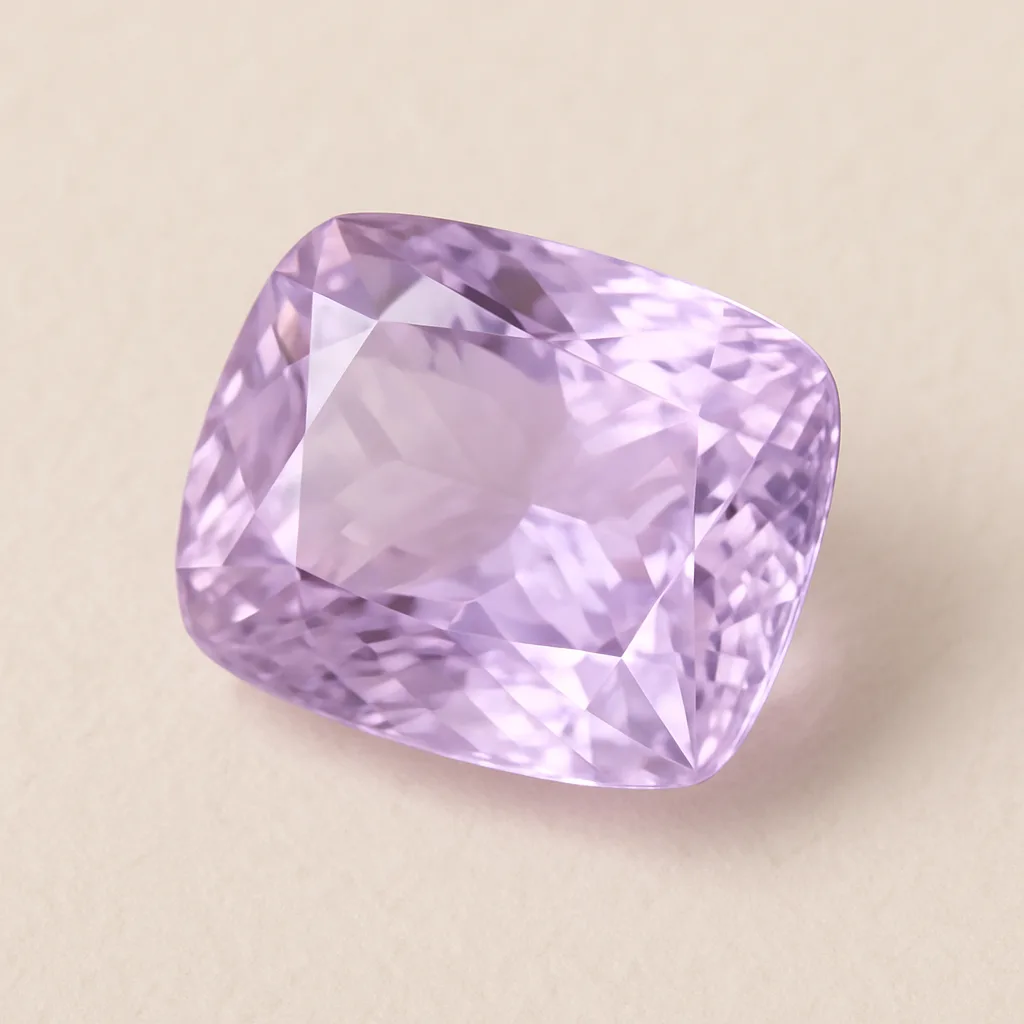
identified this stone yet
Kunzite
| Hardness | 6.5-7 |
| Specific gravity | 3.18 |
| Refractive index | 1.660-1.676 |
| Crystal system | 単斜晶系 |
Soft pink through delicate lilac to deeper violet-pink. Color is highly directional — orientation during cutting determines the dominant face-up tone. The most prized stones show a saturated, slightly violet pink.
- Often very clean — eye-clean large stones are routine
- planes parallel to the prism faces
- nclusions oriented along the c-axis
- Etch features on surfaces
- Doubly refractive (biaxial positive)
- Extreme : colorless, pink, and violet along three axes
- Two directions of perfect at nearly 90°
- 01Extreme through a dichroscope is the strongest single test — three clearly different colors
- 02Strong orange-pink LW UV is highly diagnostic
- 03Perfect may be visible as flat reflective planes inside the stone
- 04RI 1.66–1.68 and SG 3.1–3.2 separate kunzite from morganite and rose quartz
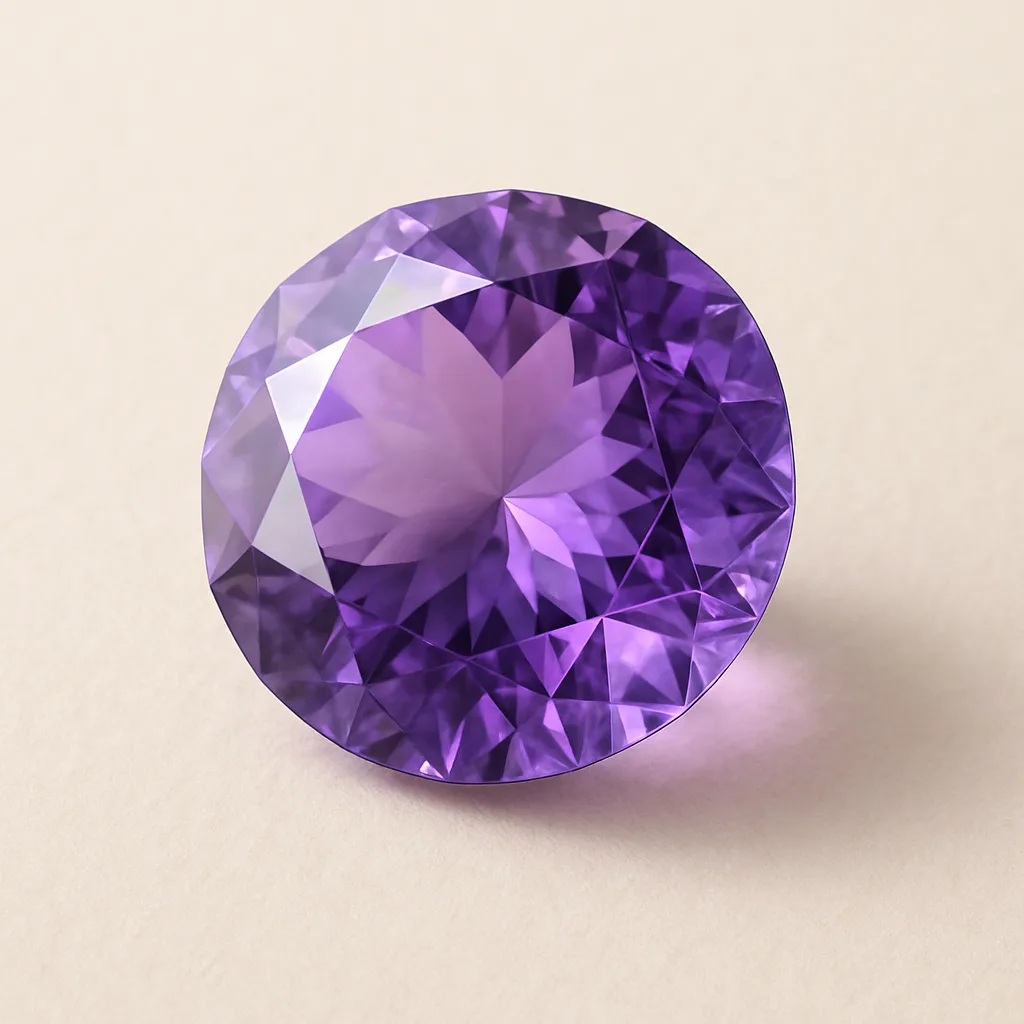
- Perfect in two directions makes kunzite fragile — protective settings only
- Never ultrasonic or steam; warm soapy water and a soft brush only
- Store away from direct sunlight and avoid heat — color can fade visibly within weeks of intense exposure
Roughly $30–$80/ct for commercial pale stones, $150–$400/ct for clean 5–15 ct material with good pink saturation, and $500–$1,200+/ct for top deeply saturated 20 ct+ stones. Color stability and origin (especially Pala) command premiums.
Note: Irradiation followed by heat treatment is sometimes used to deepen pink, but treated color is unstable and prone to fading. Most reputable kunzite is sold untreated. Cutters orient stones to maximize face-up color, accepting larger sizes than typical (because pink saturation rises with depth). Always store away from sunlight.
Kunzite is spodumene (LiAlSi₂O₆) tinted pink to lilac by trace manganese. Discovered in 1902 at the Pala Chief Mine in San Diego County, California, it was named the same year by George Frederick Kunz of Tiffany & Co. Today's main sources are Afghanistan's Nuristan and Kunar provinces, Pakistan's Shigar Valley, Brazil's Minas Gerais, and Madagascar. Crystals are often large and well-formed, yielding flat, elongated cuts.
Origins
aceted, so 'fine large' is common at this gem.
History
Kunzite is one of the few major gems with a documented modern discovery: identified at the Pala Chief by Frederick Sickler in 1902 and analyzed and named that same year by Kunz. Tiffany & Co. quickly featured it in Edwardian-era jewelry, and oversized kunzites became fashionable in mid-20th-century cocktail rings. A famous example is the 396-carat Kunzite Pendant gifted by John F. Kennedy to Jackie Kennedy, intended for a Christmas she never received him.
Lore & symbolism
Kunzite has no traditional birthstone association but is increasingly marketed as a stone of emotional healing and the heart chakra in modern lapidary lore.
Tools to confirm this stone
Tools that help confirm Kunzite. Tap any item to jump to the matching section on the gem tools page.
- 10× loupeDETAILS →
Essential 10× tool to read inclusions, polish marks, and color zoning
- DichroscopeDETAILS →
Strong pleochroism — confirm both axes through twin windows
- Chelsea filterDETAILS →
Quick chrome-content screen — chromium-bearing stones glow red through the filter
- UV lamp (long-wave 365 nm)DETAILS →
Long-wave UV reveals orange / red fluorescence (strong)
- Handheld spectroscopeDETAILS →
Absorption-line pattern identifies the chromophore (Cr, Fe, or Co)
- Last reviewed
- April 28, 2026
- Bibliography
- Gem Encyclopedia / GIA (Gemological Institute of America)
- Gem Identification Standards / Central Gem Laboratory (CGL), Tokyo
- Mineral & Gem Database / Mindat.org / Gemdat.org
- Introduction to Gemology / Gemmological Association of All Japan (GAAJ)
The gemological data on this page (refractive index, specific gravity, hardness, crystal system, etc.) is cross-checked against the authoritative primary sources listed above. Values may be revised as gemological research advances.