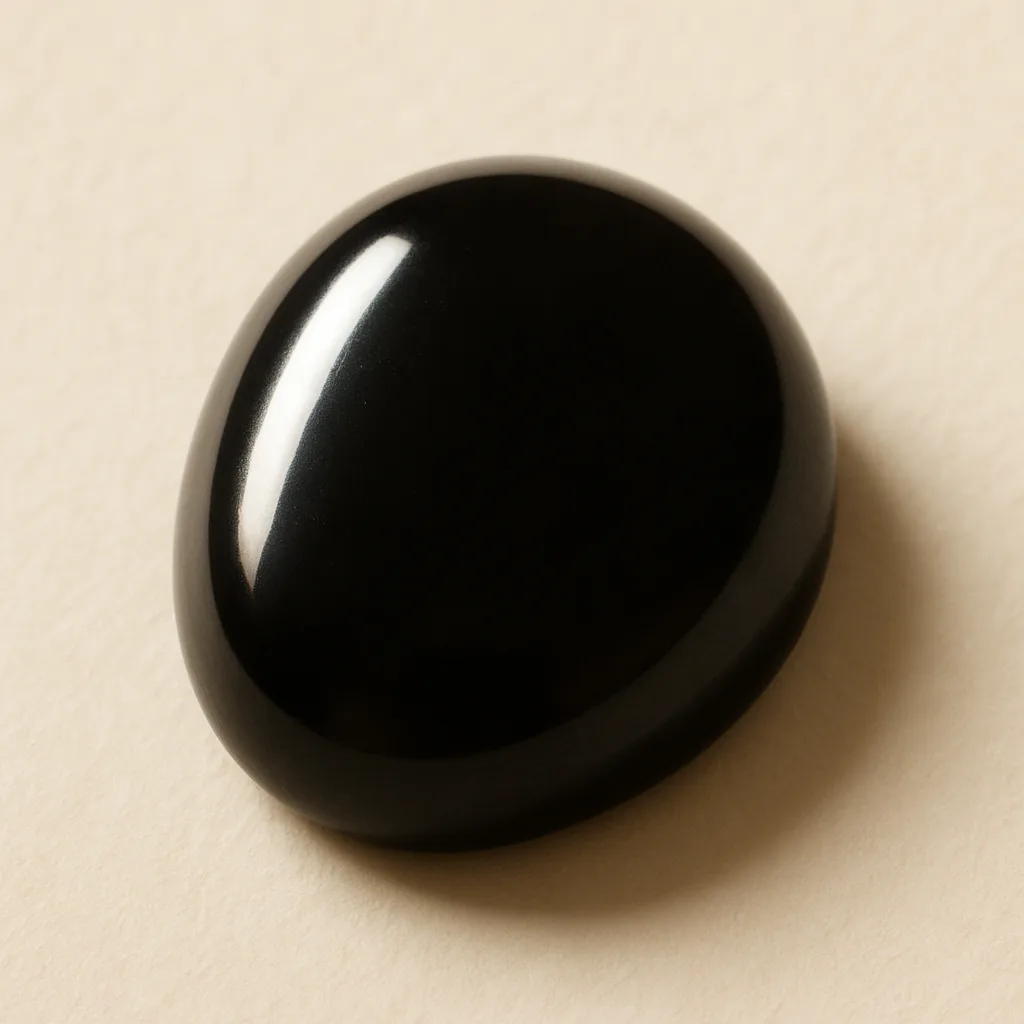
identified this stone yet
Jet
| Hardness | 2.5-4 |
| Specific gravity | 1.30-1.35 |
| Refractive index | 1.64-1.68 |
| Crystal system | 非晶質(有機化石) |
Deep velvety black with a slight brown undertone in transmitted light; takes a very high polish on the best Whitby material. Hard jet (Whitby standard) is more compact and polishable than soft jet (Spanish and lower-grade English material), which is more prone to cracking.
- Wood-grain growth-ring structure visible under magnification in well-preserved material
- Pyrite specks (iron sulfide deposited from the anoxic burial environment) — characteristic of Whitby material
- Occasional preserved Araucariaceae cellular structure visible in thin section
- Surface microcracks (crazing) in older worked pieces from desiccation
- Effectively singly refractive (amorphous organic structure)
- Refractive index 1.64–1.68 (spot readings often inconsistent across the specimen)
- Specific gravity 1.3–1.35 — the lightest of all gem materials, distinctively lower than any silicate
- Mohs 2.5–4 — soft, easily carved with hand tools and a fingernail can mark soft jet
- Opaque even in thin sections; warm to the touch
- 01Specific gravity 1.3–1.35 — true jet floats or just hovers in saturated brine, while black glass (~2.5), onyx (~2.6), and obsidian (~2.4) all sink; this is the single most diagnostic non-destructive test
- 02Brown streak on unglazed biscuit (white for onyx and black glass) — destructive but definitive
- 03Hot-pin streak produces a coal-tar smell — destructive test, used only on inconspicuous areas of contested antique pieces
- 04Warm to the touch (low thermal conductivity, like all organics) — contrasts with cold-to-touch onyx, glass, and obsidian
- 05Mohs 2.5–4 — a steel knife marks jet but not onyx (Mohs 7) or obsidian (Mohs 5–5.5)
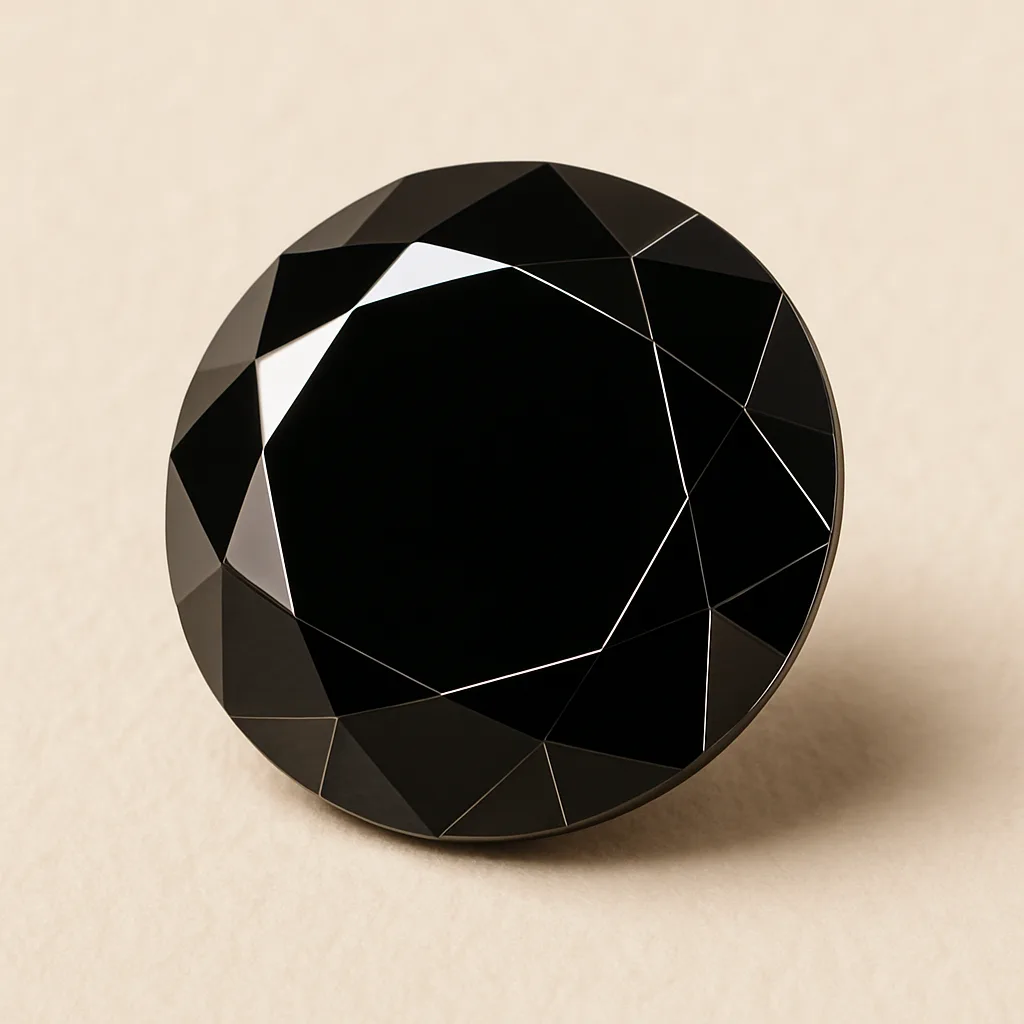
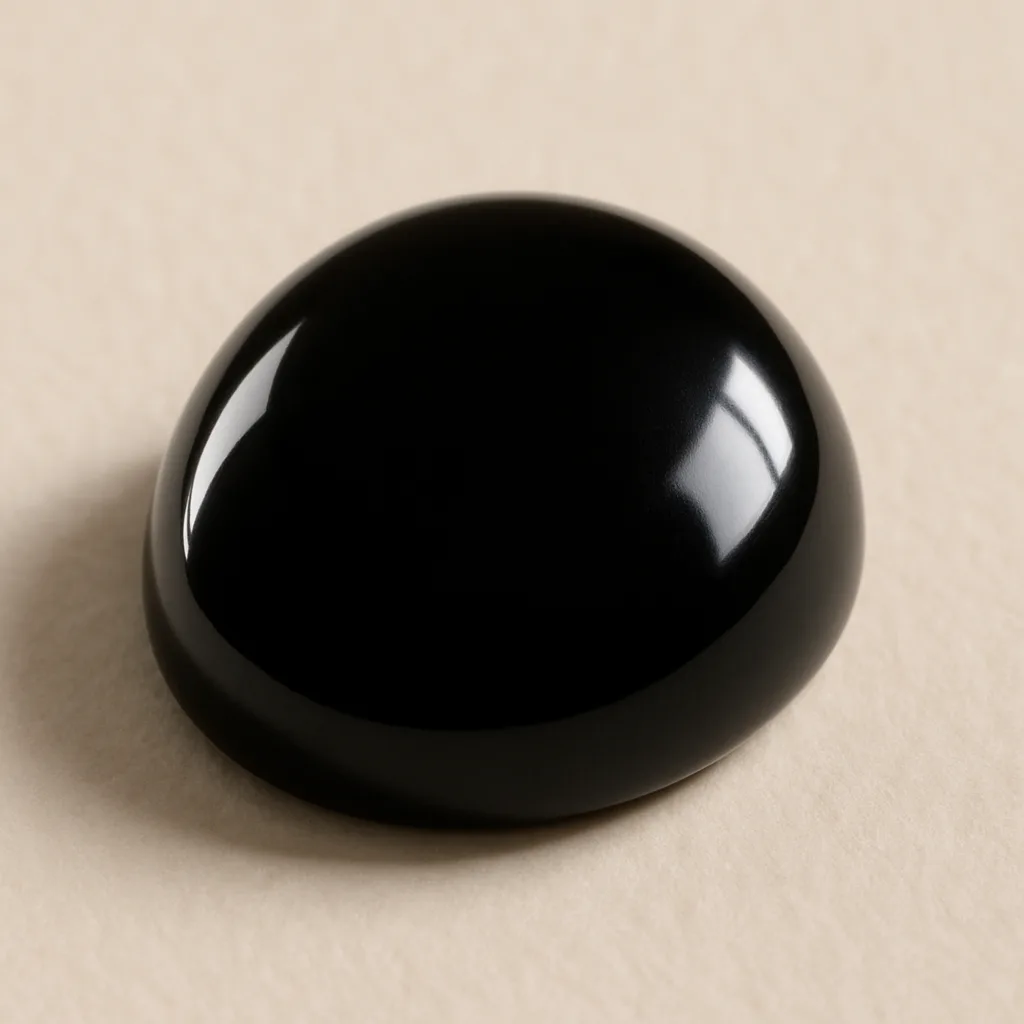
- Mohs 2.5–4 — soft and scratch-prone; suitable for pendants and brooches, less ideal for rings
- Avoid sudden temperature changes — thermal shock causes crazing and surface microcracking
- Never ultrasonic or steam — vibration and heat both damage the organic structure
- Clean only with a soft dry cloth or barely-damp cotton; soap solutions can dull the polish
- Store separately from harder gems; do not expose to prolonged dry heat (radiator vicinity, direct summer sun in a closed car)
Modern hand-carved Whitby jet jewelry $50–500 per piece for contemporary workshop output; antique Victorian Whitby jet brooches and necklaces $100–3,000 depending on size, workmanship, and provenance; museum-grade Bronze Age and Roman jet artifacts are not traded commercially.
Note: The contemporary jet market is small, niche, and centered on Whitby itself, where a handful of family workshops continue to source rough from the Yorkshire coast and produce hand-carved jewelry, often for the Victorian-revival, goth, and historical-reenactment markets. The dominant disclosure issue is the systematic mislabeling of black glass ('French jet,' 'imitation jet'), vulcanized rubber/ebonite ('vulcanite jet'), bog oak, anthracite coal, and various plastics (Bakelite, modern resins) as 'jet' in the antique and costume-jewelry trade. None of these imitations behaves like real jet under the hot-pin or specific-gravity tests. A simple float test in saturated brine separates true jet (floats or hovers, SG ~1.3) from black glass (SG ~2.5, sinks), onyx (SG ~2.6, sinks), and vulcanite (SG ~1.2 — similarly low, hot-pin test gives the additional diagnostic).
Jet is a hard variety of brown coal — fossilized wood (Araucariaceae driftwood, principally Araucaria mirabilis-type ancestors of the modern monkey-puzzle tree) buried in marine shales during the Toarcian stage of the Lower Jurassic, around 182 million years ago. Mohs 2.5–4 (soft, easily carved), SG 1.3–1.35 (the lightest of gem materials — fine jet floats in saturated salt water and is barely denser than water itself), RI 1.64–1.68 measured by spot reading, but readings are often inconsistent across the material. Jet is warm to the touch (low thermal conductivity, like other organics), takes a high polish, and produces a brown streak on unglazed biscuit and a coal-like smoke when touched with a hot pin — both destructive but diagnostic tests in cases of doubt. Whitby jet is the chemical and mechanical standard against which all other jet is measured; 'Spanish jet' from Asturias and 'French jet' (a misnomer — French jet is actually black glass) are inferior or imitation grades.
Origins
Whitby on the North Yorkshire coast of England is the world's standard source — the Toarcian shales exposed along the cliffs between Robin Hood's Bay and Saltwick Nab contain the original 'hard jet' that defines the species. Whitby jet has been worked continuously since Bronze Age burial finds (c. 1500 BCE) and Roman jet ateliers operated at Eboracum (York), shipping jet pendants, hairpins, and amulets across the western Roman provinces. Spain's Asturias (around Oviedo) produces a softer, more brittle 'Spanish jet' used in Santiago de Compostela pilgrim badges and in modern Spanish costume jewelry. Smaller jet sources include Wyoming (Acoma Pueblo jet), Pennsylvania, Colorado, Turkey (Erzurum), and France (Aude). Whitby production effectively ceased in the early 20th century with the collapse of the Victorian mourning market, though small workshops have continuously operated.
History
Bronze Age burial mounds across Yorkshire and Scotland (c. 1500 BCE) contain Whitby jet beads, pendants, and disc buttons — among the earliest evidence of long-distance prestige-goods trade in the British Isles. Roman Eboracum (York) operated jet-carving ateliers from c. 200 CE producing the Medusa-head pendants, hairpins, and ring blanks found across Roman Britain, Germania, and as far as the eastern provinces. Anglo-Saxon and Viking-period jet appears in Whitby Abbey associated finds, and medieval pilgrims to Saint Hilda's shrine at Whitby Abbey purchased jet rosaries and crucifixes. The defining moment in jet's history was the death of Queen Victoria's husband Prince Albert in December 1861, after which Victoria entered a 40-year mourning that effectively mandated black jewelry for the British court and, by social emulation, for the upper and middle classes of Britain, France, Germany, and the eastern United States. Whitby's jet industry exploded — at peak production in 1873 the town of approximately 14,000 inhabitants contained around 1,500 jet workshops, and Whitby jet was the second-largest export of the British jewelry trade after Birmingham silver. Edward VII's accession in 1901 and the gradual relaxation of formal mourning customs after Victoria's death led to a precipitous collapse; by the 1920s Whitby's jet industry had effectively ended, with only a handful of family workshops surviving into the 21st century.
Lore & symbolism
Pliny the Elder records jet ('gagates,' from the Lycian river Gages where it was first known to Greek and Roman commerce) as a substance that, when heated, drives away serpents and exposes hysteria — early sympathetic-magic and proto-medical claims. Medieval Christian symbolism associated jet with the cardinal vice of pride mortified and with monastic discipline; Saint Hilda's Abbey at Whitby produced jet rosaries as a mark of contemplative devotion. Northern European folklore credits jet with apotropaic functions against the evil eye, against thunderstorms, and against childbirth complications. Victorian mourning etiquette, codified in publications such as Cassell's Household Guide (1869), strictly required jet (or 'jet substitutes' for the less wealthy) during the first six months of widow's mourning, with gradual relaxation to other dark stones and finally to pearls and amethysts over a two-and-a-half-year mourning cycle.
Tools to confirm this stone
Tools that help confirm Jet. Tap any item to jump to the matching section on the gem tools page.
- 最終確認日
- 2026年4月28日
- 参 考 文 献
- Gem Encyclopedia/ GIA (Gemological Institute of America)
- 宝石鑑別基準/ 中央宝石研究所 (CGL)
- Mineral & Gem Database/ Mindat.org / Gemdat.org
- 宝石学入門/ 全国宝石学協会
本ページの物性値(屈折率・比重・硬度・結晶系等)は、上記の権威ある一次資料を相互参照して編集しています。最新の鑑別研究の進展により値が更新される場合があります。