identified this stone yet
Jadeite
| Hardness | 6.5-7 |
| Specific gravity | 3.34 |
| Refractive index | 1.66-1.68 |
| Crystal system | 単斜晶系(多結晶集合体) |
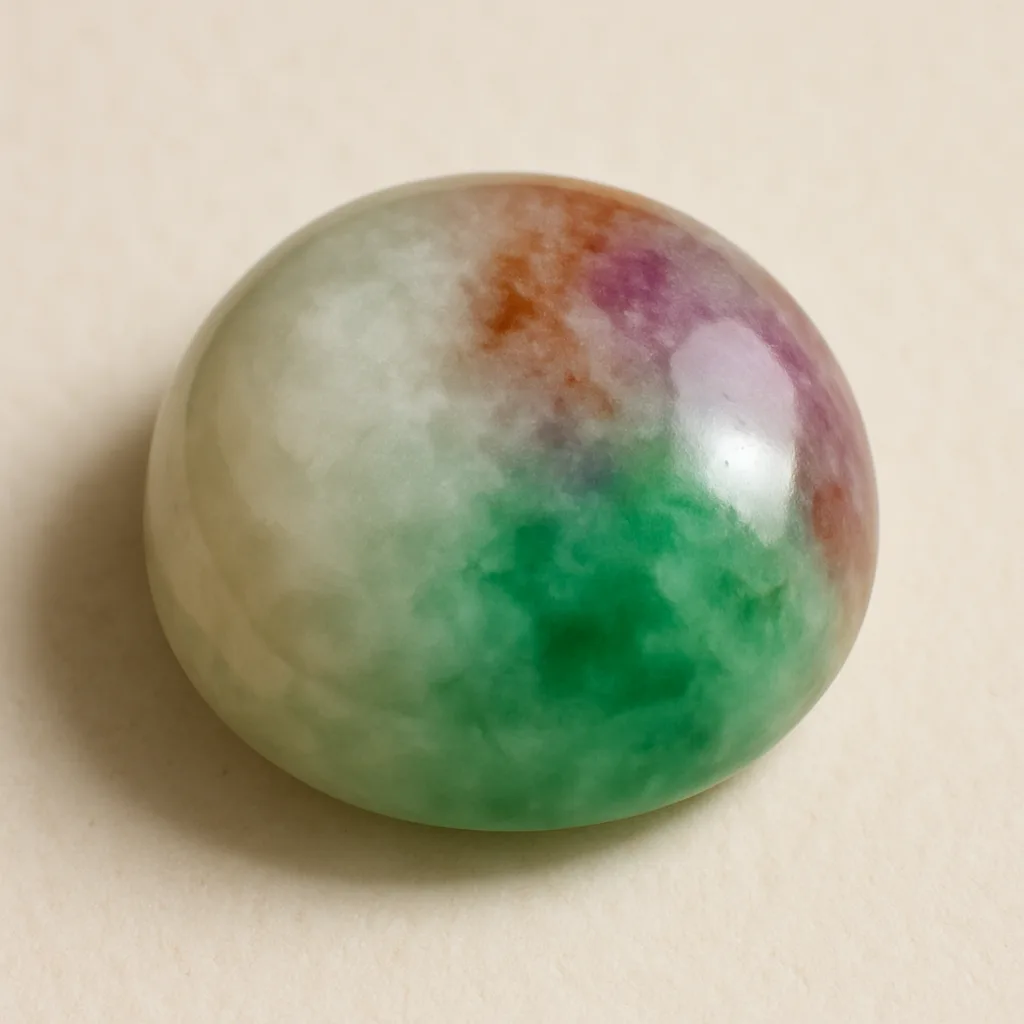
White ('mutton-fat'), apple-green, emerald-green, lavender, yellow, red-brown, and rare blue-green ('Olmec jade'). The benchmark is Imperial Jade — translucent, pure green with no gray or yellow modifier.
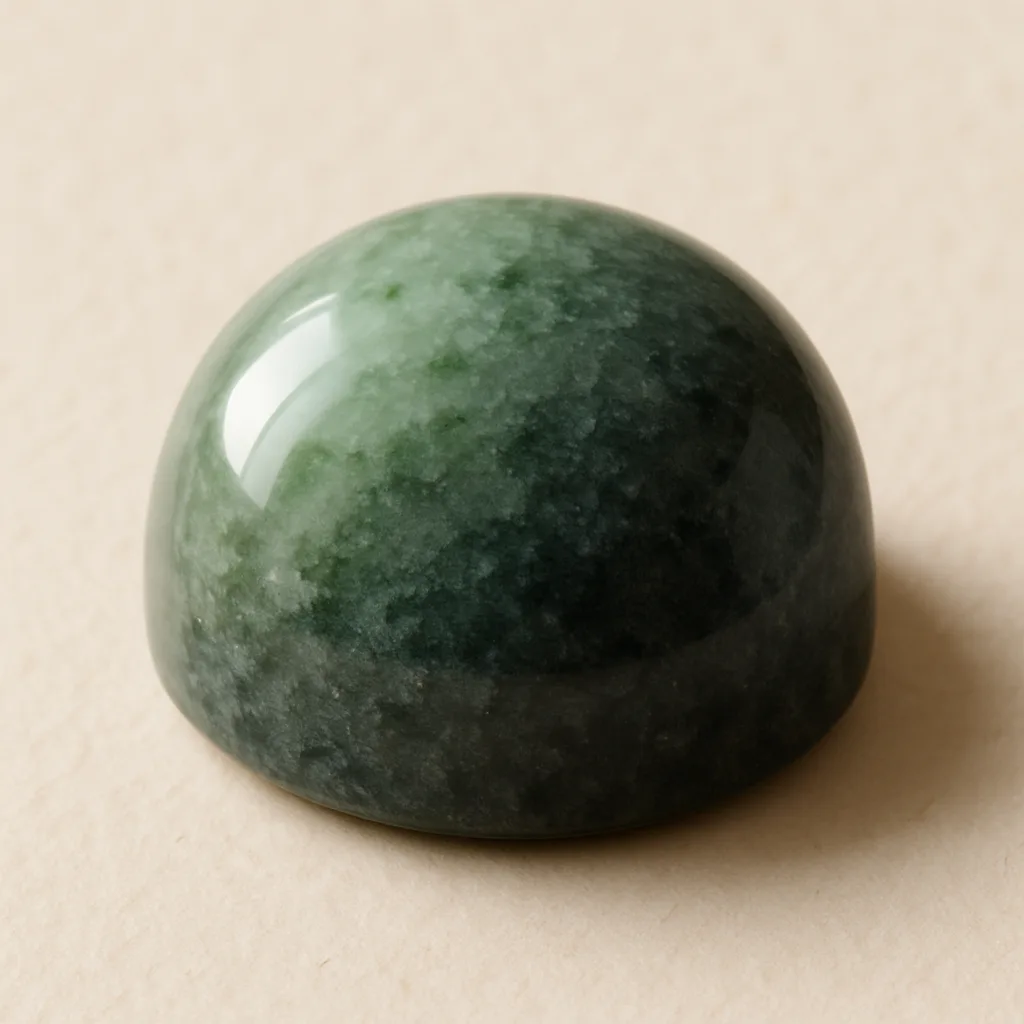
- Granoblastic to fibrous interlocking texture visible at 10× ('orange-peel' surface after polishing)
- Black chromite spots and chromite-rich veining
- Color zoning and irregular green patches against a paler matrix
- Pressure-twinning lamellae in coarser-grained 'old-mine' material
- Aggregate optical behavior — no sharp shadow on the refractometer (a single broad reading around 1.66)
- Toughness ranks among the highest of all gem materials
- Specific gravity ~3.30–3.38 — heavier than nephrite
- 6.5–7
- 01Fibrous, interlocking 'orange-peel' surface texture under reflected 10× light
- 02Specific gravity around 3.33 — distinctly heavier than nephrite (~2.95) or chrysoprase (~2.6)
- 03Inert under both LW and SW UV; strong uniform indicates Type B polymer impregnation
- 04Cool, soapy feel and the characteristic 'click' when two pieces tap together
- Mohs 6.5–7 but exceptionally tough thanks to its interlocking fibrous structure — daily wear is fine
- Sensitive to acids and strong alkalis
- Never ultrasonic-clean Type B jadeite — the polymer matrix will craze
From a few US dollars per gram for commercial Type B/C material up to hundreds of thousands of dollars per carat for top-color Type A Imperial Jade cabochons. A single fine bangle bracelet has sold above US$10 million.
Note: The trade grades jadeite as Type A (no treatment beyond a traditional wax polish), Type B (bleached and polymer-impregnated), and Type C (dyed). Only Type A holds its value; Type B-and-C is a separate market. Always require a recognized lab report (GIA, HKJSL, GIT, NGTC) for any high-value purchase — visual identification of polymer impregnation is unreliable.
Jadeite is a sodium-aluminum pyroxene (NaAlSi₂O₆) that occurs as tough, microcrystalline aggregates. Mineralogically distinct from nephrite, the two were lumped together as 'jade' until the French chemist Alexis Damour separated them in 1863. Jadeite's color spans white ('mutton-fat'), green, lavender, yellow, red-brown, and rare blue-green; the trade ranks specimens by translucency and color saturation, with the legendary 'imperial' tone — pure, glowing emerald-green — at the apex. Outside Myanmar, jadeite occurs in Guatemala's Motagua Valley (the Olmec and Maya source) and along Japan's Itoigawa River, where Jōmon-period craftsmen worked it 5,000 years before any European mineralogist learned of it.
Origins
Hpakant in Kachin State, Myanmar, produces nearly all of the world's gem-quality jadeite and is the only consistent source of Imperial Jade. The Motagua Valley in Guatemala — the original source for Olmec and Maya jade — was rediscovered in the 1950s and is the world's only commercial source of the rare blue-green and 'galactic' jadeites. Russia (Polar Urals), Kazakhstan, Itoigawa in Japan's Niigata Prefecture, California's Clear Creek area, and New Zealand's Marlborough region all produce smaller quantities. Itoigawa is the world's oldest documented jade-working site, with Jōmon-period beads dating to roughly 5000 BCE.
History
Chinese civilizations have prized jade as the supreme stone for over four thousand years, though almost all archaeological 'jade' from the Han dynasty onward is nephrite, not jadeite. Jadeite reached Beijing only in the late 18th century, when Burmese tribute caravans began carrying it overland through Yunnan. Empress Dowager Cixi (1835–1908) became its most famous champion, and her tomb was rumored to contain a coffin of solid Imperial Jade. The Hutton-Mdivani necklace — twenty-seven matched Imperial Jade beads once owned by Woolworth heiress Barbara Hutton — sold at Sotheby's Hong Kong in 2014 for HK$214 million, the world auction record for jadeite.
Lore & symbolism
Recognized in some traditions as a May birthstone and as the gift for the 12th wedding anniversary. In Chinese culture jade embodies the Five Virtues of the Confucian gentleman: benevolence, righteousness, propriety, wisdom, and sincerity. Māori carvers regard pounamu (nephrite jade) as a living taonga or treasure, but Imperial-grade jadeite carries the related Asian symbolism of prosperity, longevity, and Heaven's favor.
Tools to confirm this stone
Tools that help confirm Jadeite. Tap any item to jump to the matching section on the gem tools page.
- 最終確認日
- 2026年4月28日
- 参 考 文 献
- Gem Encyclopedia/ GIA (Gemological Institute of America)
- 宝石鑑別基準/ 中央宝石研究所 (CGL)
- Mineral & Gem Database/ Mindat.org / Gemdat.org
- 宝石学入門/ 全国宝石学協会
本ページの物性値(屈折率・比重・硬度・結晶系等)は、上記の権威ある一次資料を相互参照して編集しています。最新の鑑別研究の進展により値が更新される場合があります。