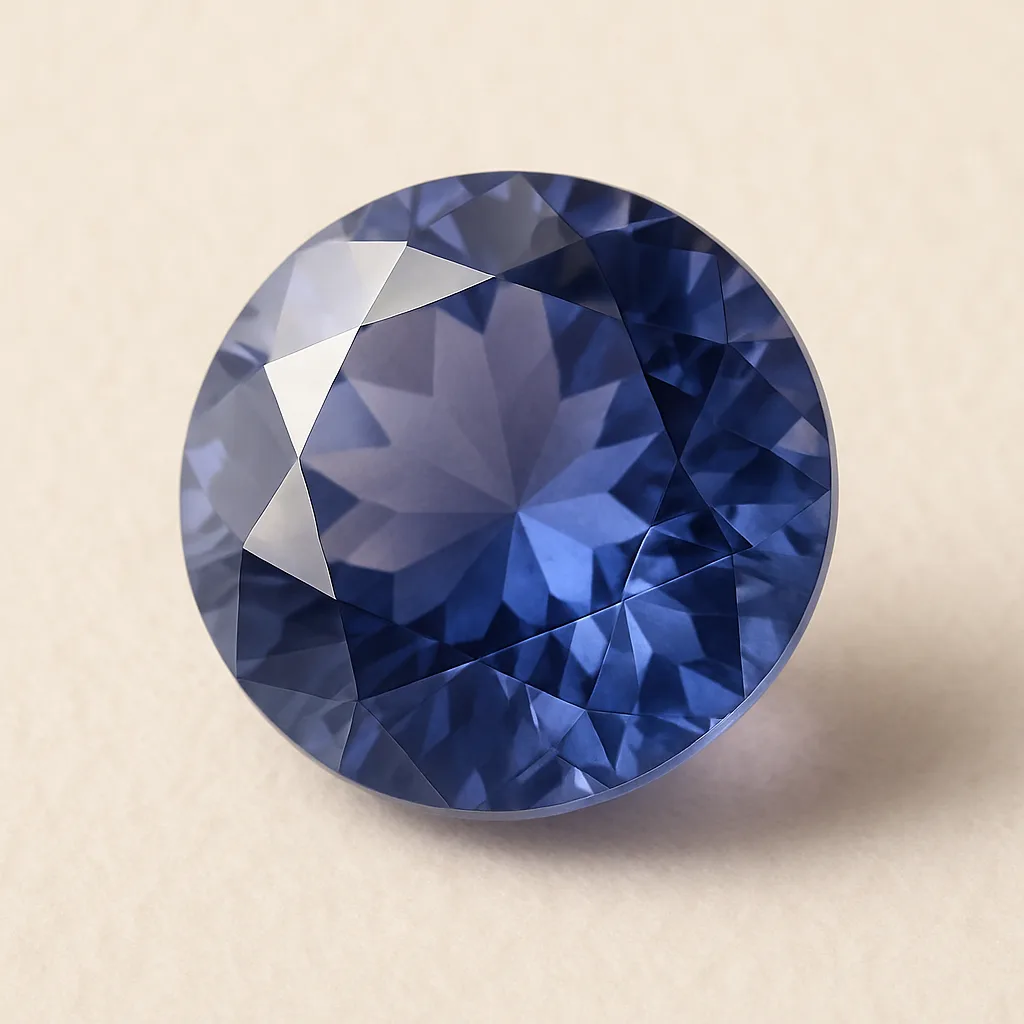
identified this stone yet
Iolite
| Hardness | 7-7.5 |
| Specific gravity | 2.61 |
| Refractive index | 1.542-1.551 |
| Crystal system | 斜方晶系 |
Deep violet-blue (most prized) through sapphire-blue to softer blue-gray. Trichroism produces dramatic color shifts when the stone is rotated 90° — well-cut iolite is oriented to show the strongest blue face-up.
- Reddish hematite or goethite platelets — diagnostic when present (the rare 'bloodshot iolite')
- nclusions parallel to crystal axes
- nclusions
- Color zoning visible in immersion
- Doubly refractive (biaxial negative)
- Strong trichroism: violet-blue, colorless, and pale yellow along three axes
- Vitreous luster, occasionally with a slight greasy sheen
- 01Extreme trichroism through a dichroscope is the single strongest test — three distinct colors confirm iolite
- 02RI 1.532–1.553 and SG 2.55–2.75 separate iolite from tanzanite (much higher RI ~1.69, SG ~3.35) and sapphire (SG ~4.0)
- 03Rotating the cut stone 90° face-up should produce visible color shift even without a dichroscope
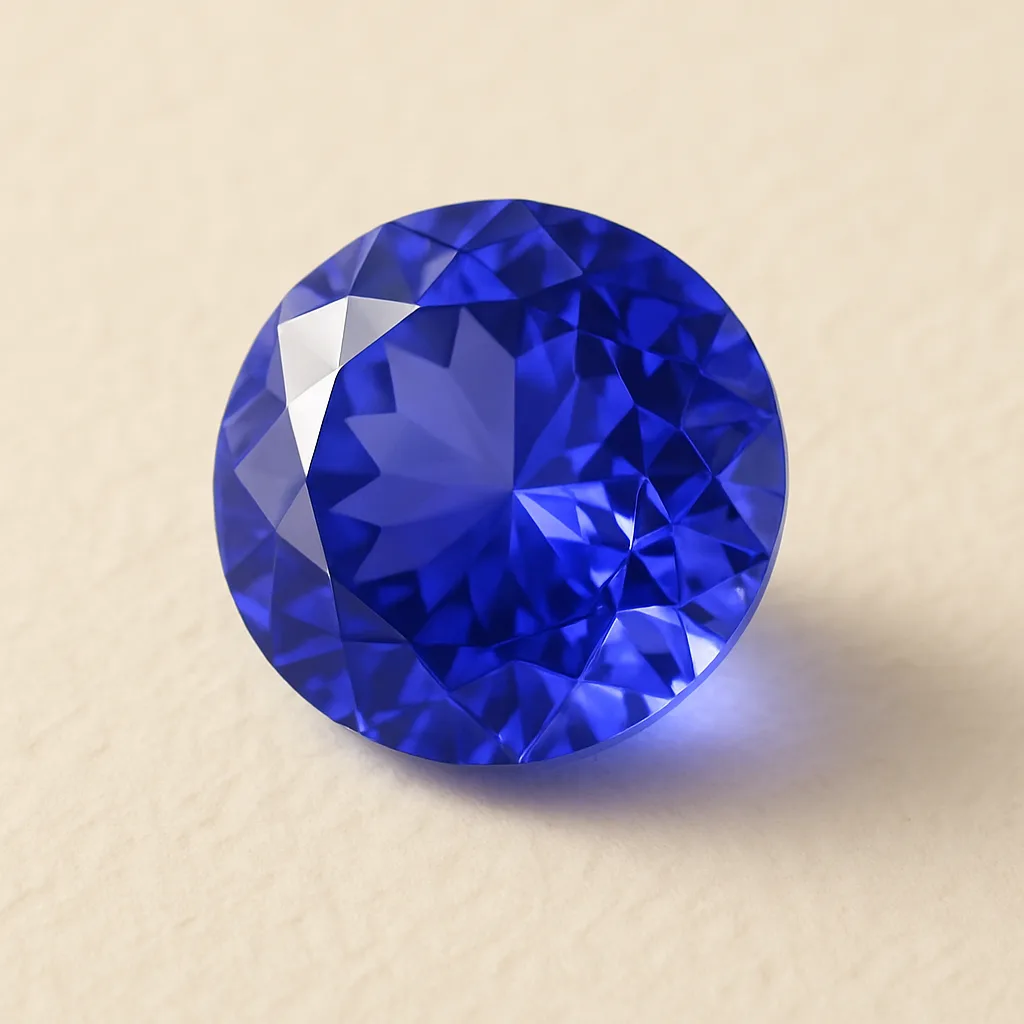
- Mohs 7–7.5 with one direction of distinct — durable but requires care
- nclusion-free stones
- Avoid sharp impacts and prolonged exposure to harsh acids
Roughly $20–$80/ct for commercial Indian material, $100–$300/ct for clean Sri Lankan stones with strong violet-blue saturation, and $400–$800+/ct for fine 5 ct+ Madagascan or Ceylon material with top color. Iolite is one of the most undervalued violet-blue gems for its visual impact.
Note: Iolite is sold essentially untreated — heat or irradiation are not standard. Synthetic iolite exists but is commercially insignificant. The chief market concern is confusion with tanzanite (which iolite resembles in saturated stones); reliable separation is by RI, SG, and pleochroism intensity. Cutters sacrifice considerable rough to orient stones for the best face-up blue, which is why well-saturated material commands premiums.
Iolite is the gem name for cordierite (Mg₂Al₄Si₅O₁₈), a magnesium-aluminum silicate. Its dramatic trichroism — violet-blue along one axis, colorless along the second, and pale yellow along the third — was probably exploited by Norse navigators around 1000 CE: thin slabs functioned as polarizers that could pinpoint the sun's position through cloud cover, an interpretation supported by Thorkild Ramskou's 1967 hypothesis. Modern gem sources include Sri Lanka, India, Madagascar, Tanzania, and Brazil.
Origins
aceted stones.
History
Cordierite was first described and named in 1813 by French mineralogist Pierre Cordier; the gem trade name 'iolite' (from Greek ios, 'violet') gained prominence in the late 19th century. The Viking 'sunstone' (sólarsteinn) referenced in Norse sagas was likely iolite — a hypothesis reinforced when a polarizing calcite crystal was recovered from a 16th-century Elizabethan shipwreck, confirming the broader navigational use of polarizing minerals.
Lore & symbolism
Iolite has no traditional birthstone status but is sometimes marketed as the 21st wedding anniversary stone. Modern lore associates it with vision, intuition, and inner journeys — themes that resonate with the Viking navigational story.
Tools to confirm this stone
Tools that help confirm Iolite. Tap any item to jump to the matching section on the gem tools page.
- 最終確認日
- 2026年4月28日
- 参 考 文 献
- Gem Encyclopedia/ GIA (Gemological Institute of America)
- 宝石鑑別基準/ 中央宝石研究所 (CGL)
- Mineral & Gem Database/ Mindat.org / Gemdat.org
- 宝石学入門/ 全国宝石学協会
本ページの物性値(屈折率・比重・硬度・結晶系等)は、上記の権威ある一次資料を相互参照して編集しています。最新の鑑別研究の進展により値が更新される場合があります。