identified this stone yet
Dyed Howlite
| Hardness | 3.5 |
| Specific gravity | 2.58 |
| Refractive index | 1.583-1.605 |
| Crystal system | 単斜晶系 |
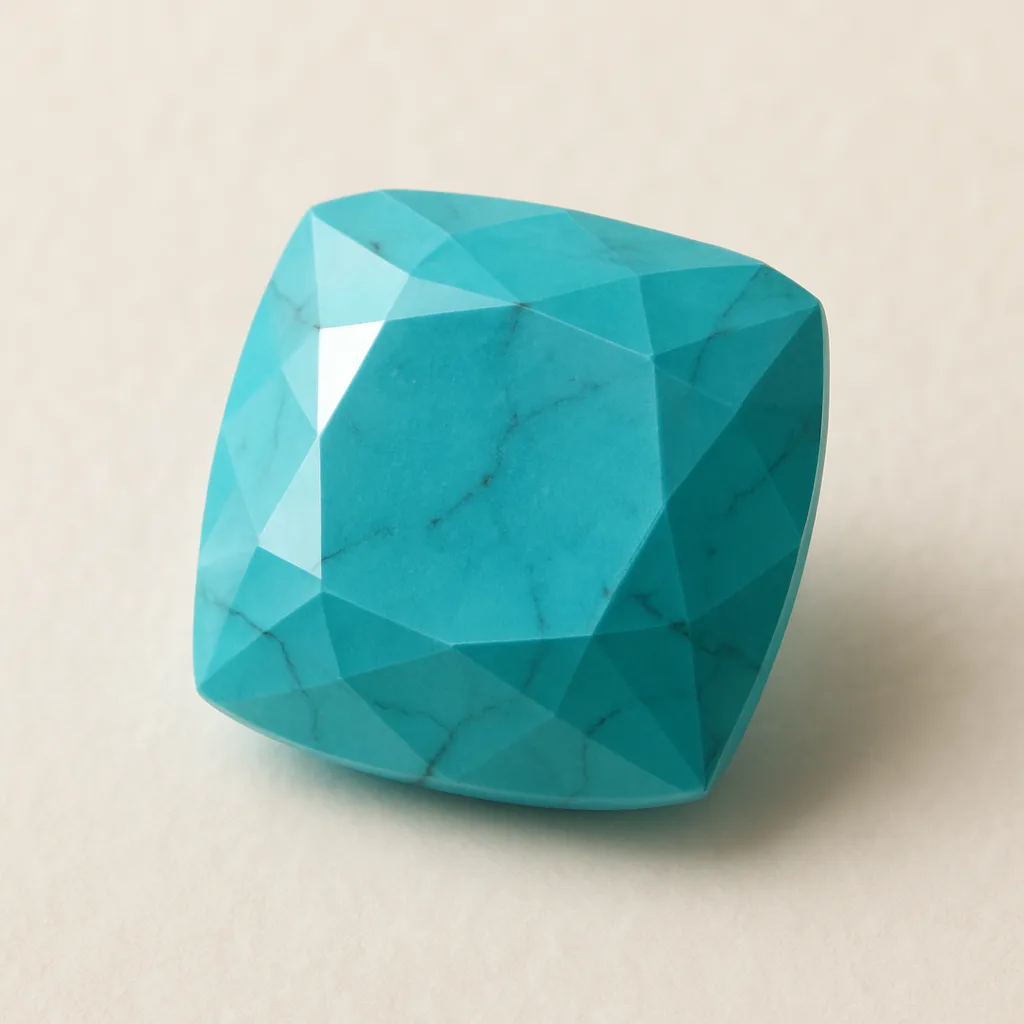
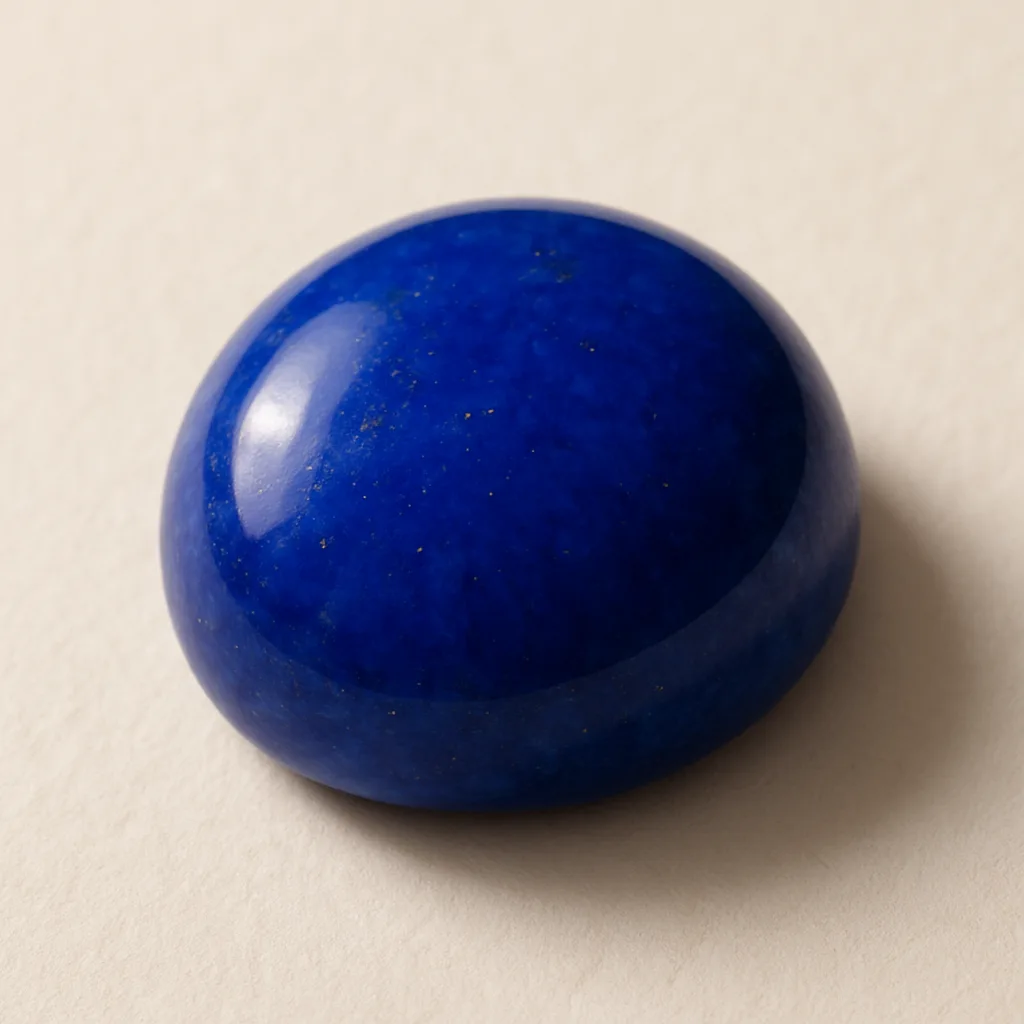
Sky-blue to turquoise-blue from copper-sulphate or aniline dye, often with the natural grey-to-black matrix vein pattern preserved — mimicking Sleeping Beauty (Arizona) or Persian (Iranian) turquoise matrix. The Persian-style lapis-imitation variant uses ultramarine-blue dye plus pyrite-flake glitter dust. Heavily dyed material may show colour pooling and uneven distribution at 10× magnification.
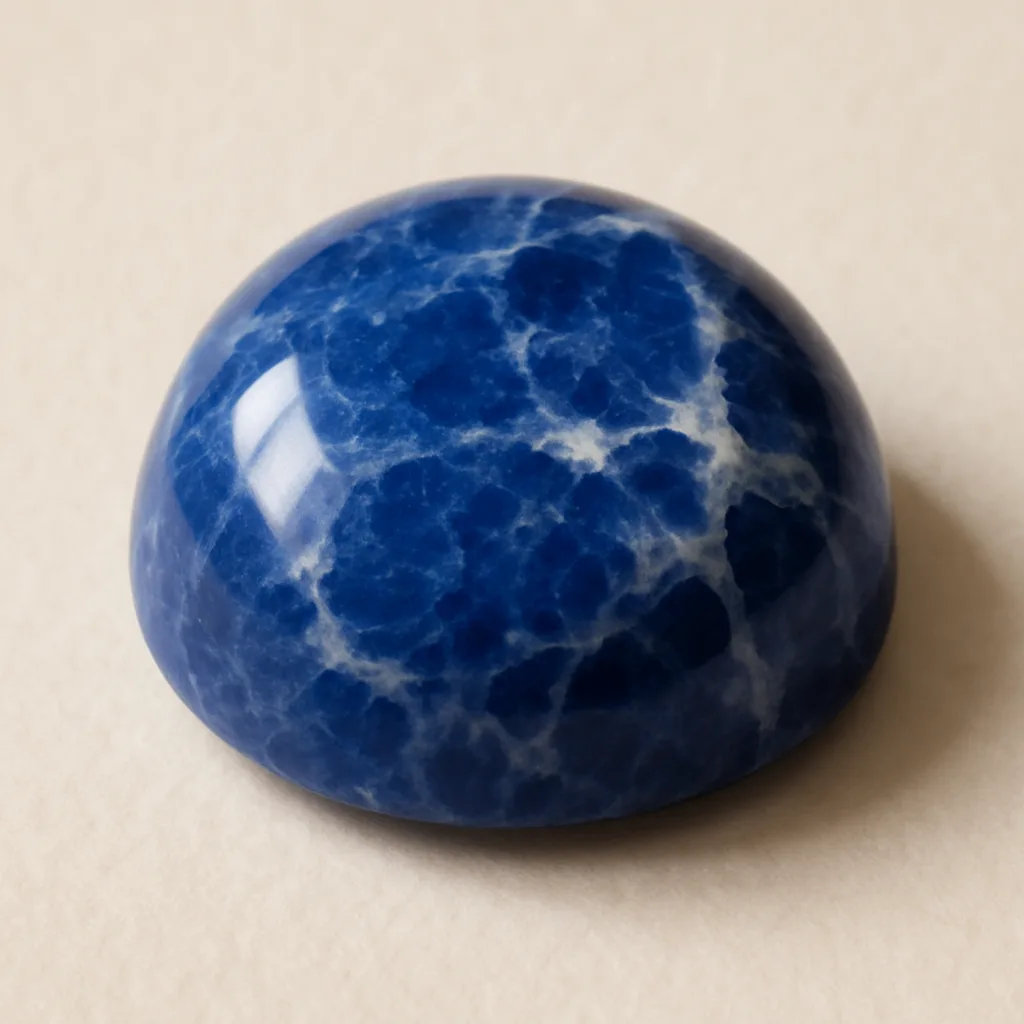
- Black or grey dendritic vein matrix — the natural feature of howlite that mimics turquoise matrix pattern
- Dye pooling along cracks and porous regions visible at 10× — diagnostic of dye treatment
- Acetone-soluble dye transfer onto a cotton swab — diagnostic field test for dye disclosure
- Uneven colour distribution from incomplete dye penetration
- Surface dye residue at the drill-hole edges of beads — diagnostic at 10×
- Pyrite-flake glitter dust (in the lapis-imitation variant) added externally rather than naturally embedded
- Refractive index 1.586–1.605 (the natural-howlite range, unchanged by dyeing)
- Biaxial doubly refractive in single crystals but the nodular massive material shows aggregate-mass behaviour on the polariscope
- Specific gravity 2.58 — diagnostic against turquoise (2.60–2.91) and lapis lazuli (2.70–2.90)
- Mohs 3.5 — soft, easily scratched by quartz (Mohs 7) and steel knife (Mohs 5.5)
- Monoclinic
- Inert under both LW and SW UV — diagnostic against many turquoise specimens which show weak greenish
- 01Acetone swab test on a hidden surface — blue colour transfer to the swab is diagnostic of dyed material
- 02Specific gravity 2.58 — separates from turquoise (2.60–2.91) and lapis lazuli (2.70–2.90)
- 03Refractive index 1.586–1.605 — separates from turquoise (1.610–1.650) and lapis lazuli (1.50)
- 04Dye pooling along porous regions visible at 10× magnification — diagnostic of any dyed porous material
- 05Mohs 3.5 — softer than turquoise (Mohs 5–6); scratches with a copper coin
- 06Inert under UV — separates from some turquoise specimens with weak
- Mohs 3.5 — very soft, easily scratched
- Dye is solvent-sensitive — avoid acetone, alcohol, paint thinners, and nail-polish removers which dissolve the dye and fade the colour
- Sunlight and prolonged UV exposure fade the dye over months to years
- Perspiration and cosmetics gradually leach the dye out — daily-wear pieces show fading within 6–12 months
- Clean only with a soft dry cloth; no ultrasonic, no steam, no chemical cleaners
- Store away from direct sunlight in dark-storage conditions to preserve dye colour
Wholesale dyed-howlite beads and cabochons at $0.30–$5 per piece for mass-production Chinese and Indian material; better-quality dyed cabochons with controlled matrix patterning at $5–$30 per piece; large carved decorative pieces at $20–$200. Authentic natural-howlite specimens from the Brookville Nova Scotia type locality (Henry How originals preserved in the Dalhousie Mineral Collection) are research-only and non-commercial. Modern Turkish natural-howlite cabochons (undyed, showing the natural white-with-grey-veining) trade at $5–$50 per piece at mineral shows. The price differential versus genuine turquoise (Sleeping Beauty Arizona at $100–$2,000 per carat; Persian Nishapur at $500–$10,000+ per carat) is the source of the dyed-howlite fraud problem.
Note: Disclosure as 'dyed howlite' is mandatory under FTC Jewelry Guides §23.23 and CIBJO Blue Book — selling dyed howlite as 'turquoise,' 'White Buffalo Turquoise,' 'White Turquoise,' 'Howlitite,' 'Turquenite,' 'Sacred Buffalo Stone,' or any other name implying natural turquoise origin is illegal in the US, EU, UK, and Japan. The Native American Arts and Crafts Act 1990 (US, 25 USC §305 et seq.) makes the misrepresentation of dyed howlite as 'Indian-made turquoise' a federal offense with criminal penalties. Standard test: a drop of acetone on a cotton swab applied to a hidden surface (typically inside the bead drill-hole) — dyed howlite transfers blue colour to the swab while natural turquoise does not. Chemical confirmation by refractive index (howlite 1.586–1.605 versus turquoise 1.610–1.650) and specific gravity (howlite 2.58 versus turquoise 2.60–2.91) is straightforward in a gemological laboratory. The market price differential is roughly 100–500× — dyed howlite at $0.50–$30 per cabochon versus natural Persian or Sleeping Beauty turquoise at $50–$10,000+ per carat for premium material.
Dyed howlite is white-with-grey-veining natural howlite (Ca₂B₅SiO₉(OH)₅) impregnated with copper-sulphate or aniline blue dye to imitate turquoise (CuAl₆(PO₄)₄(OH)₈) or lapis lazuli (a rock containing lazurite + pyrite + calcite). Natural howlite is a calcium borosilicate hydroxide that crystallizes in the monoclinic system at low-temperature evaporite borate deposits, producing nodular masses with characteristic black or grey vein networks (the dendritic matrix). The high porosity of the natural material (Mohs 3.5, SG 2.58) allows easy dye absorption from aqueous baths at 60–80°C, and the resulting product mimics turquoise's blue-green colour and matrix-veining pattern remarkably well. Disclosure as 'dyed howlite' is mandatory under FTC Jewelry Guides §23.23 and CIBJO Blue Book — the chemical distinction (borate versus phosphate) is gemologically decisive and the price differential between dyed howlite ($5–$30 per ) and natural turquoise ($100–$10,000+ per carat for Sleeping Beauty or Persian-grade material) is dramatic. The natural species was decisively confirmed and re-described from Brookville, Nova Scotia type-locality material by Adolf Magnus-Petersson at Saint Mary's University Halifax in modern crystallographic studies — Magnus-Petersson's work established the canonical reference structure that Strunz–Nickel Hey's Mineralogical Tables uses.
Origins
Type locality: Brookville, Hants County, Nova Scotia, Canada (where Henry How discovered the species in 1868 in gypsum-anhydrite evaporite beds of the Carboniferous Windsor Group). Modern world sources of the natural species include California (the Tick Canyon area in the Sterling Borax mine, Los Angeles County; Lang in Kern County), Turkey (Eskişehir Province — the dominant world source of howlite for the dyeing trade since the 1980s), Russia, Mexico, Germany (Stassfurt evaporites), and Argentina. The Turkish material from the Sögüt-Bilecik district and the Eskişehir-Sivrihisar-Sariçayir area is the dominant supplier to the Chinese and Indian dyeing factories that produce the world's dyed-howlite jewelry. The Brookville Nova Scotia type-locality has not been worked commercially since the late 19th century and survives only as a research-specimen reference site under Saint Mary's University Halifax mineralogical conservation; Magnus-Petersson's modern crystallographic re-study used the original Henry How specimens preserved in the Dalhousie College mineral cabinet (now the Dalhousie Mineral Collection at the Sir James Dunn Science Building).
History
Henry How (1828–1879), Professor of Chemistry at Dalhousie College, Halifax, Nova Scotia, discovered howlite in 1868 in the Carboniferous gypsum-anhydrite evaporite beds at Brookville, Hants County. How published the original description in the American Journal of Science in 1868 as 'a new mineral' and submitted material to James Dwight Dana at Yale who named it 'howlite' in System of Mineralogy 1868 edition. The species was largely a research curiosity through the early 20th century. Adolf Magnus-Petersson at Saint Mary's University, Halifax, undertook the definitive modern crystallographic re-study in the late 20th century, establishing the canonical Ca₂B₅SiO₉(OH)₅ formula and the monoclinic-system structure. The dyed-howlite trade emerged in the 1970s as turquoise prices rose during the American Southwest jewelry boom — initially small-scale workshops in Mexico and the American Southwest, scaling to industrial Chinese and Indian production from the 1990s. The 'White Buffalo Turquoise' branding controversy began c. 1985 when undisclosed dyed howlite was sold as a rare Native American sacred stone — leading to the 1985 CIBJO Disclosure Resolution requiring 'dyed howlite' labelling. The 1993 FTC Jewelry Guides §23.23 codified the requirement in US law; 1996 and 2000 enforcement actions against multiple Southwest dealers established legal precedent. The 2000s 'Magnesite' confusion (a separate but visually similar species, MgCO₃) compounded the disclosure problem — both white nodular materials with grey vein matrices are dyed and sold interchangeably without distinction. CIBJO Blue Book editions 2010 onward distinguish dyed howlite, dyed magnesite, and natural turquoise as three separate disclosure categories.
Lore & symbolism
No traditional birthstone designation (synthetic/imitation by virtue of the dye treatment). The unfortunate 'White Buffalo Turquoise' or 'Sacred Buffalo Stone' marketing exploits Native American spiritual associations — the actual Sacred White Buffalo (Lakota Wakȟáŋ Tȟáŋka) is a rare albino American bison whose appearance is considered prophetically significant in Lakota and broader Plains tribal traditions, and the cultural appropriation in jewelry marketing has been criticized by tribal cultural authorities (the United Indian Nations of Oklahoma 2008 statement, the Navajo Nation 2010 advisory). The modern crystal-healing tradition (Melody 1995, Hall 2003) treats natural howlite as a calming and patience stone — these associations transfer to the dyed material in metaphysical-shop marketing but lack any historical foundation. The Henry How discovery story (a chemistry professor at the small colonial Dalhousie College finding an entirely new species in local gypsum beds and submitting it to Dana at Yale) gives natural howlite a place in the history of North American mineralogy that the dyed material rarely reflects.
Tools to confirm this stone
Tools that help confirm Dyed Howlite. Tap any item to jump to the matching section on the gem tools page.
- 最終確認日
- 2026年4月28日
- 参 考 文 献
- Gem Encyclopedia/ GIA (Gemological Institute of America)
- 宝石鑑別基準/ 中央宝石研究所 (CGL)
- Mineral & Gem Database/ Mindat.org / Gemdat.org
- 宝石学入門/ 全国宝石学協会
本ページの物性値(屈折率・比重・硬度・結晶系等)は、上記の権威ある一次資料を相互参照して編集しています。最新の鑑別研究の進展により値が更新される場合があります。