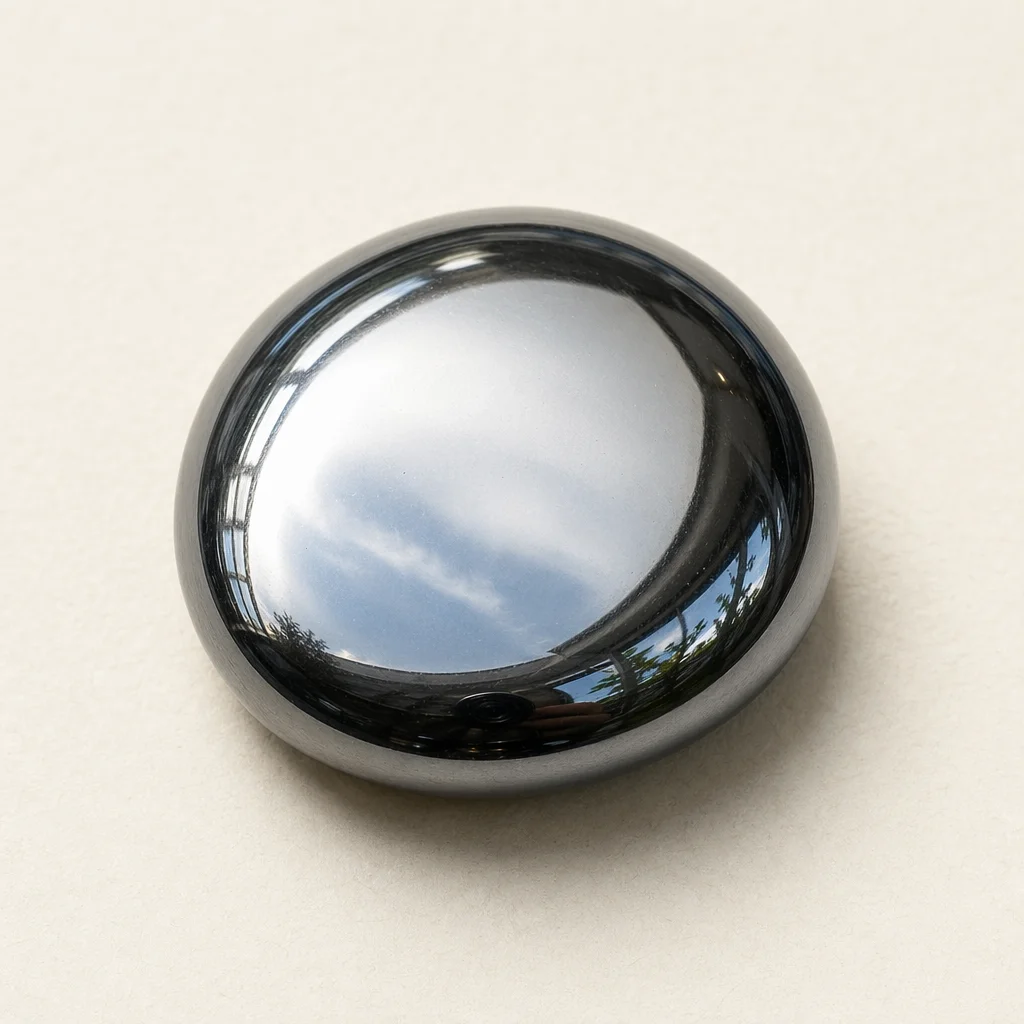
identified this stone yet
Hematite
| Hardness | 5.5-6.5 |
| Specific gravity | 5.26 |
| Refractive index | 2.94-3.22 |
| Crystal system | 六方晶系(三方晶系) |
External color silvery gray, black, or steel-blue with submetallic to metallic luster; red, red-brown, or earthy where porous or weathered (red ochre). The streak is invariably blood red — the diagnostic.
- nclusions or martite alteration zones in pseudomorphic material
- Quartz or hematite veinlets in massive lapidary blocks
- Banded iron-formation textures in oolitic material
- Mirror-bright parting surfaces in specular varieties
- Doubly refractive, uniaxial negative
- Refractive index 2.94–3.22 — among the highest of any gem species
- Specific gravity 5.1–5.3 — distinctively heavy
- Submetallic to metallic luster on polished surfaces
- Opaque in massive form; very thin sections show deep red transmission
- 01Blood-red streak on unglazed porcelain — the diagnostic and definitive test, unchanged since Theophrastus
- 02Weak paramagnetism only — does not adhere to a hand magnet, unlike strongly magnetic synthetic hematine
- 03Specific gravity 5.1–5.3 — distinctively heavy in the hand compared to most opaque black gems
- 04Mohs 5.5–6.5 — scratches with a steel file but not with a knife blade
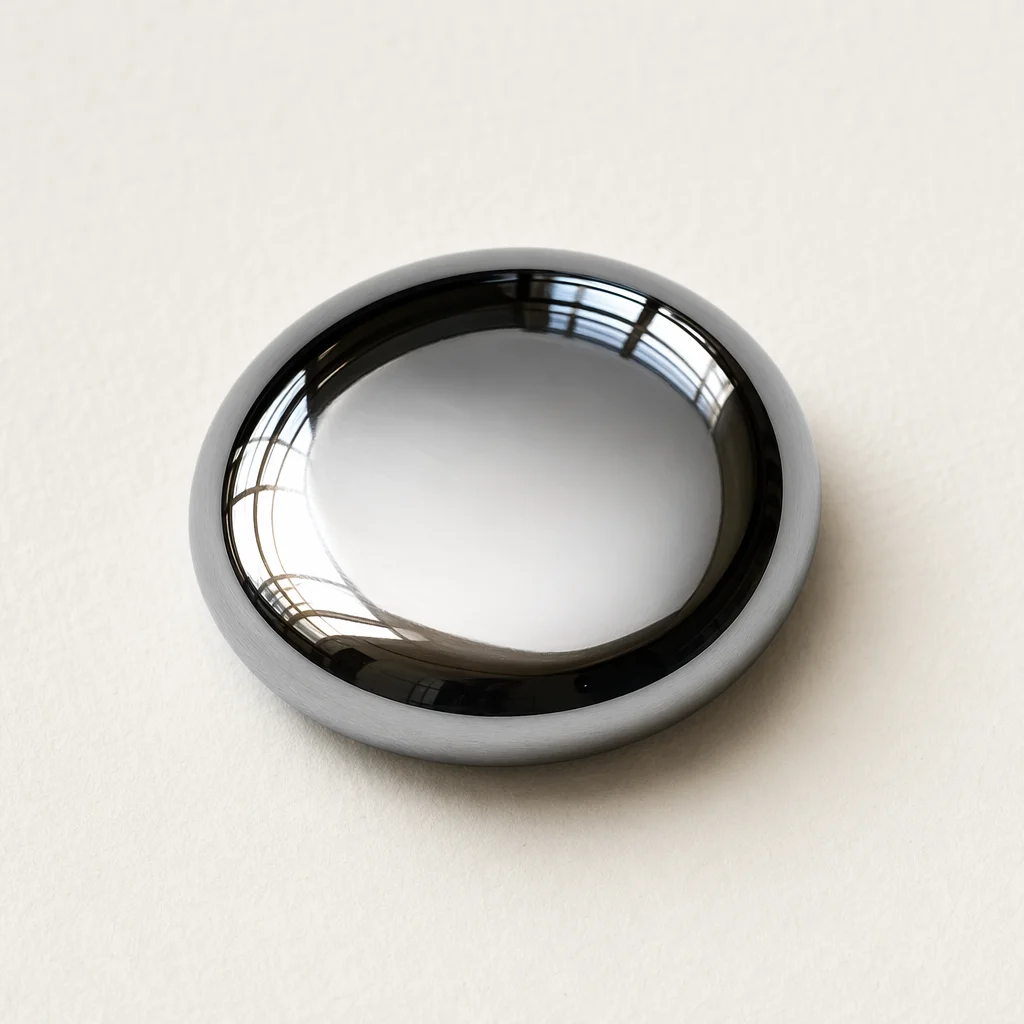
- Mohs 5.5–6.5 — moderate durability; suitable for beads, pendants, and intaglios, less ideal for daily-wear ring stones
- Polished surfaces hold a high mirror finish but can be scratched by quartz and other harder gems — store separately
- Avoid ultrasonic and steam cleaning — vibration can damage fracture-prone material; warm soapy water is preferred
- Stable to most jeweler's chemicals; avoid hydrochloric acid (slowly dissolves iron oxides)
Polished beads and cabochons of natural hematite typically $5–30 per piece in retail jewelry; fine collector specimens of Cumbria specular hematite reach $500–5,000+ at mineral auctions.
Note: Untreated natural hematite is sold in jewelry primarily as polished beads, cabochons, and intaglios, with the higher-grade specular and kidney-ore material reserved for mineral specimens rather than the jewelry trade. The dominant retail issue is misrepresentation: most 'hematite' jewelry, particularly the magnetic clasp/healing-bead market, is in fact the strongly magnetic synthetic barium-strontium ferrite 'hematine' (also called Hemalyke, Hematin, or 'magnetic hematite'). Disclosure is patchy at the retail level. A simple magnet test settles the question — real hematite at most clings weakly; hematine sticks firmly.
aceted beads ground from massive material. Hematite is only weakly paramagnetic — a hand magnet does not lift it — which separates real hematite from the strongly magnetic synthetic ferrite imitation 'hematine.'
Origins
Cumbria's Florence Mine and Egremont district in northwest England produced the world's finest specular hematite — bright mirror-platy rosettes — from the 18th century until mine closure in 2007; museum specimens from this locality remain the benchmark. Brazil's Itabira and Minas Gerais are the largest economic iron-ore producers and supply most of the world's lapidary hematite. Elba (Italy) is the classical Mediterranean source mined since Etruscan times. Lake Superior's banded iron formations (Mesabi Range, Marquette Range) yield the oolitic and granular material familiar to North American collectors. Smaller gem-trade sources include Switzerland's Binn Valley specular hematite, Brazil's Congonhas-do-Campo, and Morocco's Ouarzazate region.
History
Red ochre — finely ground earthy hematite — is the oldest pigment in human use, appearing in Blombos Cave South Africa engravings around 100,000 BCE and in Lascaux and Altamira cave paintings 17,000 BCE. Egyptian Predynastic cosmetics (4500 BCE) used powdered hematite as a red eye-paint base, and Pompeian fresco red is hematite-rich. Pliny's Naturalis Historia (77 CE) describes the streak test and records hematite amulets given to Roman soldiers to staunch bleeding and grant courage in battle — a usage rooted in the Greek haima 'blood' association. Renaissance and Baroque intaglio workshops carved heraldic seals from polished hematite, and the Victorian mourning industry of the 1860s–1890s used hematite beads, rosettes, and intaglios as a less expensive alternative to Whitby jet during the long aftermath of Prince Albert's 1861 death. The 20th century saw hematite displaced from jewelry by cheaper synthetic ferrite ('hematine'), which now dominates the market for what consumers casually call 'hematite beads.'
Lore & symbolism
Greek and Roman tradition associated hematite with Ares/Mars — the warrior's stone, carried for protection in combat. Egyptian Books of the Dead reference hematite amulets shaped as the tjet (Isis knot) buried with the deceased to ensure resurrection. Medieval European folk medicine prescribed hematite worn against the skin to slow hemorrhage and to treat anemia — a sympathetic-magic logic of red-stone-for-blood-disorder that, in inadvertently iron-rich form, occasionally worked. Modern crystal-healing literature positions hematite as a grounding stone for protection and absorption of negative energy; these claims have no historical or scientific basis.
Tools to confirm this stone
Tools that help confirm Hematite. Tap any item to jump to the matching section on the gem tools page.
- 最終確認日
- 2026年4月28日
- 参 考 文 献
- Gem Encyclopedia/ GIA (Gemological Institute of America)
- 宝石鑑別基準/ 中央宝石研究所 (CGL)
- Mineral & Gem Database/ Mindat.org / Gemdat.org
- 宝石学入門/ 全国宝石学協会
本ページの物性値(屈折率・比重・硬度・結晶系等)は、上記の権威ある一次資料を相互参照して編集しています。最新の鑑別研究の進展により値が更新される場合があります。