identified this stone yet
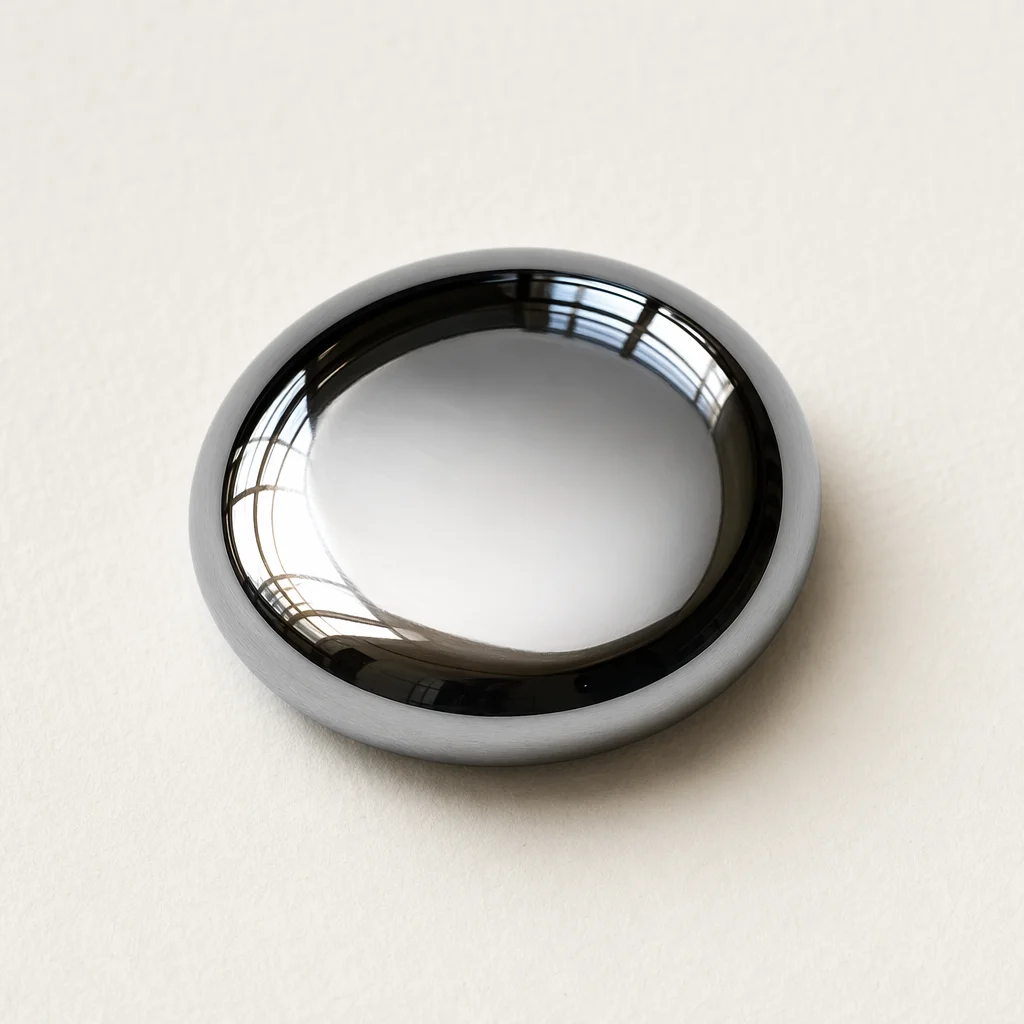
Hematine (Magnetic Hematite)
| Hardness | 5-6 |
| Specific gravity | 5.0-5.2 |
| Refractive index | 不明(金属光沢) |
| Crystal system | 等軸晶系(人工セラミック) |
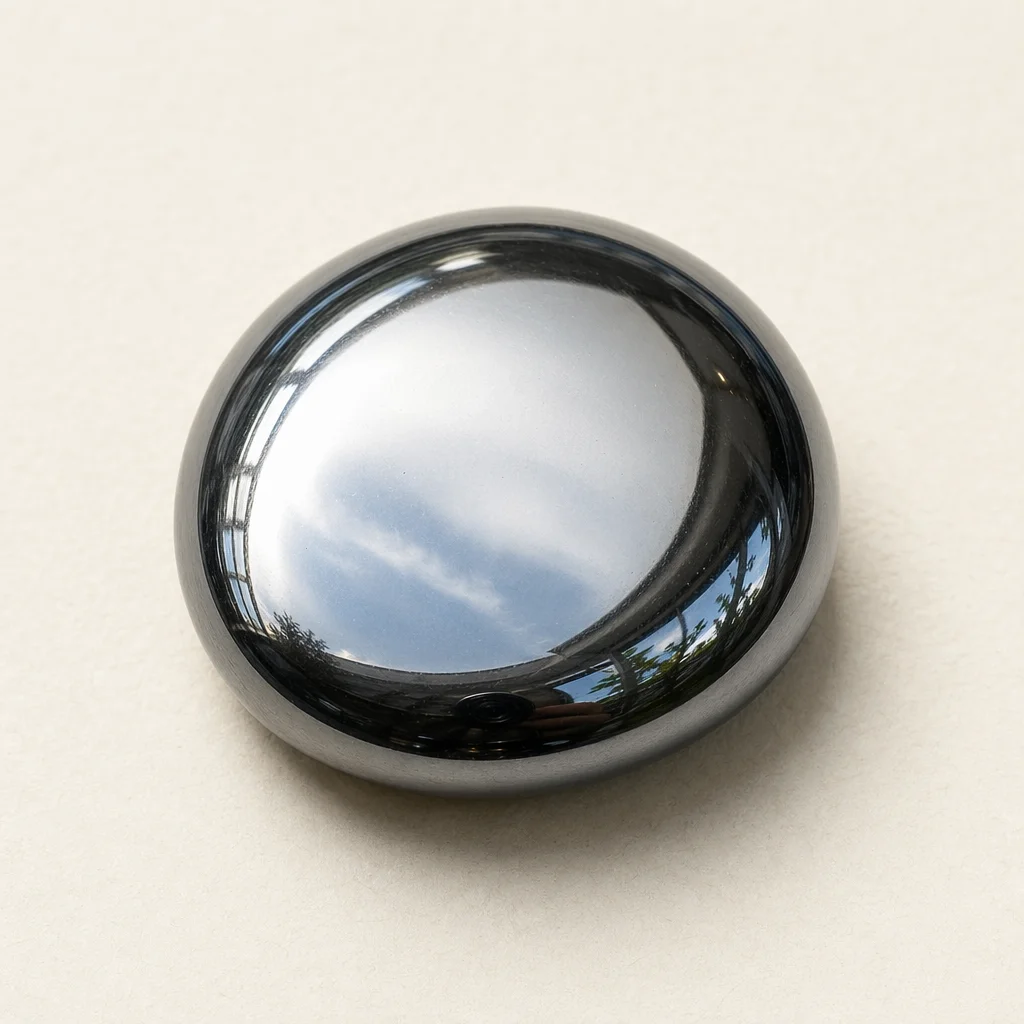
Uniform deep black with high metallic lustre (hexcode #1A1B1F to #3A3D42). The diagnostic 'streak' test on unglazed porcelain produces blood-red streak — identical to natural hematite (the etymological source of the species name from Greek 'haima' for blood). Surface finish ranges from mirror-polished to bead-blasted matte; the sintered structure shows no internal colour variation.
- Uniform sintered grain structure visible at 20× — diagnostic of ceramic origin versus natural hematite's lamellar twinning
- Press-die parting lines and surface seams from the moulding process
- Pin-holes from incomplete sintering — visible as small dark spots in the surface
- Uniform dense matrix with no internal colour variation
- Magnetic-domain texture revealable by ferrofluid testing — confirms ferrimagnetic engineering
- Absence of natural hematite's characteristic lamellar twinning visible under crossed polars
- Opaque metallic lustre — singly reflective polished surface
- Specific gravity 4.6–4.8 — slightly lower than natural hematite (5.0–5.3) due to the binder phase
- Mohs 5–6 (the ceramic matrix range)
- Red streak on unglazed porcelain (the diagnostic hematite-and-hematine identical test — does not distinguish them)
- Strong ferrimagnetic response to neodymium magnets — diagnostic versus natural antiferromagnetic hematite
- Magnetic field strength at contact typically 1000–3000 gauss for jewelry-scale pieces — the AHA cardiac-device interference threshold
- 01Strong magnetic attraction to a neodymium magnet at 5–10 cm distance — diagnostic single-test identifier separating from natural hematite
- 02Specific gravity 4.6–4.8 versus natural hematite 5.0–5.3 — clean separation on hydrostatic balance
- 03Uniform sintered grain structure at 20× — diagnostic of ceramic origin
- 04Press-die seams and parting lines visible on surface — characteristic of moulded production
- 05Absence of lamellar twinning under crossed polars — natural hematite shows characteristic twin lamellae
- 06Mohs 5–6 — overlap with natural hematite (Mohs 5.5–6.5) so the scratch test alone is not diagnostic
- Strong magnetic field — keep at least 15 cm from implanted pacemakers, ICDs, insulin pumps, and other electronic medical devices per AHA 2007 guidance
- Keep away from credit-card magnetic strips, mechanical watches, and electronic-storage media
- Mohs 5–6 — moderate hardness but the binder phase can chip on impact
- Surface finish degrades with perspiration and prolonged skin contact — periodic polishing with a soft cloth maintains lustre
- No ultrasonic cleaning (can crack the ceramic matrix); steam cleaning is acceptable but unnecessary
- Do not represent or market as having medical or therapeutic benefit — FDA and FTC enforcement applies
Wholesale magnetic-hematine beads at $0.20–$2 per piece for mass-production Chinese material; magnetic-bracelet 'wellness' products at $10–$200 per piece retail; better-quality lapidary cabochons at $5–$30 per piece. Vintage 1985–1995 Steve Spivak Iron Wonder original-line magnetic bracelets reach $50–$300 per piece at collector auctions. The genuine natural hematite gem material from Cumbria, England (the historic Cumberland iron-mining district) and Brazil (Itabira, Minas Gerais) trades at $50–$500 per carat for cabochons — a 50–250× price differential versus the synthetic, which is the source of the disclosure-fraud problem.
Note: Disclosure as 'hematine,' 'magnetic hematite,' or 'synthetic ferrite' is mandatory under FTC Jewelry Guides §23.24 and CIBJO Blue Book — selling the sintered ferrite as 'natural hematite' is illegal in the US, EU, UK, and Japan, with documented enforcement actions in 2003–2008 (Arizona, New Mexico, California). The Native American Arts and Crafts Act 1990 makes misrepresentation as 'Indian-made hematite' a federal offense. Standard test: any neodymium magnet at 10 cm distance will attract hematine strongly while natural hematite shows no significant response (natural hematite below the Morin transition at -10°C is antiferromagnetic and essentially non-magnetic at room temperature). The American Heart Association 2007 Scientific Statement requires consumer warning labels for magnetic-jewelry products listing implanted cardiac device interference risk; major retailers including Walmart and Amazon include this warning at the SKU level. The medical-claims market has been the subject of FDA enforcement actions: magnetic bracelets cannot be marketed for arthritis, pain relief, or any specific medical indication without FDA medical-device approval, which has not been granted.
abochons, and ornamental pieces. The deliberate ferrimagnetic ordering is engineered by controlling the magnetite-to-hematite ratio and the annealing atmosphere — the resulting ferrite ceramic shows specific magnetization typically 30–80 emu/g (versus essentially zero for natural antiferromagnetic hematite). The terminology distinction in gem-trade disclosure is critical: 'hematite' (the natural antiferromagnetic α-Fe₂O₃ mineral) versus 'hematine,' 'magnetic hematite,' 'Hemalyke,' or 'Magnetite-like' (the synthetic ferrimagnetic ceramic). Production sources include Chinese industrial ceramic factories (Guangdong and Jiangsu provinces, the dominant world supply since the 1990s) and historical German Bavarian sintered-ferrite producers (the 1930s magnetic-imitation industry). The metaphysical and 'magnet therapy' market accounts for over 90% of retail volume — the medical claims for magnetic-bracelet pain relief have been systematically debunked in randomized controlled trials (CARMS-1, BMJ 2004; the Mayo Clinic 2006 review) but the market persists. Disclosure as 'hematine' or 'synthetic magnetic hematite' is required under FTC Jewelry Guides §23.24 and CIBJO Blue Book.
Origins
Industrial manufacturing centres are Guangdong and Jiangsu provinces in China (the dominant world supply since c. 1995); historically German Bavarian sintered-ferrite producers in the 1930s established the technique under the trade name 'Hämatin' for industrial bearings and ornamental beads. Steve Spivak's 'Iron Wonder' magnetic-bracelet line (1985, USA) was the breakthrough commercial product that launched the modern 'magnet therapy' market. The Karl Schmetzer 1996 Gems & Gemology paper ('Identification and Manufacture of Magnetic Hematite Substitutes') is the definitive gemological reference. The 1990s American Sears and JCPenney catalogues popularized 'hematite magnetic bracelet' jewelry as wellness products, and the disclosure-fraud problem (selling synthetic ferrite as 'natural hematite') generated FTC enforcement action through the 2000s. Production today is concentrated in Yiwu and Shantou industrial-jewelry districts in China, with secondary production in Thailand, India, and Mexico for regional markets.
History
Sintered iron-oxide ceramic technology emerged in 1930s Germany at Siemens-Schuckert and AEG laboratories in Berlin and Nuremberg, primarily for transformer cores and inductor materials — the technique was adapted for ornamental and 'magnetic-medicine' beads by Bavarian small-workshop producers in the late 1930s, sold under the trade name 'Hämatin' (a deliberate near-homophone for natural hematite). The post-WWII collapse of small-scale German production was followed by 1960s–1980s sporadic American hobbyist and small-workshop manufacture. The breakthrough modern era began in 1985 when Steve Spivak (a New Jersey jewelry designer) commercialized the 'Iron Wonder' magnetic-bracelet line marketed for arthritis pain relief — the FDA filed an enforcement action against unsubstantiated medical claims in 1989, but the product survived as a 'wellness/lifestyle' item. Chinese industrial production scaled massively from 1995 onward as the global magnet-therapy market exploded; by 2010 estimated global retail volume exceeded $1 billion annually for magnetic-hematite jewelry. The Karl Schmetzer 1996 Gems & Gemology paper documented the gemological signatures of the synthetic ferrite and established the industry-standard nomenclature distinction. The 2007 American Heart Association Scientific Statement on cardiac device interference identified magnetic-hematite bracelets as a documented risk for implanted pacemaker and defibrillator wearers. The 2010 Cochrane systematic review of magnet therapy for pain found no significant clinical effect beyond placebo. Disclosure-fraud lawsuits in Arizona, New Mexico, and California in 2003–2008 established legal precedent for civil damages where retailers sold hematine as 'natural hematite,' particularly in the Native American jewelry context where the FTC Indian Arts and Crafts Act applies.
Lore & symbolism
No traditional birthstone designation (synthetic ceramic material). The 'magnet therapy' market mythology attaches modern pseudo-scientific claims about blood flow, energy meridians, and chakra alignment to magnetic-hematite jewelry — these claims have no scientific basis and are routinely flagged by FDA, FTC, and the UK Advertising Standards Authority for unsubstantiated health marketing. Natural hematite (the antiferromagnetic α-Fe₂O₃ mineral, etymology from Greek 'haima' blood, named for the red streak) carries genuine ancient lore: used as the iron-red pigment in Lascaux and Chauvet cave paintings (40,000–17,000 BP), polished as Egyptian and Sumerian protective amulets, ground into the 'rouge' polishing compound for medieval European armour. The synthetic hematine inherits this association by visual similarity but lacks the historical legitimacy.
Tools to confirm this stone
Tools that help confirm Hematine (Magnetic Hematite). Tap any item to jump to the matching section on the gem tools page.
- 最終確認日
- 2026年4月28日
- 参 考 文 献
- Gem Encyclopedia/ GIA (Gemological Institute of America)
- 宝石鑑別基準/ 中央宝石研究所 (CGL)
- Mineral & Gem Database/ Mindat.org / Gemdat.org
- 宝石学入門/ 全国宝石学協会
本ページの物性値(屈折率・比重・硬度・結晶系等)は、上記の権威ある一次資料を相互参照して編集しています。最新の鑑別研究の進展により値が更新される場合があります。