identified this stone yet
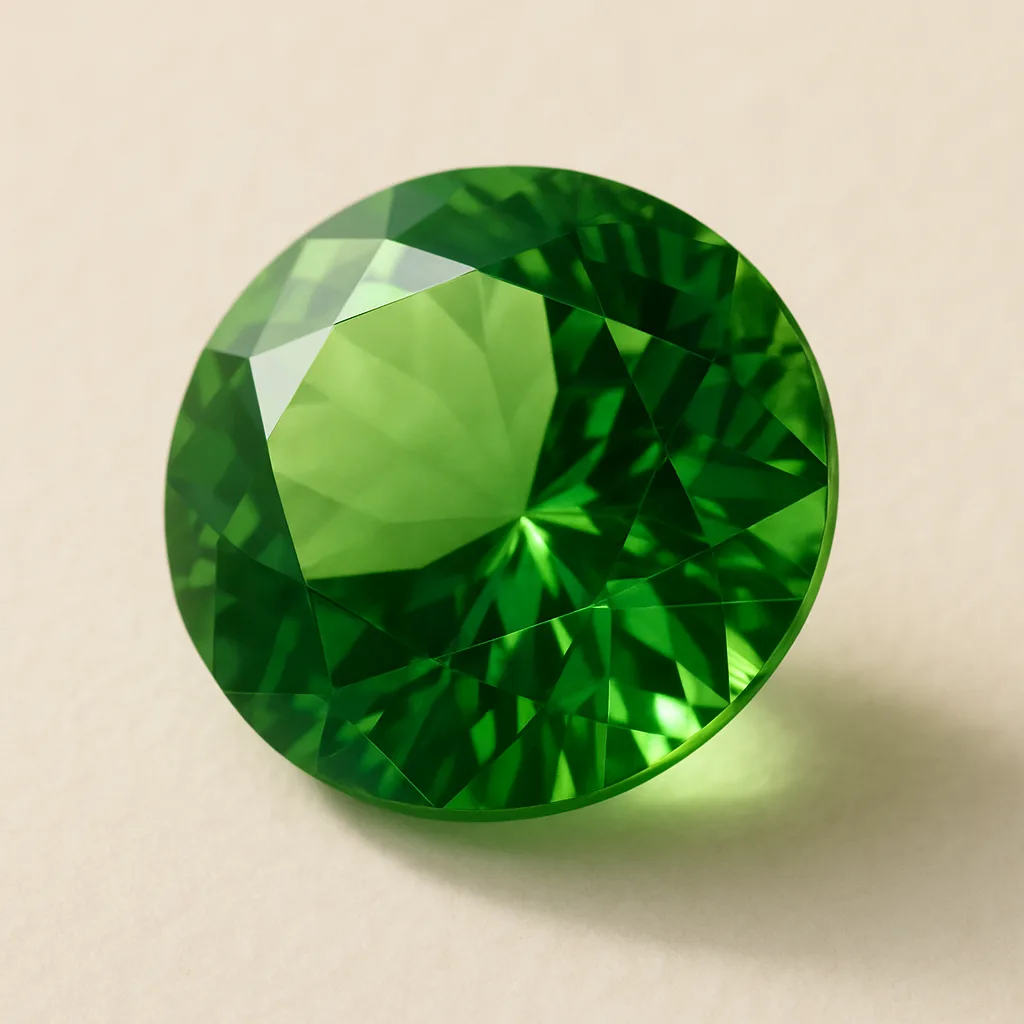
Green Glass
| Hardness | 5-6 |
| Specific gravity | 2.4-2.5 |
| Refractive index | 1.50前後 |
| Crystal system | 非晶質 |
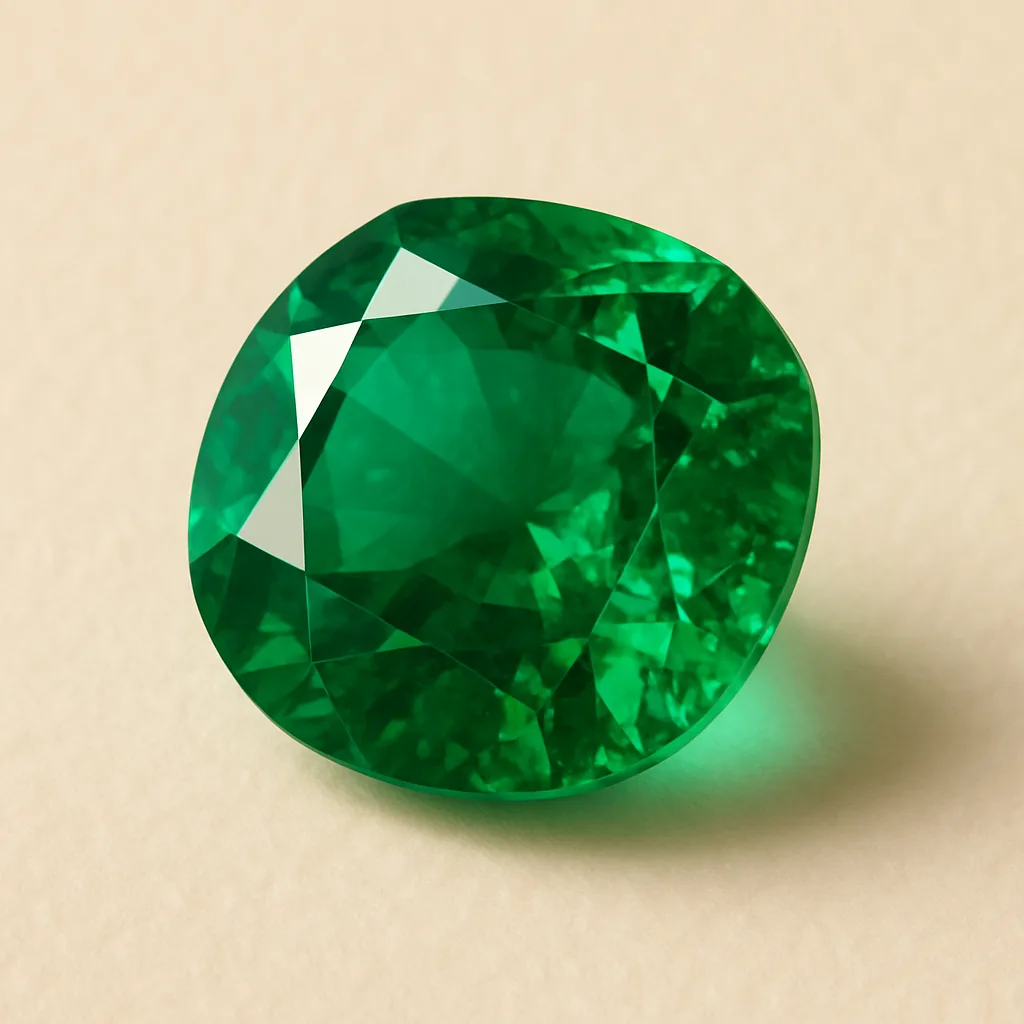
Saturated emerald-green (chromium 0.1–0.3 wt% Cr₂O₃), bottle-green (iron-rich), olive-green (iron-and-sulfur), pale turquoise-green (copper oxide), and the rare Bohemian 'beryllium green' yellow-green specialty paste. Chromium-doped material closely approximates Colombian Muzo or Chivor emerald saturation; copper-doped material approaches less expensive Brazilian emerald or chrome diopside tones; iron-rich material imitates aquamarine-green (the rare green beryl distinct from emerald).
- Regular round gas bubbles distributed evenly through the matrix — diagnostic of pressed or molded glass at 10×
- Surface molding seams and press-die parting lines on backs
- Chromium-rich color zoning streaks (schlieren) from incomplete batch mixing
- Devitrification crystallites in older or heat-stressed material
- Lampwork beads: spiral flow lines from molten-glass winding
- Singly refractive (amorphous glass structure) — no at any orientation
- Refractive index 1.50–1.70 depending on lead content
- Specific gravity 2.4–4.5 — lead-crystal at the high end, soda-lime at 2.4–2.5
- Mohs 5–6 — easily scratched by quartz (Mohs 7)
- Conchoidal fracture — diagnostic of amorphous materials
- Chelsea filter response: chromium-doped material turns pink-red (same response as natural chromium-bearing emerald — non-diagnostic alone)
- 01Regular round gas bubbles visible at 10× — immediately diagnose pressed or molded glass; natural emerald never shows this signature
- 02Singly refractive (no ) versus natural emerald's clear at 30× immersion
- 03Refractometer reads 1.50–1.70 versus natural emerald 1.577–1.583
- 04Mohs 5–6 scratches against a steel knife; natural emerald (Mohs 7.5–8) is unaffected
- 05nclusions at 10×; glass: regular round bubbles only
- 06Specific gravity 2.4–4.5 versus natural emerald 2.67–2.78 — overlap; refractometer is the cleaner diagnostic
- Mohs 5–6 — stores separately to avoid scratches
- Avoid ultrasonic cleaning — vibration can crack the brittle matrix
- Stable to light and mild detergent; warm soapy water and soft brush
- Avoid thermal shock — conchoidal fracture risk
- Avoid strong acids and bases — surface etching possible
Modern molded and faceted green-glass cabochons trade at $0.30–$3 per piece wholesale (Indian and Chinese mass production); Czech Gablonzer pressed-glass and lampwork material runs $2–$25 per piece. Murano lampwork green beads in millefiori or aventurine techniques reach $50–$300 per bead at gallery prices. Genuine eighteenth- and nineteenth-century chromium emerald paste (Strass-tradition French, Bohemian Gablonzer) trades at $200–$3,000 per piece at vintage and estate auctions; museum-quality royal-attribution pieces can reach $50,000–$500,000.
Note: Disclosure as 'glass' or 'imitation emerald' is mandatory under FTC Jewelry Guides §23.25, CIBJO Blue Book, and JIS Z 9529. Beware of green glass marketed as 'created emerald' or 'lab emerald' — true lab-created emerald (Chatham flux-grown, Gilson flux-grown, Russian hydrothermal) is synthetic beryl with the same composition and properties as natural emerald and requires separate disclosure under 'synthetic emerald' (not 'imitation'). Chelsea filter response is not diagnostic between chromium-bearing natural emerald and chromium-doped green paste — both turn pink-red; refractometer (1.50–1.70 for glass versus 1.577–1.583 for emerald) and polariscope (singly refractive for glass, doubly refractive for emerald) provide the diagnostic separation. Czech Gablonzer pressed-glass emerald-green cabochons from documented pre-WWII production retain collector value.
Green glass is amorphous SiO₂-based paste colored green by transition-metal oxides. Chromium oxide (Cr₂O₃) at 0.05–0.5 wt% produces the saturated emerald-green tones that dominate high-grade emerald imitations; copper oxide (CuO) under oxidizing conditions yields the cooler turquoise-green and bottle-green tones; iron-and-sulfur combinations produce the rare yellowish 'olive' and forest-green shades. Non-crystalline, isotropic, Mohs 5–6, SG 2.4–4.5, RI 1.50–1.70, singly refractive, conchoidal fracture. Chromium-doped green paste shows a characteristic Chelsea-filter response — pink to red under the standard cobalt-chrome filter, the same response as chromium-bearing natural emerald — that distinguishes it from copper- or iron-colored greens but does not separate it from natural emerald (requiring examination and refractive index measurement for final identification). Industrial production from Bohemian Gablonzer (Jablonec nad Nisou), Murano (Venice), and modern Indian and Chinese factories.
Origins
aceted stones. Italy (Murano, Venice — Cima, Salviati, Effetre) supplies high-grade lampwork beads. France (Saint-Gobain, Baccarat) produced eighteenth- and nineteenth-century chromium paste descended from Strass; Limoges porcelain works contributed the parallel ceramic-glaze tradition. India (Firozabad) and China (Shandong, Hebei provinces) dominate twentieth- and twenty-first-century mass production. Specialty Roman 'Egyptian green' (lead antimonate, Pb₂Sb₂O₇) reproductions are produced by European specialty firms for archaeological reproduction work.
History
Roman green glass appears at Pompeii from the first century CE; Pliny's Naturalis Historia Book 36 (c. 77 CE) describes copper-colored 'smaragdine' green glass and the substitution of green paste for natural smaragdus (a broad term covering emerald, green tourmaline, and other green stones in classical lapidary tradition). The Venetian cristallo tradition (Angelo Barovier, Murano, c. 1450) established medieval Italian leaded-glass production with green-glass specialties for ecclesiastical use. Bohemian glass under Emperor Rudolf II in Prague (1576–1612) developed the regional industry. Georg Friedrich Strass's Paris atelier (1730s) introduced the first commercially successful chromium-doped 'emerald paste' to European court jewelry — the chromophore identification was empirical at this period (Vauquelin would not identify chromium as an element until 1797). The discovery of pure chromium oxide as a green colorant by Louis Nicolas Vauquelin in 1797 (from Siberian crocoite samples) systematized the green-paste production. Daniel Swarovski's 1892 Wattens factory perfected the cutting process for green-paste components, and Coco Chanel's 1920s costume-jewelry collections featured extensive use of green paste alongside crystal and pearl. The 1968 US FTC Jewelry Guides §23.25 required explicit 'glass' or 'imitation emerald' disclosure.
Lore & symbolism
No birthstone designation (synthetic/imitation material). The emerald association carries strong cultural symbolism — emerald is the May birthstone, Cleopatra's preferred stone from the Mons Smaragdus mines (Egyptian Eastern Desert, exploited c. 1500 BCE through Roman period), and the 'Stone of Venus' in the Western lapidary tradition. The Bohemian Gablonzer regional craft tradition is preserved under UNESCO intangible cultural heritage protection. Modern crystal-writing assigns no specific spiritual properties to glass imitations.
Tools to confirm this stone
Tools that help confirm Green Glass. Tap any item to jump to the matching section on the gem tools page.
- 最終確認日
- 2026年4月28日
- 参 考 文 献
- Gem Encyclopedia/ GIA (Gemological Institute of America)
- 宝石鑑別基準/ 中央宝石研究所 (CGL)
- Mineral & Gem Database/ Mindat.org / Gemdat.org
- 宝石学入門/ 全国宝石学協会
本ページの物性値(屈折率・比重・硬度・結晶系等)は、上記の権威ある一次資料を相互参照して編集しています。最新の鑑別研究の進展により値が更新される場合があります。