identified this stone yet
Gray Moonstone
| Hardness | 6-6.5 |
| Specific gravity | 2.56-2.59 |
| Refractive index | 1.518-1.526 |
| Crystal system | 単斜晶系 |
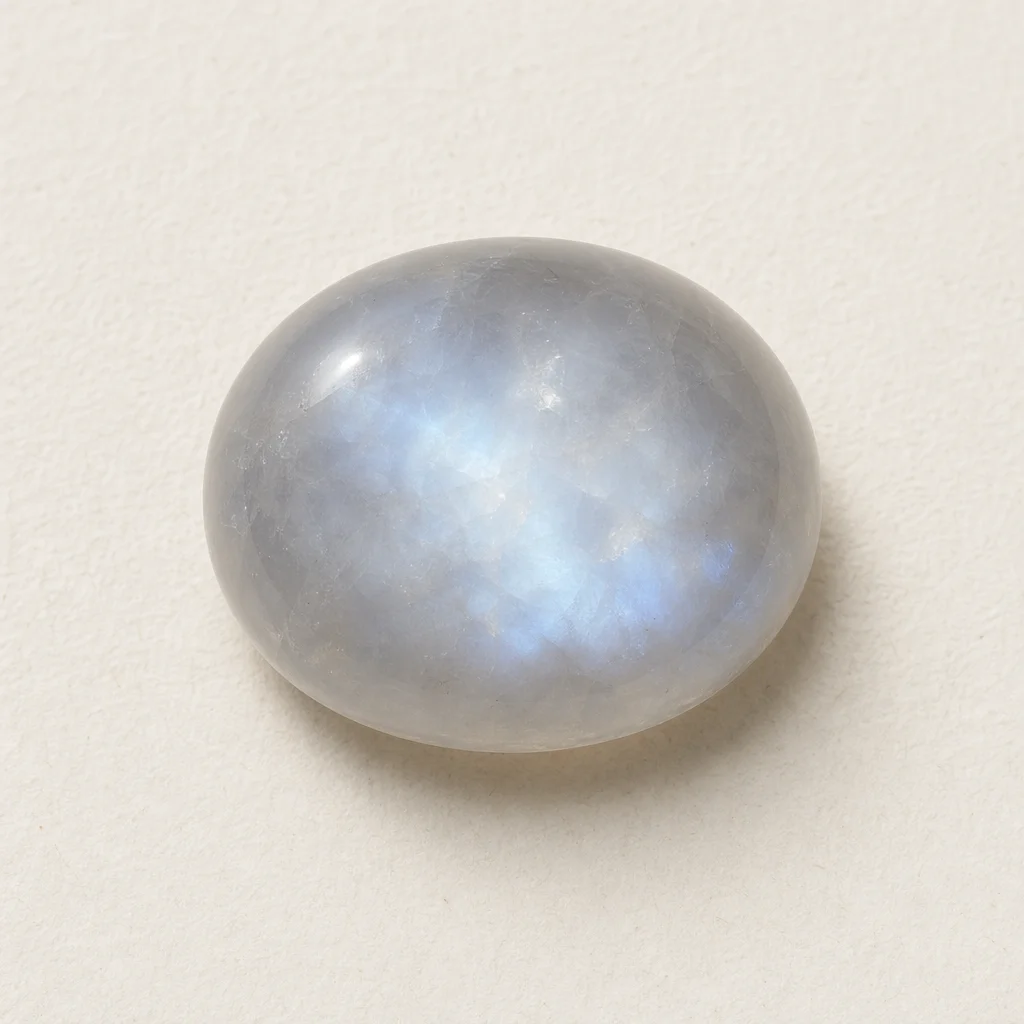
Body color ranges from soft silver-gray through smoky charcoal to near-black; the diagnostic adularescent sheen is consistently blue-white to silvery-blue, occasionally with subtle violet or lavender flashes in finer Tirunelveli stones. The contrast between dark body and bright sheen is typically more dramatic than in white moonstone, giving the material the contemplative, dusk-like quality that drove its 2010s designer-jewelry popularity. Cat's-eye and four-rayed star phenomena occur occasionally in heavily-included material.
- nclusions)
- nclusions characteristic of feldspar group minerals
- Stress 'cars' along planes (the German gemological term Karren) — diagnostic of the perfect 90 ° system
- nclusions producing the gray body color
- Adularescence — the diagnostic billowy blue-white sheen produced by light scattering through perthitic lamellae
- Biaxial negative; refractive index 1.518–1.526; ~0.006
- Specific gravity 2.56–2.59
- Perfect in two directions intersecting at 90 ° (010 and 001)
- Vitreous luster
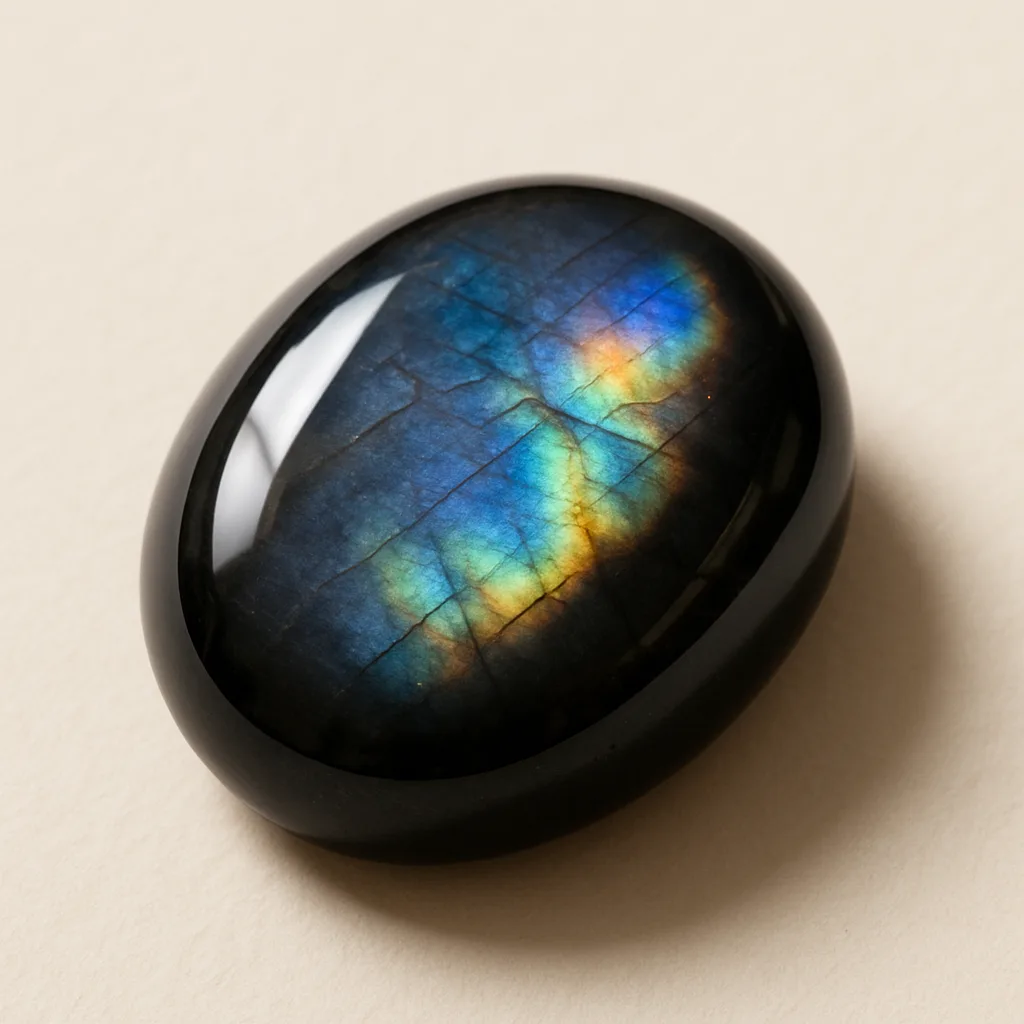
- 01Soft blue-white adularescence floating over a gray body — the diagnostic optical signature, never matched by labradorite (which shows discrete colored flashes) or by glass imitations (which show no at all)
- 02 cut is universal — cuts essentially never appear in the trade because the is best displayed across a domed surface
- 03June birthstone with strong Indian and Roman lapidary tradition
- 04Perfect 90 ° visible at edges and corners on careful inspection
- Mohs 6–6.5 — moderate hardness, scratches readily on harder surfaces
- Perfect in two 90 ° directions makes the stone highly impact-sensitive — ring settings should use protective bezel rather than four-prong
- Ultrasonic and steam cleaning strongly discouraged — planes can propagate under cavitation stress
- Stable to light and standard cleaning chemicals; mild detergent and soft brush recommended
Faceted and cabochon gray moonstone trades at $30–$200 per carat for typical commercial quality; fine designer-grade Tirunelveli cabochons with strong blue-white adularescence run $80–$400/ct. Cat's-eye and four-rayed star phenomena add 50–100 % premium. Sri Lankan-provenance pieces and antique Art Nouveau Tiffany moonstone command significant premiums at estate auction.
Note: No treatments are routinely applied to gray moonstone — the natural color and adularescence are the marketed properties. Beware of 'gray moonstone' that is in fact white moonstone with surface backing or backing-foil treatment to darken the apparent body color (the foil shows on careful tilted inspection). Indian Tirunelveli supply is the contemporary commercial standard; Sri Lankan Meetiyagoda gray-tinged material commands a premium for the historical mining provenance. CIBJO and AGTA disclosure rules apply but no treatment is generally needed.
Gray moonstone (KAlSi₃O₈ + minor NaAlSi₃O₈, the orthoclase / albite series within feldspar group) is the gray-bodied variety of moonstone, optically defined by adularescence — a billowy blue-white sheen that floats above the surface as the viewing angle changes. The phenomenon arises from light scattering through alternating submicroscopic lamellae of orthoclase and albite produced by exsolution as the original homogeneous feldspar melt cooled below the perthitic miscibility gap. Mohs 6–6.5, SG 2.56–2.59, RI 1.518–1.526 (biaxial negative), nclusions in the host feldspar produce the smoky background through which the adularescence plays. Indian Tirunelveli district material is the contemporary commercial standard; Sri Lankan Meetiyagoda yields some gray-tinged production alongside its better-known white.
Origins
India (Tamil Nadu — Tirunelveli, Madurai, and Kanyakumari districts in the southern Granulite Terrain) is the dominant commercial source for gray moonstone, with mining concentrated along the alluvial deposits of the Tambaraparani and Vaigai river systems. The Indian production reaches the global market primarily through Jaipur and Ratnapura cutting houses. Sri Lanka (Meetiyagoda, Galle district — the world's most famous moonstone mine, in continuous production since the late nineteenth century) yields some gray-tinged material alongside its iconic white production. Madagascar (Ambositra), Myanmar (Mogok), Tanzania (Tunduru), the United States (Virginia and New Mexico), Brazil (Minas Gerais), and Australia (New England) yield secondary supply. The Tirunelveli operations are largely small-scale artisanal, with rough sold through Madurai and Chennai dealers to Jaipur cutters.
History
Moonstone has been continuously prized as a sacred lunar stone across the Indian, Sri Lankan, and Roman traditions for over two millennia. Pliny the Elder in Naturalis Historia (77 CE) records the Roman astrolithos / selenitis association with Diana and the moon; the Vedic tradition assigns moonstone (chandrakanta) to the moon (Chandra) in jyotish navaratna ritual. Adularia, the parent feldspar mineral name, was introduced by Italian mineralogist Pietro Maria Andrea Pini in 1781 from specimens collected at the Adula massif in the Lepontine Alps of Ticino, Switzerland — and the optical phenomenon 'adularescence' takes its name from the same locality. Gem-A and the early-twentieth-century European mineralogists Adolf Bauer (Edelsteinkunde 1896) and Karl Schlossmacher (Edelsteine und Perlen 1932) systematized the modern gemological understanding of the perthitic exsolution origin of the . White moonstone dominated commercial supply throughout the late nineteenth and early twentieth centuries through Sri Lankan Meetiyagoda production, and Tiffany & Co. featured Sri Lankan moonstone prominently in its Art Nouveau period (1890–1915, Louis Comfort Tiffany). Gray-bodied material remained a specialist taste through the mid-twentieth century. The 1990s New Age movement (and specifically the Mary Daly / feminist-spirituality reinterpretation of lunar imagery as sacred dark mother) brought renewed attention to dark-bodied moonstone; the 2010s minimalist-jewelry trend (Bing Bang, Catbird, Wwake, and similar Brooklyn / Tokyo studios) made Indian Tirunelveli gray and black moonstone a designer staple — an aesthetic shift well-documented in Bain & Company / De Beers diamond-industry-disrupting trend reports of the period.
Lore & symbolism
June birthstone (alongside pearl and alexandrite — American National Jewelers Association list). Third wedding anniversary stone in some lists. Vedic jyotish chandrakanta (moonstone) is the Moon's gemstone — Chandra in the navagraha — and traditionally worn in silver on the right ring finger. The Hindu tradition that moonstone forms from solidified moonlight underlies its ongoing role in Indian wedding jewelry. Modern crystal-writing positions gray moonstone as a stone of intuition, dream-work, and the contemplative dark moon — a feminist-spirituality reframe that has driven contemporary designer-jewelry adoption. Roman tradition associates moonstone with Diana / Artemis and lunar magic; Greek selenitis is the etymological source of the modern English 'selenite' (used today for the gypsum mineral, but originally for moonstone).
Tools to confirm this stone
Tools that help confirm Gray Moonstone. Tap any item to jump to the matching section on the gem tools page.
- 最終確認日
- 2026年4月28日
- 参 考 文 献
- Gem Encyclopedia/ GIA (Gemological Institute of America)
- 宝石鑑別基準/ 中央宝石研究所 (CGL)
- Mineral & Gem Database/ Mindat.org / Gemdat.org
- 宝石学入門/ 全国宝石学協会
本ページの物性値(屈折率・比重・硬度・結晶系等)は、上記の権威ある一次資料を相互参照して編集しています。最新の鑑別研究の進展により値が更新される場合があります。