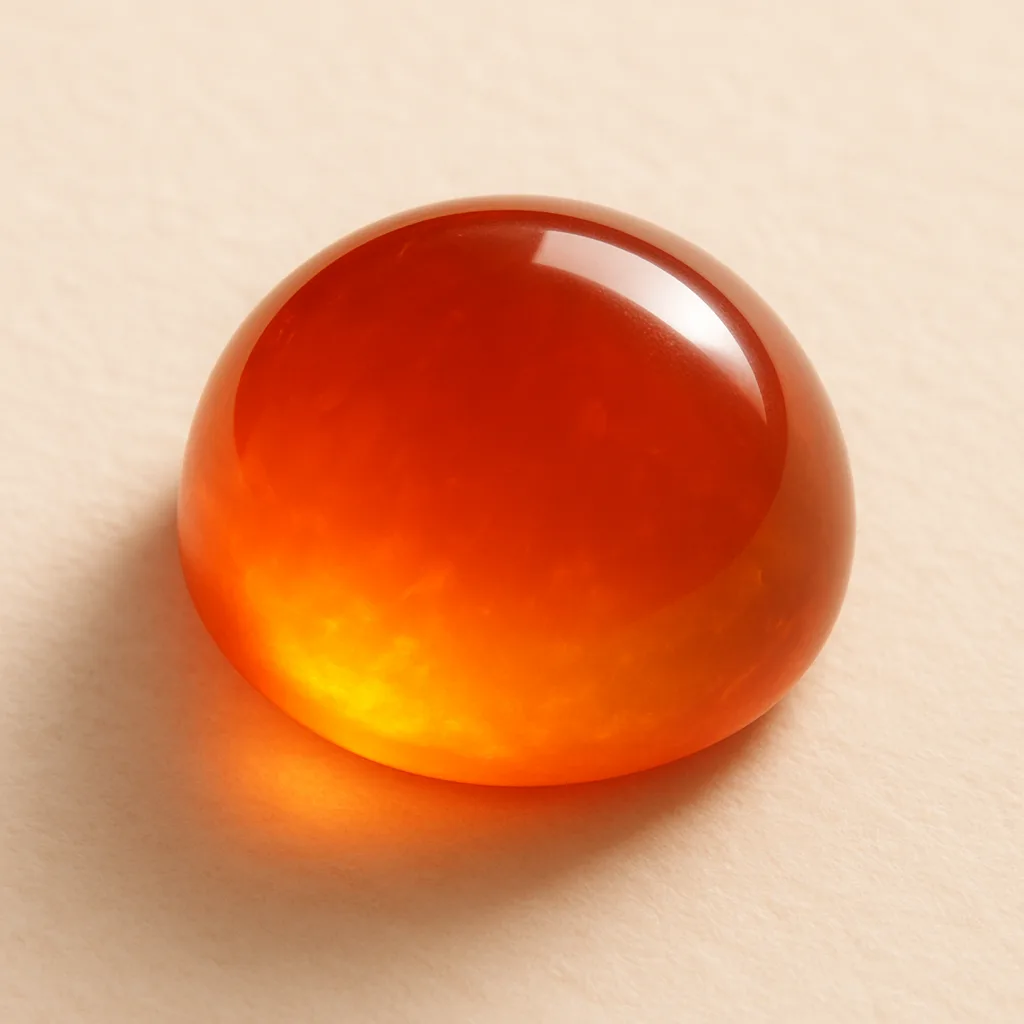
identified this stone yet
Fire Opal
| Hardness | 5.5-6 |
| Specific gravity | 1.97-2.20 |
| Refractive index | 1.37-1.47 |
| Crystal system | 非晶質(含水シリカ) |
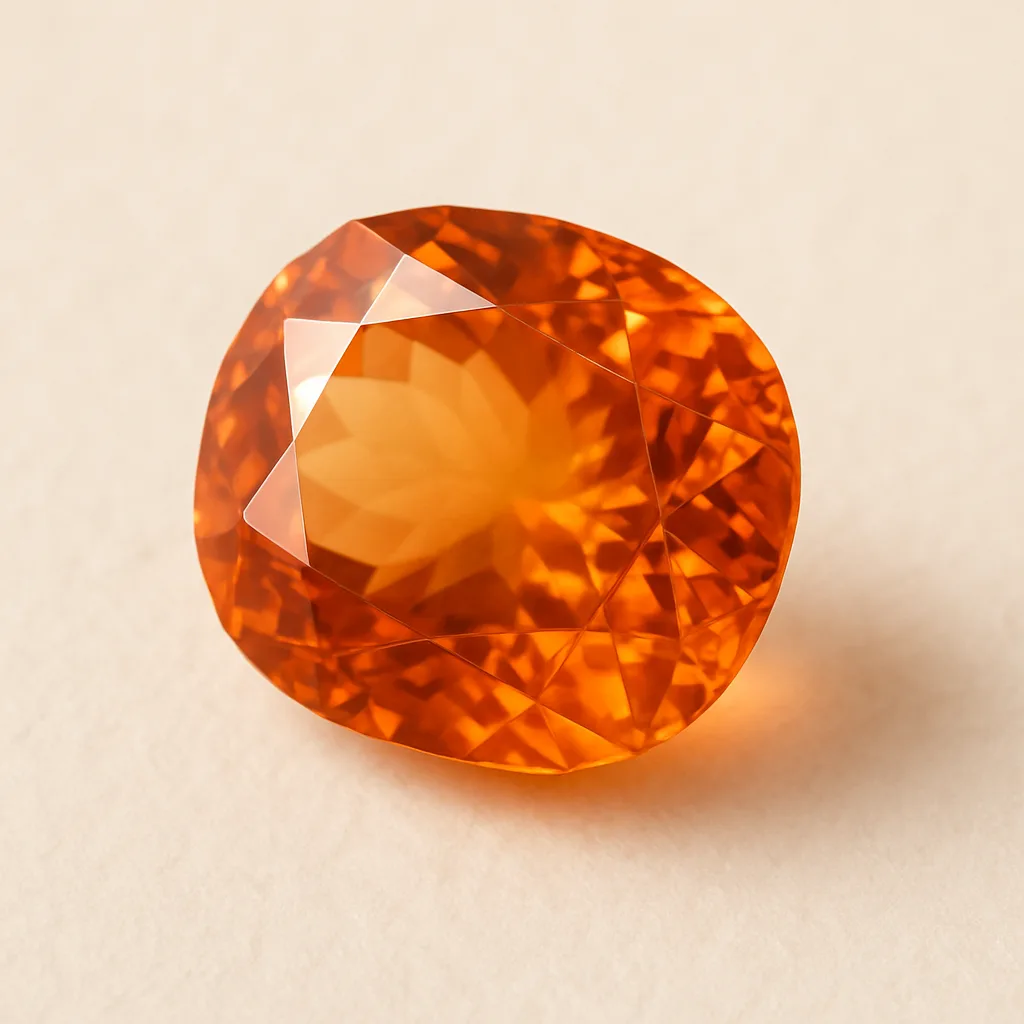
Vivid orange, golden yellow, cherry red, and warm amber, ranging from nearly transparent ('jelly opal') to translucent. The most coveted tone is a saturated red-orange with high transparency and an internal glow — sometimes called 'cherry opal.'
- nclusions
- Microscopic iron oxide particles distributed through the host (the chromophore)
- Occasional rhyolite matrix relics near the edges
- Stress fractures and incipient crazing — common in older Mexican material
- Amorphous, singly refractive (no )
- Strong vitreous to resinous luster
- Transparent to translucent body — distinctive among the opals
- Play-of-color present only in 'precious fire opal'
- 01Glowing transparent orange-to-red body color with little or no play-of-color
- 02RI 1.37–1.47 and SG 1.97–2.20 confirm opal
- 03Mexican rhyolite matrix on rough specimens
- 04Crazing risk — examine surface carefully under 10× for incipient fractures
- Mohs 5.5–6.5 — softer than most gems; protective settings advised
- Highly susceptible to crazing from dry air or temperature shock — never store in low humidity or near heat sources
- Never use ultrasonic or steam cleaners
- Wipe with soft cloth and warm soapy water only
Roughly $20–$100/ct for pale Mexican or Brazilian material, $200–$800/ct for vivid cherry-red transparent stones above 1 ct, and $2,000–$10,000+/ct for precious fire opal showing both fiery body and strong play-of-color from the rare La Esperanza pockets. Transparency and saturation drive most of the spread.
Note: Fire opal is rarely treated, though sugar treatment and smoke treatment exist to deepen body color — both should be disclosed. The biggest stability concern is crazing: fire opal from arid Mexican deposits can develop fine surface cracks if exposed to dry air or sudden temperature change. Always store in stable humidity. Synthetic fire opal exists but is uncommon at retail.
Fire opal is hydrated silica (SiO₂·nH₂O) colored by trace iron oxides distributed through the amorphous host. Unlike black, white, and crystal opal, fire opal is valued primarily for its body color — clear, fiery orange to red — and most material shows little or no play-of-color. The rare specimens that do combine fiery body with play-of-color are called 'precious fire opal' and command premiums. Mexican volcanic deposits in Querétaro and Jalisco supply the benchmark material; Brazil's Piauí state and Oregon's Opal Butte are secondary sources.
Origins
Mexico is the historical and present center: the Magdalena and Cerro Viejo deposits in Jalisco, and the Querétaro fields (especially the La Esperanza, La Trinidad, and La Carbonera mines near Magdalena), produce fire opal in volcanic rhyolite hosts. Brazil's Pedro Segundo deposit in Piauí, discovered in 1971, supplies large quantities of pale to deep orange material. Oregon's Opal Butte yields rare American fire opal. Ethiopia's Welo Province occasionally produces hydrophane fire opal in orange-red tones, but those stones share the moisture-sensitivity of all Welo material.
History
The Aztecs called fire opal 'quetzalitzlipyollitli' — the stone of the bird of paradise — and dedicated it to the sun god Tonatiuh. Spanish conquistadors brought it to Europe in the 16th century, where it appeared in royal and ecclesiastical jewelry through the Renaissance. Commercial mining at Magdalena began in 1835 when Don José María Siurob rediscovered the deposit, and fire opal was declared Mexico's national stone in the 20th century. The 1971 Pedro Segundo strike in Brazil briefly threatened Mexican dominance but the two sources now coexist.
Lore & symbolism
The October birthstone, symbolizing passion, courage, and creative fire. In Mexican folk tradition, fire opal is said to embody the warmth of the sun and protect against fear. The 14th wedding anniversary gem.
Tools to confirm this stone
Tools that help confirm Fire Opal. Tap any item to jump to the matching section on the gem tools page.
- Last reviewed
- April 28, 2026
- Bibliography
- Gem Encyclopedia / GIA (Gemological Institute of America)
- Gem Identification Standards / Central Gem Laboratory (CGL), Tokyo
- Mineral & Gem Database / Mindat.org / Gemdat.org
- Introduction to Gemology / Gemmological Association of All Japan (GAAJ)
The gemological data on this page (refractive index, specific gravity, hardness, crystal system, etc.) is cross-checked against the authoritative primary sources listed above. Values may be revised as gemological research advances.