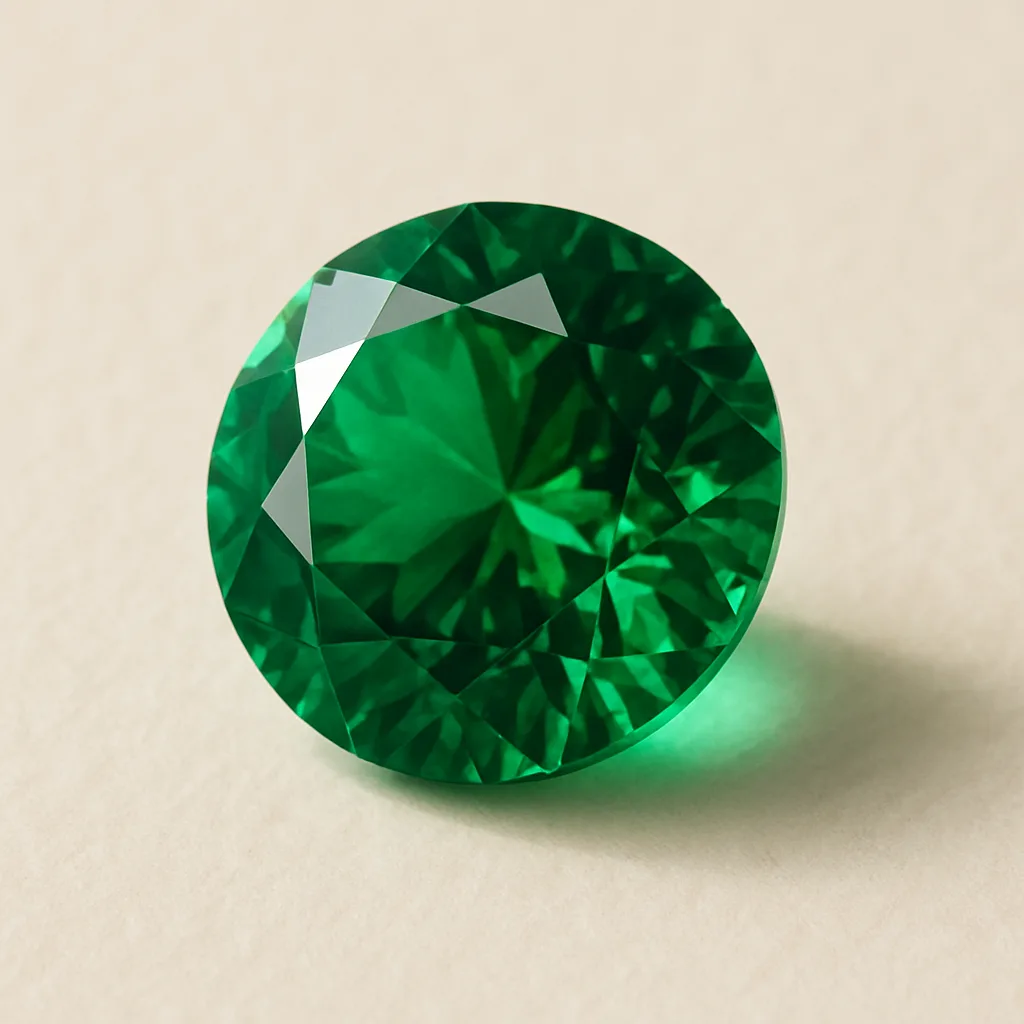
identified this stone yet
Synthetic Emerald
| Hardness | 7.5-8 |
| Specific gravity | 2.66-2.70 |
| Refractive index | 1.561-1.568 |
| Crystal system | 六方晶系 |
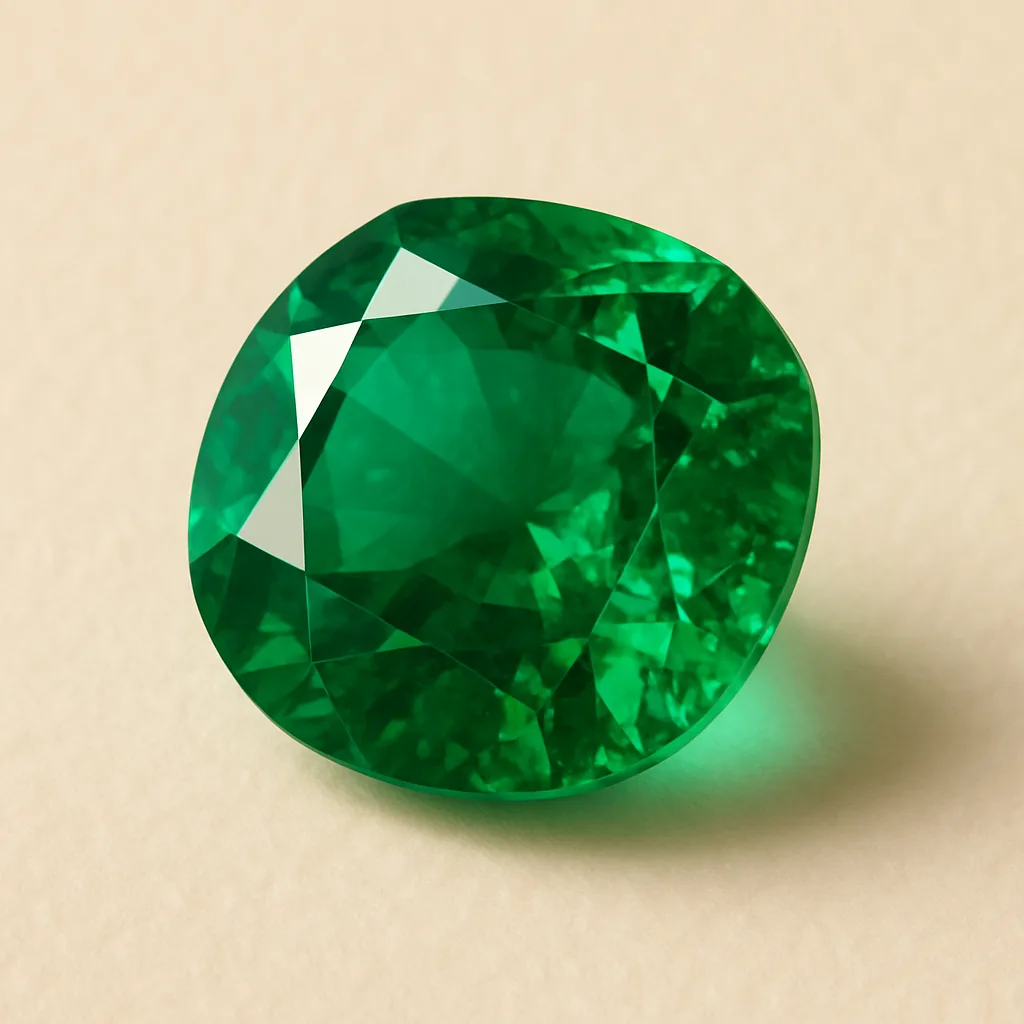
Vivid pure green through bluish-green, with most commercial production targeting the saturated medium-green tone associated with fine Colombian emerald. Synthetic emerald typically shows more even color saturation than natural material from any single origin, with no significant zoning or 'jardin' character.
- Flux-grown: wispy 'veil' or 'feather' flux residue, often forming distinct curtain-like patterns
- Flux-grown: platinum-crucible flakes appearing as metallic specks
- Hydrothermal: chevron (V-shaped) growth banding visible at 10×
- Hydrothermal: nailhead spicules where crystal grew around a foreign
- Lechleitner overgrowth: distinct boundary between natural seed beryl core and synthetic emerald rim
- Doubly refractive (uniaxial negative) — identical to natural emerald
- Strong dichroism — green and bluish-green
- ~0.005–0.009 (slightly lower than some natural Colombian material)
- RI 1.561–1.570 — typically slightly lower than natural emerald (which often runs 1.565–1.602)
- 01RI below 1.565 is a strong synthetic indicator (natural Colombian emerald typically 1.578–1.602)
- 02Chevron growth or nailhead spicules indicate hydrothermal synthetic
- 03Wispy flux veils or platinum flakes indicate flux-grown synthetic
- 04Strong red UV with no natural 'jardin' is a synthetic warning sign
- 05Lab reports from GIA, AGL, or GRS are essential — hydrothermal material can be visually indistinguishable from natural
- Mohs 7.5–8 with — avoid ultrasonic cleaning despite the lack of oil treatment
- Warm soapy water with a soft brush is safe
- Stable to light and normal cleaning chemicals
- Avoid sudden thermal shock
Roughly $10–$50/ct for commercial flux-grown Chatham or Gilson synthetic emerald in standard sizes, $80–$300/ct for high-quality clean material above 3 ct, and $300–$800/ct for premium hydrothermal Tairus emerald with natural-looking color and inclusions. Far less expensive than natural emerald of comparable color and clarity.
Note: Disclosure is mandatory under modern trade-naming standards (CIBJO, JIS, FTC). 'Created emerald,' 'lab-grown emerald,' and 'synthetic emerald' are acceptable terms; 'cultured emerald' is increasingly used for hydrothermal material. Unlike natural emerald, synthetic emerald is generally not oil-treated or fracture-filled — the synthesis produces clean material directly. Hydrothermal Russian Tairus emerald can be exceptionally difficult to distinguish from natural Colombian material visually and requires lab analysis for definitive identification; lab reports are essential above $200/ct.
nclusions where the crystal grew over a seed. The 'Lechleitner overgrowth' technique, developed in the 1960s, grows a thin synthetic emerald layer over a natural pale-beryl seed — producing a stone that combines natural and synthetic features and required new gemological identification protocols when it first appeared.
Origins
nclusions than flux-grown material. Australian Biron operated hydrothermal emerald production from 1980 (with later changes in operator). German Lechleitner pioneered the overgrowth technique in the 1960s. Smaller production continues in Thailand, China, and India.
History
Emerald synthesis has the longest history of any modern colored-stone synthesis. French mineralogist Jacques-Joseph Ebelmen produced the first laboratory emerald crystals in 1848 — too small for gem use but a proof of concept. Otto Feuer and Charles Friedel in Paris attempted flux synthesis in 1888 with limited commercial success. The breakthrough belongs to Carroll Chatham, who began experimenting as a teenager in 1929 and produced his first gem-quality flux-grown emerald in 1935 — material he marketed under the trade name 'Chatham Created Emerald.' Pierre Gilson commercialized industrial-scale flux synthesis in France beginning in 1964. The hydrothermal era opened with the Russian (USSR) Institute of Geology and Mineralogy in Novosibirsk developing flux-melt and later hydrothermal protocols, with commercial Tairus production reaching Western markets in the 1990s. Modern Russian hydrothermal emerald is the most natural-appearing synthetic material on the market and routinely requires lab analysis (LA-ICP-MS, advanced FTIR) for definitive identification.
Lore & symbolism
May's birthstone (synthetic versions accepted as substitutes for natural emerald). The 20th and 35th wedding anniversary gem. Synthetic emerald has no traditional folklore — it postdates the lapidary tradition by millennia — but modern crystal writing positions it as a stone of accessible new beginnings and democratized love. Some traditional astrological practitioners hold that synthetic stones lack the 'spiritual energy' of natural material, a position not shared by all schools.
Tools to confirm this stone
Tools that help confirm Synthetic Emerald. Tap any item to jump to the matching section on the gem tools page.
- 最終確認日
- 2026年4月28日
- 参 考 文 献
- Gem Encyclopedia/ GIA (Gemological Institute of America)
- 宝石鑑別基準/ 中央宝石研究所 (CGL)
- Mineral & Gem Database/ Mindat.org / Gemdat.org
- 宝石学入門/ 全国宝石学協会
本ページの物性値(屈折率・比重・硬度・結晶系等)は、上記の権威ある一次資料を相互参照して編集しています。最新の鑑別研究の進展により値が更新される場合があります。